Tag Archives: esophageal varices

A Bigger Pill To Swallow

If you’re about to have your first video capsule endoscopy (VCE) or simply wondering what the experience is like then read on. I underwent my third procedure in September 2023, each one has been slightly different.

Fantastic Voyage – revisited

In November 2018 I had my first VCE and afterwards published a blog post “Fantastic Voyage” as it reminded me of that sci-fi film about a submarine crew who are shrunk to microscopic size and venture into a body to repair a damaged organ. What follows updates that post and then goes on to describe the two further procedures.

Why did I need a VCE in the first place?

I was feeling fit, well and with a good QOL. Colonoscopies, endoscopies & biopsies were all clear but… test results were suggesting the opposite – calprotectin approaching 2000 (normal range 50 to 100); Hb hovering around 110 (not particularly low but on the way down); and I was losing weight (down by 15kg). The only part of my digestive tract that hadn’t been seen through a lens was the small bowel between duodenum and my anastomosis, where my large and small intestines had been rejoined after an ileostomy in 2010.

With a capsule there is always a risk of it becoming stuck so as a precaution a radiologist was asked to review my last MRI scan for strictures before the VCE was ordered. The alternative is to swallow a patency capsule which is a dissolvable pill that surrounds a small radio frequency identification (RFID) tag that can be identified by an X-ray or CT scan. If the pill become lodged in the gut it simply dissolves. The latest cost (2025) that I could find for an NHS capsule endoscopy procedure is £747.

The pre-procedure instructions were similar to having a colonoscopy but with none of the dreaded prep solution. The leaflet listed the medications that would have to be put on hold. These included iron tablets and loperamide 7 days out. Iron tablets – no problem, but loperamide – that was one instruction I didn’t follow. The thought of taking a trip to London without having taken it for 7 days was not even worth considering.

On arrival at the GSTT Endoscopy Department a specialist nurse outlined the procedure and ran through the risks. In the worst case scenario the capsule could become stuck and need surgery to recover it!

Several different camera systems are on the market, all working on similar principles. There are also different types of capsule for specific tasks. The more advanced ones have higher resolutions & frame rates and some communicate with the recorder unit wirelessly, without the need for sensors. In this instance the MiroCam system was being used with its array of sensors picking up the capsule signal and sending it to the recorder.

The first task was to attach the numbered sensors in the correct positions around the abdomen and connect them to the wiring harness, very similar to an ECG. The harness itself was quite bulky. The nurse then produced the capsule, asked me to hold it between my fingers then pass it in front of the recorder unit. A bleep showed that they had paired. My information had already been entered into the recorder unit with the display showing name, hospital number etc.

VCE sensors on a wired unit

How easy was it swallowing the capsule?

The answer, for me, was very easy. One gulp of water and it was on its way. The nurse switched on the live monitoring function and we watched it enter my stomach. To save battery power she then switched it off and I didn’t have the courage to try switching it on again in case I ruined the whole procedure (…and what if I had seen something that, to my eyes, looked wrong? A surefire way of inducing hypochondria).
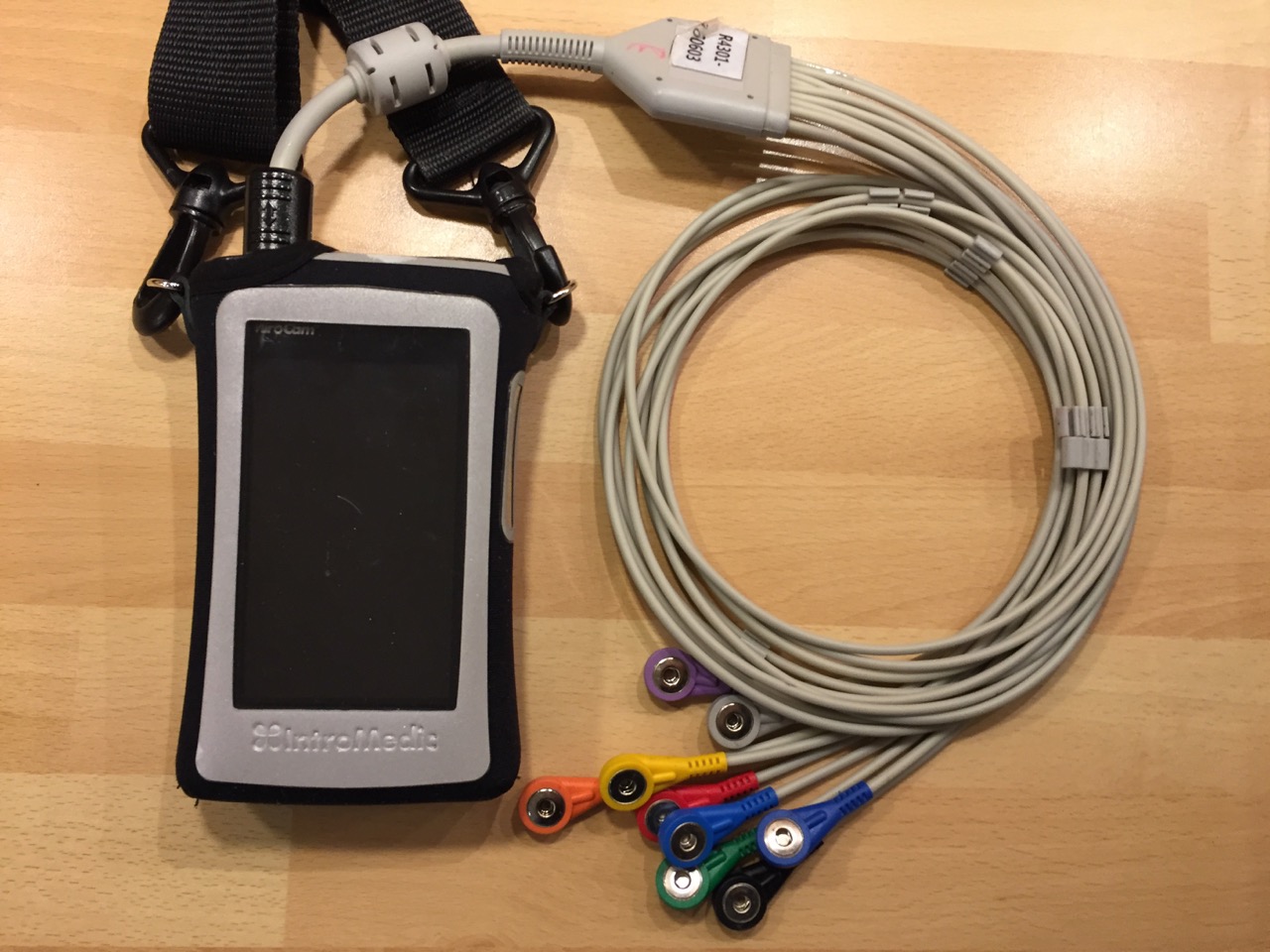
Wired receiver unit

The unit had a 12 hour battery life and switched itself off automatically after that time had elapsed. I could then remove the sensors and return the recorder unit. The results were due in two weeks time.

When would I be able to eat and drink again? Coffee two hours after swallowing the camera, a light meal after another two hours and then resume normal eating after six hours. You’ll be pleased to know that the camera is not retrieved after the procedure (although there are some types that do rely on the patient “collecting” it and returning it to the hospital for analysis!).

Wearing the receiver unit took me back to having a stoma as it was hanging in the same position as the bag and the adhesive on the sensors gave a similar sensation to that of a stoma backplate.


When the report was available it showed that Crohn’s had re-surfaced in my small bowel in the form of mild to moderate inflammation. This was a disappointment as I had been in drug free remission since 2011. A printed copy of the endoscopy report, in glorious living colour, arrived in the post. I was intrigued by the transit times : 15 minutes to make it through the stomach; 2 hours 52 minutes travelling through the small bowel; and 8 hours 51 minutes in the colon. These were classed as being “within average range”.

Luckily there was a summary report; unluckily there it was in black and white “…with a background of Crohn’s these are in keeping with mild to moderate active disease”. As a result I was started on Vedolizumab.

Video Capsule No.2

In August 2020 I received a call from Endoscopy appointments to arrange for a follow-up VCE to see if the inflammation in my small intestine was still there. I would need the obligatory small bowel MRI first to ensure there were no strictures that could trap the capsule on its journey.

We were in the depth of COVID restrictions and the procedure was considered to be an AGP (Aerosol Generating Procedure) and as a consequence I needed to have a negative COVID result 3 days prior to the hospital visit. It was arranged for a courier to deliver a test kit, wait for me to carry out the test and then return it to GSTT for analysis. It turned out negative.

The endoscopist had been working at GSTT for 15 years but, surprisingly, our paths had never crossed. He explained that the hospital had access to 7 different camera systems and that their prominence as a leading teaching hospital meant that manufacturers were keen to make their systems available. The one they would be using that day was made in Wuhan (yes, THAT Wuhan) and was the first one to include a type of AI which highlighted frames needing particular attention when reviewing. Two representatives from the manufacturer sat in on the procedure to observe it being carried out.

Unlike my previous VCE this capsule transmitted directly to a receiver worn on a belt without the need for sensors. It was a lot more convenient. The output from the camera was displayed on the receiver and also on a laptop.

I asked if it would be possible to examine my oesophageal varices to see if they needed banding. I was hoping to avoid a conventional endoscopy later in the year. Yes, it would be possible by adopting an “oesophageal protocol”, a fancy way of saying you lie down as the camera is swallowed so that the passage through to the stomach is slowed down. Swallowing it whilst lying down was not as difficult as it sounded but even so it only took a few seconds before it entered my stomach.

I lay on a pivoted bed. It was tilted head first, feet first, then left and right so the camera could video all around the walls of my stomach. A patch of inflammation appeared. It would be discussed at the next MDM on Friday. Eventually the camera was allowed to pass into the duodenum and it was time to get back on my feet.

I returned to St.Thomas’ the following day to drop the recorder belt back. Eventually the follow-up letter arrived from the VCE Virtual Clinic. It was good news, very good news. The vedolizumab was doing its job.

Video Capsule No.3

The same again but different : In March 2023 I ended up in our local A&E with internal bleeding. An upper GI endoscopy showed oesophageal varices had regrown despite being OK when checked a few weeks previously. What had caused them to reappear?

A small bowel MRI scan picked up a new clot in my superior mesenteric vein and I went to see a thrombosis consultant. Our discussion boiled down to should I start on blood thinners, something I had declined in the past. Before making the decision he wanted to make sure that I was not bleeding in locations other than my oesophagus hence requesting a VCE.

When the nurse rang to arrange the date for the procedure she said that she would be including sachets of MoviPrep. I remarked that a) I hadn’t had to take prep on the previous occasions and b) if I had to then I would prefer Citrafleet. The instructions arrived together with the Citrafleet.

The preparation was now virtually the same as having a conventional colonoscopy with the same restrictions on the type of medications and the timing of meals during the countdown to procedure day.
(Having had the conversation about not having prep I recalled that when I had been through our medicine cupboard I had found a sachet of MoviPrep and assumed it had been sent for some colonoscopy in the dim and distant past. Maybe I hadn’t used it prior to a previous VCE.)

This time the capsule was the two lens version which results in it being larger than the previous ones I had swallowed. That didn’t present a problem but then I have become used to swallowing pills and capsules. Out of curiosity I asked the nurse how they would administer it if someone couldn’t swallow and she replied that it is possible to introduce the capsule with an endoscope!

The set-up was slightly different from before. There was a disposable belt with built-in sensors, fastened with velcro around the waist. A cable connected it to the recorder unit hung over one shoulder. Apart from that the operation was as previously described and at exactly 12 hours from the start the receiver bleeped and switched itself off. I returned the recorder to GSTT the following day.

I mentioned to the nurse that I had a follow-up appointment with the thrombosis consultant in two weeks time. She said that it should be possible to have, at least, a preliminary run through by then but you have to remember there are nearly 100,000 frames produced.

…and then I had a short wait until talking to the thrombosis consultant and deciding if I should start taking blood thinners. By the time of the tele appointment with him the VCE report was available. We covered a lot ground, probably too much to take in to be honest. My case had been discussed at the Thrombosis Radiology MDM and the decision was to not start anti-coagulation. I was quite happy not to be taking even more medication!

Fifty Shades of Grey

Let’s get my latest appointment out the way…….

Monday – 24th April 2017 – Gastro Appointment, Guy’s Hospital

I hadn’t planned this appointment, neither had my gastro consultant but the booking system had other ideas. It must be set to auto repeat every 6 months and doesn’t take into account any ad-hoc appointments in between. I had intended to cancel but I’m pleased I didn’t as there were things that needed talking through. I produced the obligatory list of questions (responses in red) :

1.    Biopsy results (from 11th March colonoscopy) – the report from the path lab said that the biopsies were consistent with “quiescent” Crohn’s disease. This result was about as good as it could get. Once you have the disease there will always be some signs of it, even when in remission.

2.    Explanation of rising calpro levels given result of recent colonoscopy?       – to be honest, he simply did not know what was causing the raised calpro levels. He had been concerned that something had been missed during a previous colonoscopy hence the repeat, in March, carried out by his trusted colleague (and watched by an audience of trainee, international gastroenterologists).

3.    If calprotectin tests not giving meaningful pointer to Crohn’s activity what monitoring regime should we adopt? – I had anticipated what the answer would be and I was right. If you start to feel the Crohn’s is becoming active then we’ll take it from there.

4.    The upper GI surgeon (Professor), who I saw locally (see previous post) regarding gallbladder removal, was talking about referral to a specialist liver facility “in case of needing a transplant” arising from complications during the  cholecystectomy (sounded very drastic) – my gastro agreed that I should be referred to a specialist unit in view of my concurrent conditions. The most likely unit would be the one at Kings College Hospital. The issue of needing a transplant would be a last resort if something went very wrong during the operation. He typed a letter to the Professor suggesting that the referral should go ahead.

5.    Awaiting ultrasound appointment (locally) to look at liver, gallbladder, bile duct and portal vein – noted. No date as yet.

6.    Pros and cons of having gallbladder removed? – to be discussed with specialist liver facility. Even if I decide not to have surgery I would at least be on their radar so that should I end up having another jaundice incident, that needed urgent resolution, they would already be aware of my case.

7.    Fibro-scan to see if liver cirrhosis progressing – he filled in the online booking form to request the scan. (Date now through – 4th September)

8.    Current weight 78.2kg. The target weight set prior to my ileostomy (October 2010) was to get UP to 90kg, which I achieved with the aid of 3 x Fortisip (300 calories each) per day. My subsequent decline by 12kg has been quite a loss – whilst I felt fit at this reduced weight it was a lot lighter than the previous target weight. I thought I had better point it out. We would continue to monitor.

9.    Next steps – ultrasound scan; fibro-scan; no further colonoscopies at present; follow-up appointment in 6 months time (the booking system should already be doing that); yearly endoscopy at Christmas to check varices + appointment with specialist liver unit.

50 Shades of Grey

For 30 years I really didn’t want to delve too deeply into my health. It was clear, black and white, I had Crohn’s Disease (after the usual “is it IBS debate” within the medical profession). It was centred mainly around the join between my small and large intestines (a common location) and had caused a stricture. Despite this I spent many years in remission.

In the last few years my medical life has become more complex with new issues arising. Most of them  are very definitely not black or white.

It started with the dramatic fall in my platelet count that has never recovered (thrombocytopenia). Was it really as a side effect of the Azathioprine I had been taking for 8 years? You would expect it to have bounced back when I stopped the drug. Is it related to my spleen becoming enlarged? Could this be the cause of the platelets issue instead? Two bone marrow biopsies later and there is still no definitive answer.

Next there was the incident where new blood vessels had grown in my esophagus and then burst. A subsequent x-ray showed a blood clot had formed in my portal vein (thrombosis) which had increased the pressure in the veins higher up. Most likely cause of the clot? The current theory is it’s the result of peritonitis following a perforated bowel operation in….1979! Really? That long ago? Apparently there is always a risk of PVT during any surgery. I’ve also seen research that once you have Crohn’s patients you are more susceptible to clots.

As a result of the above incident it was suggested that I might have Primary Sclerosing Cholangitis (PSC) I had a fibro-scan on my liver which showed signs of cirrhosis. What caused that? It certinly wasn’t alcohol related as I drink very little. Is it linked to that blood clot? I then had a liver biopsy and, thankfully, it showed no PSC.

What caused my recent jaundice incident last January? I felt no pain whatsoever only violent shivering and turning yellow. It must have been gallstone related but this is usually accompanied by the most excruciating pain. Again there is a potentially a link between Crohn’s and the increased likelihood of developing gallstones.

…and so to my latest consultation. Yet another puzzle – how to explain a rising calprotectin level with a colonoscopy, and biopsies, that showed I’m in remission.

…and not forgetting the reason I had that second colonoscopy – to see if there was any evidence of the strictures which showed up on the MRI scan, which there wasn’t. Another conundrum and one that had also happened back in 2012.

…and, of course, there’s the biggest grey area in the room – what causes Crohn’s Disease?

I’m not going to lose any sleep over the above. What’s done is done. It’s more out of curiosity that I would like definitive answers. In an ideal world I’d get a gastroenterologist, a hepatologist and a haematologist in a room together and let them reach a concensus on likely causes. That isn’t going to happen anytime soon…….

…but maybe the combination of conditions would at least give me a winning hand playing “Illness Top Trumps”


Living with a timebomb

I’m not trying to scare anyone with this story. It is very unlikely you will experience the same but it is worth being aware of yet another part of the rich tapestry that Crohn’s Disease can weave for us.

This is what happened…..

Monday 28th May 2012 – Outpatient Appointment at Guy’s.

The original intention was to go into work as usual then catch the Tube down to London Bridge in time for my 10 o’clock appointment. I wasn’t feeling so good so decided to catch a later train and go direct to the hospital. I’m used to an early start with virtually no traffic so rather underestimated how long it would take to get to Redhill station from home. By the time I got to the station I could hear the train pulling into the platform. I didn’t realise that it would wait there 5 minutes before leaving so I tried to run and realised just how bad I felt. My chest started heaving and my heart pumping. I really thought I was having a heart attack. Once I was on the train I managed to take some deep breaths and gradually return to some type of normality.

I made my way to the Outpatients Dept. in time for my appointment but then had a long wait before seeing my consultant. When I was finally called in I was relieved to find that I was seeing the top man, not one of the registrars. He did apologise for the long wait.

We went through my list of queries and eventually discussed  the issue I was having with passing a jet black liquid from my back end. He asked me to get a sample for analysis which I thought would be easy but no luck. He also asked me to make an appointment to repeat the colonoscopy to verify the results of the MRI scan.

Eventually I was on my way home and by now the temperature was high. I bought a bottle of cold drink and then boarded the train back to Redhill. By the time I got home I was feeling pretty exhausted and went to have a lie down to recover. Around six o’clock I started to feel sick so disappeared into the toilet and then it happened… (don’t read any further if you are squeamish)

I brought up a large amount of what looked like redcurrant jelly but was clearly freshly congealed blood. I must have gone into shock for a few minutes, thinking “What do I do now?” (Not like me at all. I usually come quickly to terms with what is happening, decide the best actions to take and get on with it but this was like nothing I had experienced before and for a while I couldn’t cope).

I came to the conclusion that this was definitely a 999 moment. I heard my wife coming back from feeding our ponies so called out to her to ring the number. She made the call and then responded to the long series of questions that you now get asked by the operator. The decision to send an ambulance was made and my wife then hurried herself to get together some things into a bag before the ambulance pulled up our sideway. She didn’t quite finish as the ambulance arrived incredibly quickly. When she opened the door she recognised the paramedics as the ones who had taken me into hospital the last time we had reason to call 999 (see “Post Op – Back Home” page – 12th November). They came in to see what state I was in, took one look at the blood surrounding me and, to put me at ease, told me that it was only a small amount!

I was loaded into the ambulance and then went through various tests before we set off. They were obviously concerned at my state and said that my blood pressure was very low. They put me on a drip and the driver said “I think we’ll go for the siren”…….

A few minutes later we arrived at East Surrey Hospital and I was taken straight into the Accident and Emergency assessment area and was immediately seen by a doctor to make sure I was stable. Over the next hour or so I was seen by a couple more doctors whilst they decided the best ward for me to be sent to. Their decision was to admit me to the Medical Assessment Unit where I underwent further assessment. By this time my sister had turned up to take my wife home so we said our goodbyes and I waited to see where I would end up.

My wife returned home and had to clear up the blood from the floor. I’m so lucky to have someone so tough to support me when things are going wrong.

The decision was taken to send me to the ward which specialises in gastroenterology and I was duly taken to this new ward. I then saw the doctor on duty who made sure I was comfortable and worked out what drips I needed to be on.

Tuesday 29th May 2012 – the rest of the night was spent undergoing regular checks on my blood pressure and temperature. I didn’t get much sleep but was just happy to be in the best place, given the condition I was in.

During the day I saw various doctors who were trying to decide which tests I should undergo. The immediate priority was to have an endoscopy (camera down throat) to see where the blood had come from. They tried to get me onto that day’s list and so I wasn’t allowed to eat anything. Unfortunately an emergency case took priority and at six o’clock I was told that I could eat some supper. Apparently the doctor was very surprised at how calmly I took the fact that I wouldn’t be having the test done that day and said she wouldn’t have been so laid back.

They decided that I needed to have a blood transfusion as my blood count had fallen to 6.6. The normal figure for a man is around 14. I therefore had two drips going into the cannula in my left arm.

Wednesday 30th May 2012 to Monday 4th June  – The blood transfusion had brought my blood count up to 8.6, still very low. Over the next few days I had the upper GI endoscopy. I think the doctors were expecting it to show that I had an ulcer, which had burst, or that the Crohn’s inflammation had spread into my stomach. What they actually found were esophageal varices, prominent veins in the lower third of the esophagus and usually related to alcoholism! I looked them up on the internet and found that there is a possible link between them and the Azathioprine drug that I had been on for seven years.

The next step was therefore to have an ultrasound scan to look at my liver as sometimes damage to one of the large veins could route the blood supply into the esophagus causing the varices. I asked what the outcome of this test was and it sounded like nothing particularly untoward showed up apart from a gall stone and a slightly enlarged spleen. I would ask again later, just to make sure I got that right.

The whole ward then went into a sort of 4 day limbo as it was the extended holiday weekend to mark the Queen’s Diamond Jubilee. The number of doctors was greatly reduced and were only seeing patients by exception. I resigned myself to not progressing any further with an explanation of my problem until the following Tuesday.

The phlebotomists did their usual rounds every day and I later found out that my blood count had dropped to 8.0 from 8.6. Not good and would prolong my stay in hospital. The ward sister said that the doctors would be doing a proper ward round on the following Tuesday so I had plenty of time to get a list of questions together. I resigned myself to not progressing any further with an explanation of my problem until then.

Tuesday 5th June 2012 – I knew at some point I would encounter the consultant that I had emailed around a year ago saying that, basically, I was now being treated by St.Thomas’ so not to bother to make any further appointments for me. I had a very good reason for doing this and it is recorded in my book (when it finally gets published).

I’m not going to go into all the details of this encounter but suffice to say that initially he would not look me in the eye and my decision, a year ago, was clearly still bugging him. I reiterated my original reason for leaving his care and this may not have helped the situation. (My decision to move to St.Thomas’ was not taken lightly as it is far easier for me to get to East Surrey Hospital from home, approx. 10 minutes, than it is to get to St.Thomas’). At one point it was suggested that maybe it would be best for me to be put in an ambulance and transported up to London.

I was now in the position that I was under the care of East Surrey for my emergency admission but the long term treatment of Crohn’s was still with St.Thomas’. At the end of a long and detailed discussion on what my current situation was caused by, whilst the junior doctors listened on, we ended up shaking hands and agreeing that we should do what is best for my long term health. Enough said on this matter, let’s move onto possible diagnosis, tests required and best place to have them carried out. So clearly I was not in a position to think about discharge yet.

The recurring terms he used were primary sclerosing cholangitis (PSC) and portal hypertension. He thinks that these are symptoms of a malfunctioning immune system and are also linked to my thrombocytopaenia (low platelet count) and enlarged spleen. I had thought that this last condition had been brought on by the use of Azathioprine but he was sceptical at this.

After the ward round was complete I called one of the junior doctors over and asked how to spell “that primary thing the consultant mentioned” so I could look it up. She replied that it might not be a good idea at present. I decided to park the research for the day but happened to mention it to my sister who immediately looked it up and rang me back. It was all a little scary. Ultimately, if PSC was diagnosed, the long term prognosis – liver transplant! The only way of getting a definite diagnosis would be to carry out a liver biopsy.

With regards to where the tests should be done and the subsequent treatment – I’m not sure what we concluded. I think that we agreed that due to the complex nature of my Crohn’s I would be better remaining under St.Thomas’ as they have more extensive facilities than East Surrey. I wouldrevisit this subject tomorrow on the ward round.

I try to keep a cool head at all times and remain rational so I thought I’d taken the above information in my stride but a little voice at the back of my head kept saying “you’re only keeping calm because you don’t understand the full implications of what you’ve just been told”. When I caught sight of the IBD Nurse I asked her if she could answer some questions, including what were all the long words the consultant were using. She could tell by some of my questions that no one has ever sat down and gone through some of the basic concepts of Crohn’s and its implications.

I got to thinking about this later and she had hit the nail on the head, one of her many skills! (which also includes an encyclopaedic, some might say Wikipedic, knowledge of medical terms and conditions).

No one has ever talked through the bigger Crohn’s picture. For years I thought it was simply an inflammation that caused diarrhea and some pain for which you took steroids. Some years later I ended up with a stricture so I was then aware of another possible complication. The results of the CT scan that I had done three years, or so ago, then introduced me to the concept of fistulas and having to have a stoma. It would be good to be able to spend some time talking this through with a specialist and understanding other possible symptoms and potential effects on other parts of the body. Ultimately I would like to get a clear understanding of the likely effects on my potential life expectancy or quality. I could then use the information to decide when to retire. Maybe I should talk to an actuary.

Back to the ward – it was decided that I should be given another 2 units of blood. Since I hadn’t had any for a week they needed to do another “crossmatch” as they only last 7 days. (All part of ensuring you get the right blood type).

Wednesday 6th June 2012 – that must have been the quietest night so far on the ward. I slept until about 3:00am but then couldn’t get back to sleep until around 7:00am.

The phlebotomist turned up to take more blood samples and she was followed by the registrar and junior doctors on their round. I had quickly made a list of things to ask them – the top question was “plan for escape”.

I was somewhat taken aback when the Registrar said that as long as today’s blood test showed an Hb of over 10 then I could go home. Today! I really wasn’t expecting that. I had told everyone I was in until at least the weekend or possibly would be transferred to St.Thomas’. I’ve now had to wait until around 1 o’clock for my score.

I discussed various things with the Registrar, including going over again what the endoscopy and ultrasound tests had shown. For my long term care they are suggesting that I remain under St.Thomas’ and would be liaising with my specialist there to make sure the necessary test results were passed over. One of the junior doctors was tasked with making this contact.

Thursday 7th June 2012 – back home. My first good night’s sleep for 10 days. Time to take stock. The discharge letter made interesting reading but took a fair amount of translation. The bulk of it listed what they didn’t find so I was rather confused as to what I have actually got wrong with me. The only definite observations were an enlarged spleen and a gallstone.

I read through the leaflets that came with the new drugs. They’d given me – Propanolol – a beta blocker used to prevent stomach bleeding in patients with high blood pressure in their liver or swollen blood vessels in their gullet; and Omeprazole – a proton pump inhibitor to reduce the acid in one’s stomach. Reading through the possible side effects of these two drugs I could end up with insomnia and nightmares. Fingers crossed.

…and since then? – I was put under the care of a liver specialist and underwent a liver biopsy to check for cirrhosis. The result showed mild stiffening, something to keep in mind. I now have yearly visits to the endoscopy dept to check out the varices. If they have regrown then the first visit is followed by another two or three when they “obliterate” the veins with rubber bands. Next visit January 2017.

I inevitably turned to the internet. The first page I found, when I searched for PVT and Crohn’s, started with the words “if the patient survives….” Another one said “inevitably fatal”. Not a good start and I was only partly comforted by realising that the articles were written many years ago and by hoping that treatment must have moved on leaps and bounds. If I was to suffer another major bleed from the varices it’s a question of how quick I can get to a hospital and have a transfusion.

It’s like living with a timebomb.