
Thursday 14th February 2013 – St.Thomas’ Hospital – MRI Unit
St.Thomas’ was rapidly becoming my second home. This time I would undergo a targeted MRI scan looking at the liver, biliary tract and pancreatic ducts (MRCP). The consultant had written that he wasn’t expecting to see anything significant. I was hoping he was proved right.
The procedure was set for an eight o’clock start with an instruction not to eat for six hours beforehand and to arrive 15 minutes before the due time. I would catch my normal London train.
I arrived early and made my way to the MRI Department. There was the usual questionnaire and consent forms to fill out and then the radiographer appeared and asked me to change into a surgical gown. Once I was ready she re-appeared and said: “Come this way darling, we’ll get on with the scan“. A lovely way to be greeted so early in the morning. She asked me to lay on the scanner trolley, gave me a set of headphones and asked what music I would like. As usual the scanner would be VERY NOISY.
Having heard that Radio 2 was popular with people of “my age” I opted to try it. What a mistake. It was the Breakfast Show. I couldn’t work out who the presenter was over the noise of the machine but they were truly dire and I doubt that Radio 2 will ever darken my dial again. I had to endure 30 minutes until the scan was over.
I was away from St.Thomas’ by 8:30am; the weather was looking promising. I decided to walk back to work rather than get on the Tube. I would get my exercise without needing to go out again at lunchtime. I don’t know if it was the lack of breakfast but when I arrived at work some 40 minutes later my legs were like jelly.
Monday 18th February 2013 – With Crohn’s it’s not easy to confidently plan ahead. I had various things pencilled in for the weekend – working in the garden; continuing the search for another car – but the dreaded Crohn’s reared its ugly head and I didn’t feel like venturing too far from home. That’s if it was Crohn’s, that all too frequent dilemma.
You would think after 35 years I would have been able to tell a flare-up but I was finding it difficult to remember just what it felt like or how bad it had to be before considering medication in the form of steroids. It was as if my medical memory had been reset when I went into hospital in October 2010 and since then had suffered health overload. It wasn’t simply the Crohn’s that had caused the “overload” but the combination with the other conditions.
If I wasn’t having a flare-up then it could be something I had eaten or a bug caught whilst travelling up and down to London. Usually it took a couple of days to clear up without the need for any medication apart from a few extra loperamide capsules.
In the afternoon I went to see my GP who would be retiring shortly. I wanted to discuss the mechanics of going onto warfarin and secondly to decide which of his colleagues would be best looking after my Crohn’s once he had left the practice.
In my GP’s experience it was not particularly easy to get the correct level of warfarin to start with and, as the haematologist had said, initially required weekly blood tests. It would be possible to home test if I was prepared to buy a machine at around £350 and the tests strips at £4 a go. Whilst it sounded a lot of money it could well be cost effective given the disruption to my work. Another factor to consider. We agreed which of his colleagues should take over my care.
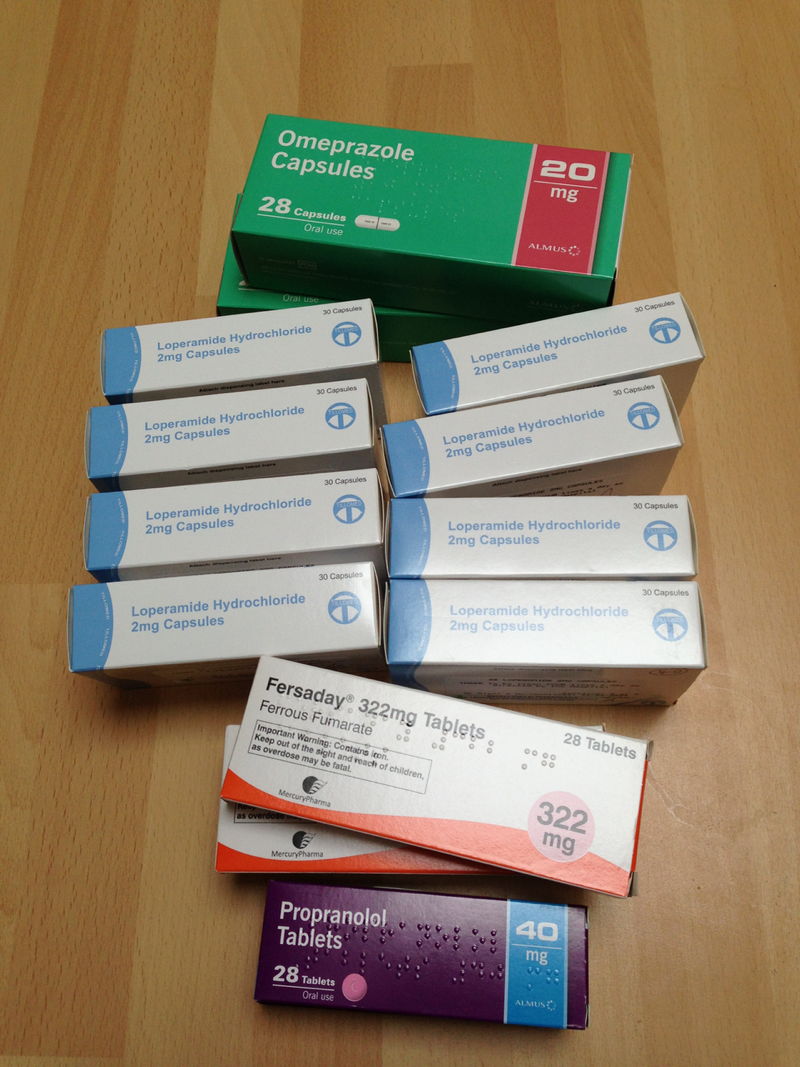
Omeprazole, loperamide, ferrous fumarate and propranolol
I called into our local chemist to pick up my latest prescription. Four items at £7.65 each and with an increase on the way. It left me wondering how patients with limited means coped. For some reason Crohn’s was not considered to be a disease that warranted free prescriptions, even though it was chronic and there was no cure. It’s only if you are unfortunate enough to have a stoma that all your supplies and medication are provided free of charge.
Wednesday 27th March 2013 – Guy’s Hospital – Haematology 2
My haematologist had said she would discuss my case with her colleague, the expert in the use of warfarin, and keep me informed of any recommendations. I was confident of hearing something. She had also apologised for the lack of follow-up letters from my previous two appointments.
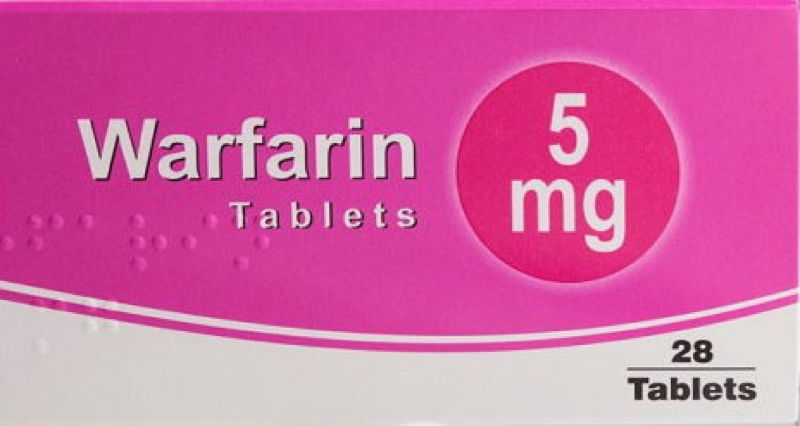
Warfarin – Yes or No?
I started to worry that maybe my trust was misplaced when I hadn’t received yet another follow-up letter and did not get a response to my emails. I started asking myself – was I being unreasonable expecting a response between appointments? That lead me on to thinking about how I should approach the subject when I saw her? Plan A – go straight in with all guns blazing or Plan B – see if it became apparent during the consultation why I had heard nothing.
I went into the appointment with three things in mind :
An expectation that I would see my usual consultant
How the consultation should proceed
My desired outcome
As I have mentioned before, it’s worth getting to haematology appointments a little earlier than the allotted time as there is always a blood sample taken and you do not see the consultant until the results are ready. The appointment was set for 11:10am on the fourth floor of Guy’s Tower. I arrived early and at eleven o’clock was called in for the blood test. A good start and it shouldn’t be long before I saw my consultant.
After another ten minutes, or so, I could hear my name being called by a new doctor. We went into one of the side rooms where my notes were open on the desk. He introduced himself and said that he had been reading the notes to get an overview of my case. I explained that I was hoping to see my usual consultant as I liked some continuity and I had the issues with follow-up letters and a lack of communication that I needed to take up with her. He replied that she was unavailable for today’s clinic. That was Plans A and B effectively consigned to the bin.
The doctor said that, having read my notes, it was apparent that the condition I was suffering from was rare. (It had also been described as “interesting”, an adjective I was becoming used to). He started to discuss my low platelets and noted that the last appointment had been in October 2012. I stopped him in his tracks and said this was a clear reason why notes and follow-up letters are so vital. I had attended two further appointments since October and the platelet issue had been put to one side as PVT, and the decision on warfarin, had taken priority. I then explained that this was an important appointment for me as I was expecting to run through my risk profile and at the end of it make the warfarin decision. I went through what my previous consultant had said about discussing my case with her boss, the blood thinner expert, who it turned out was a professor as well as a doctor.
At that point I started to think that this was all going to end up badly when measured against my expectations. I needed to kick start a reaction so I asked whether the professor was in the unit that day and what I needed to do to see her. Clearly that was never going to happen but it was worth a try! The doctor said that he would see if he could speak to my original consultant.
A few minutes later he returned with another doctor that I had not met before but I recognised her name as my appointment letters always stated that I was under her ultimate care. Putting two and two together she must have been the next one up the food chain from the doctor I usually saw. I went over what I was expecting from this consultation. She explained that she worked closely with the professor and they jointly reviewed patients’ use of warfarin. My case was complicated by my platelets being low although anything above 50 would be OK. The body produces fresh platelets on a 12-day cycle and, looking at my blood test results, I was producing fresh, “sticky” platelets, which meant that my bone marrow was functioning OK.
She then ran through the risk factors that I had previously discussed in January :
Reduced risk – have never smoked; drink very little alcohol; cholesterol average; active lifestyle
Increased Risk – have already developed PVT and a clot; Crohn’s Disease
Other consideration – low platelet count (currently 74)
Having looked at my notes, risks and results, on balance, she would not recommend warfarin yet. I told her that as far as I was concerned that was the “right” answer. If there was a low risk of clotting, then I was prepared to accept that risk to avoid having to take yet another medication. She said that if my circumstances were to change then we would need to review the decision. If, at any point, I was hospitalised again I would need to make sure I told the doctors of my history so that they could ensure I was treated accordingly.
I asked what could happen if another clot formed and whether there were any warning signs to look out for. She referred me back to her colleague and then left after assuring me that she would have a word with my original consultant.
What were the risks if another clot formed? Worst case, death, but common occurrences – clots in the leg which would be signalled by pain and heat; or sharp pain when breathing in. Both could indicate clots forming. I would have to look up the rest on the internet as I did not take them all in. He stressed that medicine was not an exact science and that they were unable to predict if I would have another clot. I assured him that it was my informed decision not to take warfarin and that I wouldn’t complain to the hospital if proved wrong.
Decision made, no warfarin.
The doctor said that he would book a follow-up appointment for six months’ time and if there had been no change in my condition they would discharge me. That sounded good. After that I would then be under the sole charge of gastroenterology.
Back in the consulting room – I thought I’d take the opportunity to ask this doctor, who was clearly in the early part of his medical career, about a few topics that I had been giving some thought to. It was encouraging to find someone who, unprompted, was telling me that his most important tool was developing the trust and communication with his patients so that they could have a completely open and honest conversation about anything that was concerning them healthwise. This aided his ability to reach a correct diagnosis.
We discussed patient records and he explained why he was impressed with the system that GSTT used and that you wouldn’t find a better system anywhere in the country. When I asked him if he thought I had made the right decision about moving my healthcare to St.Thomas’ he unequivocally agreed. We briefly talked about patient confidentiality and ended up with the recently reported failings at a large, Midlands hospital.
As I left the room the doctor assured me that he would write up my notes straight away and issue the follow-up letter. I was trying to decide, in view of the lack of notes on file from my last two appointments, whether or not to email the relevant sections of my journal to Haematology and ask them to get them put into my records. I knew they did file copies of any emails they receive.
Long-Term Plans
As I mentioned before, we had put some longer-term plans on hold until we knew where the three elements of my health were heading. All the excitement of the last few years had however reinforced a “live for today” attitude and that we might as well enjoy life now rather than plan too hard for an uncertain future.
There were still some health related issues to resolve, for instance the follow-up letters from haematology and, at some point, obtaining copies of all my notes from GSTT. There would also be some ongoing tests to be booked. I was expecting a colonoscopy just before the end of the year to check everything was fine internally, a gastroscopy around the same time to look for new varices and, in between, various blood tests.
Over those last few months my eyes had been opened, rather belatedly, to the power of social media (SoMe) and I had jumped in with both feet. There were some very active Crohn’s and IBD communities out there.
Wednesday 10th April 2013 – This was starting to become a regular theme. I would spend a few days feeling fine with my digestive system working properly and then wham! I’d be rushing off to the bathroom not knowing if it was a flare-up or something less serious. I had started to read other people’s descriptions of flare-ups on SoMe. It made me realise just how bad they could be. If I was having a flare then it was pretty minor and certainly not bad enough to speak to an IBD nurse. Whilst I might feel a bit uncomfortable it didn’t generally stop me going to work, even catching the train up to London, and I didn’t have to resort to anything more than upping the loperamide dose.
Sunday 14th April 2013 – I was catching up with some correspondence. Time for an email to Haematology chasing up the missing letters. I sent it to the head of department whose email address I found on their web page. I apologised for contacting her directly but explained that raising the issue in clinic was having no effect. I added: “I thought it was therefore best to go straight to the top so that you can delegate any necessary actions…….” and briefly explained what had happened at my last appointment.
I hit the send button and got a very prompt response, 20 minutes later, apologising and saying it would be looked into. It would be interesting to see how quickly something happened.
Friday 26th April 2013 – I contacted the IBD nurses as my consultant wanted to see me in June but I hadn’t received a date yet. A couple of days later a letter came through with an appointment set for 10th June, but with the liver specialist rather than the gastro consultant I was expecting to see.
I was going to ask them to change this but, on reflection, it could work out quite well as the liver specialist said that he wanted to discharge me from his clinic after our next meeting providing everything was going OK. I contacted the IBD nurses again and explained that I needed to see my lead consultant after the hepatologist and they duly organised a gastro appointment for two weeks later.
Monday 29th April 2013 – it’s funny how things coincide. It had reached two weeks since contacting Haematology. I decided it was time to email the Head of Department again. I would compose it over lunch.
Whilst I was still pondering what to say an email arrived from my errant consultant with an apology for the delay in responding. Copies of the follow-up letters, which had been written retrospectively, were attached. I checked their content against what I had written on my blog and they accurately recorded the chain of events and the discussions that had taken place.
Monday 10th June 2013 – St.Thomas’ Hospital – Hepatology – I took the Tube down to the hospital, scanned my barcode in reception and took a seat until my name appeared on the laser display screen.
I went off to get weighed and was given the false hope that I would be seen on time. My weight had remained steady but was above the ideal BMI range. Maybe I should have walked after all. Then it was back to the main waiting area. The screen was showing: “All clinics are running within 30 minutes of their appointment times“, but then the message for the hepatology clinic started to show it slipping further and further and I was finally seen about 90 minutes late.
When I entered the consulting room the doctor apologised, he had been dealing with an emergency all morning. It’s not worth getting wound up about delays in this situation. If you were that patient going through a crisis you would be thankful that the specialist was available straight away. With that his mobile rang and there were clearly still problems that needed resolving.
Whilst he was rapidly trying to re-adjust his brain to deal with the more mundane case in front of him I explained that I had finally managed to get Haematology to produce the required follow-up letters from previous appointments. There was a letter very neatly summarising my current condition and the reasons for not going onto anti-coagulation. I noticed that my file was already sitting open at that page. He had read it and agreed with its conclusions.
I mentioned that a year ago the words “liver transplant” were being used but over the course of the year the seriousness of my condition seemed to be lessening as various tests were carried out. He said that I shouldn’t be under the illusion that nothing was wrong as I had an enlarged spleen and liver, but he believed that the portal vein thrombosis was not an indicator of an ongoing clotting problem. He reiterated that it was likely to have been brought about by one of the surgeries I had undergone, hence he concurred with the decision not to anti-coagulate yet.
I asked if I should continue on the beta-blockers and proton inhibitors and he replied: “Yes”. We then moved onto what ongoing tests would be needed to monitor the condition. At the last gastroscopy, in November, I had not required any variceal banding. He replied that I should continue with the yearly endoscopies and entered the request for the next session into the system as we spoke. I would need to agree with Appointments the exact date and time. Apart from that he did not envisage needing any other tests.
In response to the “what signs should I be looking out for?” question, he replied that as he intended to discharge me back to the care of the gastroenterologists I should have that discussion with them.
I asked if I should be carrying any notes or a letter with me in case of another emergency admission to hospital. He suggested an SOS bracelet or medicare card with the relevant details on. I suppose I should have one anyway to record that I have Crohn’s (the invisible disease) and thrombocytopenia, let alone the other issues. Another item for my to-do list.
The final question, not on my list – were there any special precautions that I should be taking? I had already been avoiding alcohol, apart from the odd bottle of lager at weekends. He said that was a wise precaution but in reality I could treat my liver as being normal.
As I was about to leave he said: “I mean this in the best possible way but I hope I never have to see you again”. I replied that the feeling was mutual. We shook hands and hopefully that would be the last Hepatology appointment for a long while.
I went off to book a date for the gastroscopy and handed over a copy of the form that had been entered onto the system. The clerk looked me up and down and asked if I really needed to be admitted as an in-patient for the procedure. The doctor must have ticked the wrong box.
I explained that I was also expecting to be booked in for a colonoscopy around Christmas time. Was it possible to have both procedures done in a single visit? Yes, that could be arranged. We left it that I would contact them after my next gastro appointment. Something else for the to-do list.
What should the patient be told?
The follow-up letter from the hepatology appointment stated: “….I am pleased to say that with no signs of significant liver disease that I do not think he requires a follow up in this clinic”.
It raised an interesting question – what approach should doctors adopt with patients when it comes to a first diagnosis? A year ago I had been painted a bleak picture and was fairly certain I would need a liver transplant. One year on I had been discharged from the care of the liver specialist and the transplant had, hopefully, disappeared over the horizon.
Should the consultant at my local hospital have been more circumspect when explaining the possible outcome suggested by the initial tests? Should he have waited for the results of further tests before mentioning “transplant”? Is it best to hit the patient with the worst case scenario and then hope that the prognosis gets better as more tests are carried out? Maybe there isn’t a “right” answer and the doctors are trained to tailor their responses to how they gauge a particular patient will react.