
Monday 3rd December 2012 – Guy’s Hospital – Haematology 2 – the countdown to the liver biopsy started with a trip over to Guy’s. I explained to the receptionist that I needed to have a blood test and to collect a prescription. Because this was an ad-hoc arrangement I didn’t appear on any list so the receptionist would need to contact my consultant’s secretary and asked me to take a seat.
I must have been there about 20 minutes and was on the point of going back to the desk when my consultant appeared. She caught sight of me and asked if I’d had my blood test yet. I told her that there seemed to be a slight problem. I also mentioned the prescription for steroids to which she replied that I might not need them if today’s count was over 80, but I should go ahead and get the tablets as a precaution. She would email the results to me later.
The receptionist came over and they sorted out the situation. Shortly afterwards I was called in for the blood test and my consultant appeared with the prescription.
I now had a name for the steroid, dexamethasone. It was a lot more powerful than the prednisolone I had been used to. A sort of “steroid on steroids”. The theory was that a short, high dose for four days would boost my platelet count but without the side effects of taking it at a lower dose over a longer period.
The prescription was for 40mg/day. I took it down to Pharmacy. I knew from past performance that if there was a slow department it would be that one. I asked how long before it would be ready for collection and was told around 45 minutes, which was positively speedy. I had heard tales of several hours at other hospitals! I remembered my discharge from East Surrey Hospital being delayed nearly 5 hours waiting for the required tablets to be dished out.
I don’t like hanging around in crowded waiting rooms so went for a walk along the Thames and took some pictures, of course. It was grey and cold outside.
I hadn’t walked down to Tower Bridge for many years and was surprised by all the buildings that had sprung up along the South Bank. Quite impressive but turning my gaze northwards, across the river, it was a different story. The individual buildings are impressive but the whole effect of them, en masse, is a mess.
When I returned to Guy’s the tablets were ready. The pharmacist said there was one thing he needed to point out. The daily dose had to be taken in one go, after breakfast. The largest denomination tablet available was 2mg so I would need to take 20 tablets in one hit!
That evening I kept checking my email and just gone eight o’clock I got confirmation that my count was now 75. The steroids were needed and I should take the first dose in the morning as the effect peaks four to six days after starting them. My consultant said that if I needed a further blood test it could be done on the day of the biopsy. She copied the email to my gastroenterologist and asked him to arrange for a supply of platelets to be available, just in case they were needed. She had previously explained that the body builds up its store of platelets and then reacts to an event, such as a biopsy, which causes the level to drop. In my case it might be necessary to boost this level once the procedure was over.
Tuesday 4th December 2012 – I decided to work from home to keep an eye on any side effects that might follow starting the dexamethasone. After breakfast I popped the 20 tablets from the foil and swallowed them all in one mouthful. A new record for me.
I had been thinking about the plan to have a blood test on the morning of the biopsy. That would be cutting it too fine as the procedure was planned for 9:30am and wouldn’t give much time for the results to come back. I emailed the haematologist thanking her for her efforts and asking if it might be a better idea for me to call into St.Thomas’ on Monday or Tuesday to get the blood test out the way. Could she put a request on the system? I received a positive response so that was another trip to be added to my diary.
The last thing to do was ring Interventional Radiology and make sure that if I turned up unaccompanied for the biopsy they would still go ahead on the understanding that I would be escorted home. That would be OK. I also asked how soon I could be driving after the procedure and was told that it will depend on what happens.
Having been trying to manage the uncertainty out of the process it looked like some things would to wait until the day – the type of biopsy used; the recovery time and the recuperation time.
Wednesday 5th December 2012 – Up to London today for a work meeting. I popped the next 20 tabs of dexamethasone and waited to see if any side effects appeared.
In line with my new fitness regime, triggered by the recent 91kg weigh in, I decided upon a lunchtime walk. At around eleven o’clock I started to hiccup, not many, just in ones or twos. I put it down to eating a sandwich too fast, thought no more about it and went out for the walk, heading for Hyde Park. As I made my way back to work I noticed the hiccups had returned. I’m not sure how to describe them – they were triple ones but all at the same time!
Luckily they stopped before my commute home otherwise I’m sure I would have been getting some very funny looks. After dinner, that all changed. They became a lot more frequent so I Googled “dexamethasone” and “hiccups”. Maybe I should have widened the search to “all side effects”. There were many entries from people who had been on a similar high dose regime and suffered the same problem with varying degrees of severity. There was another medication that could counteract this side effect but by the time I could have seen my GP the the steroids would be finished. I would just have to grin and bear it, hoping that they stopped before bedtime. Rather worryingly one patient reported that he hiccuped for a week and was exhausted by the end of it.
At around half past ten I managed to doze on the sofa and miraculously the hiccups disappeared and didn’t return. My wife decided not to disturb me so I woke up at three in the morning and made my way to bed.
Thursday 6th December 2012 – no work today. I had a dental appointment planned and was wondering what would happen if the hiccups returned with a vengeance during my visit. I was keeping my fingers crossed!
They kept at bay until eventually returning at the same time as the previous night and then continued until 1:30am. I didn’t get much sleep and side effect No.2 appeared – my eyes started aching.
Friday 7th December 2012 – I managed to get a little sleep when the hiccups stopped but then had an early start to drive to Leatherhead to work for my other client. I took my final dose of 20 tablets. Side effect No.3 arrived – dulled taste buds.
I suffered the odd hiccup during the day but just after 10:30pm they were back in full force and continued for another four hours. It was strange how predictable the start time had become. I wondered if it would happen again the next night now that I had taken the last of the tablets.
Saturday 8th December 2012 – the side effects were getting worse! Taste buds now shot, eyes aching and difficult to focus. I had been hoping that things would start to improve. Roll on Monday when I would have a blood test and, if I was lucky, my platelet count would have shot upwards.
Sunday 9th December 2012 – I was feeling decidedly odd, flu-like and light-headed. I just took it easy all day. I would be going to London the next day so needed the rest to make sure I was fit enough for the trip. At least the hiccups had gone but my digestive system seemed to have woken up and I was ravenous. So much for my fitness regime, I had gained 2kg since Friday.
Monday 10th December 2012 – with the planned trip to London for the blood test it seemed like a good idea to combine it with a day at work and get paid. I felt better out in the cold air as it cleared my head. Having intended to find a corner on the train and try to get some sleep but bumped into an old colleague and we talked all the way up to Victoria.
I felt quite surreal walking from the station to my office, definitely not right. When I arrived at my desk I really lost it. A co-worker, with a particularly loud and grating voice, was just too much. I’m not known for being polite or tactful but I do usually know where the acceptable limit is. Not that day. Much to the amusement of one of my colleagues I went into “no inhibitions” mode. Suggesting that a co-worker should stick a bag over her head probably contravened my client’s code of conduct and I could well have ended up being booked onto the next diversity course. My colleague quickly ushered me into the next office.
It was short lived and I did apologise to most of those who had witnessed this unforgivable lapse. I had never known anything like this before so Googled “dexamethasone side effects” and came up with the following :
“Increased irritability, increased appetite, insomnia, fluid retention (including swollen ankles and feet), muscle weakness, increased blood sugar.” I could certainly vouch for the first three.
With the incident behind me I set off to St.Thomas’ for the blood test. Given my record, I was wondering if there would be any further problems such as no request sent to phlebotomy. I shouldn’t have worried. The wait was quite short and I had soon given up some blood.
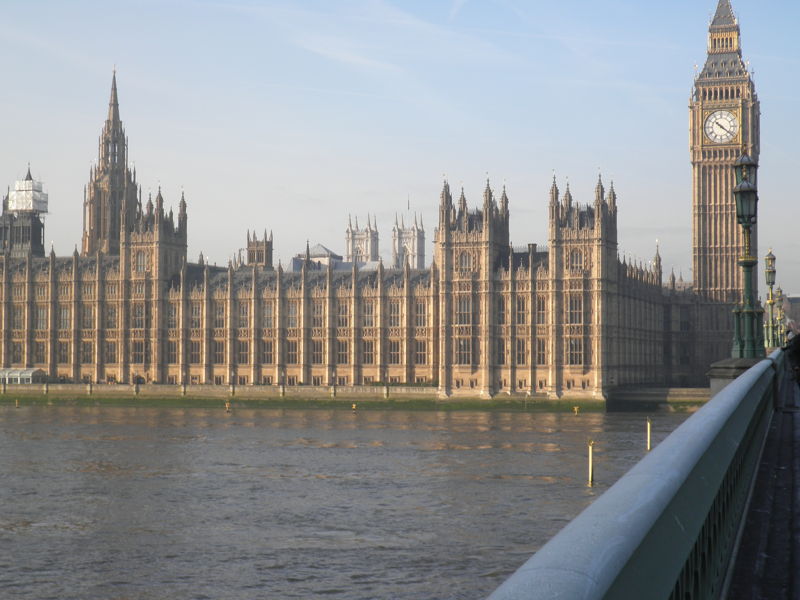
It was a gorgeous London winter’s day. Ideal weather for taking some pictures from Westminster Bridge on the way back to the Tube station. The trip must have done me good because I returned to my office in a lot calmer mood.
When I arrived home that evening I thought it would be worth emailing Haematology just to alert them to be looking out for my test results.
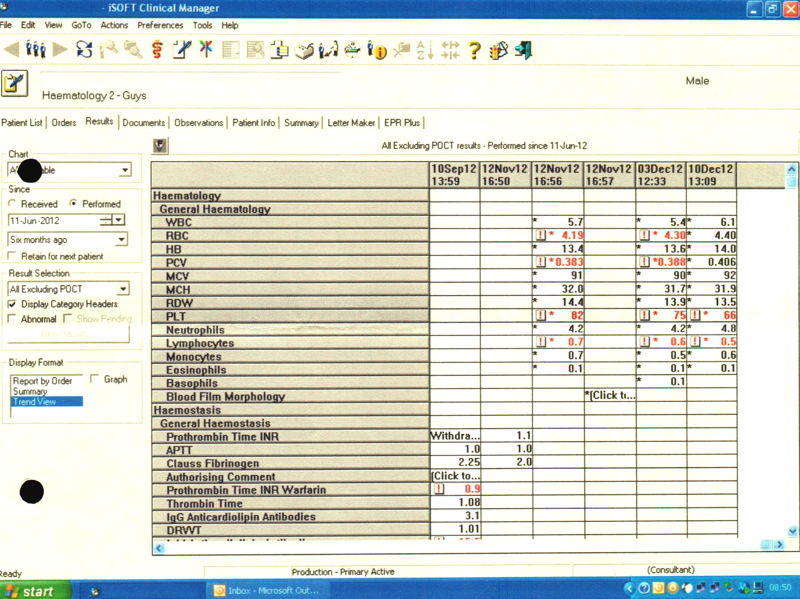
Tuesday 11th December 2012 – I didn’t want to risk another trip to London so worked from home. I needed to be ready for the biopsy. Just before nine o’clock I received the email I had been waiting for. The haematologist had attached a screen shot showing my last three blood test results –
The line to focus on was PLT and it was not good news. Not only had the dexamethasone failed to improve the platelets but the count had dropped still further and at a greater rate of decline. They would need to make sure that there was a pool of platelets available tomorrow in case the puncture wound, from the biopsy needle, started to bleed. I responded to the email and made sure I copied in both my other consultants so they were aware of the situation. I left it that unless I heard to the contrary I would be up at St.Thomas’ early the next morning. It would mean making an early start and the forecast was for the temperature to drop to minus five degrees overnight.
Wednesday 12th December 2012 – Guy’s Hospital – Haematology
After what seemed like a very long wait, the day of the liver biopsy had finally arrived. I had all the bases covered. What could possibly go wrong? This would be a standard procedure that was carried out every day but for some reason I had found the thought quite daunting. It wasn’t the procedure itself, although one description I found stated: “…liver biopsy may be an essential part of patient management, it is an invasive procedure with a relatively high risk of complications“. I was more concerned by the uncertainties due to low platelets.
The start time was set for 9:30am. The letter said be there 30 minutes earlier to get prepared. I would not be allowed to drive for 48 hours after the procedure so organised a lift down to the station. I also needed to be escorted on the journey home so my even longer suffering wife accompanied me yet again.
It must have been the coldest night of the winter so far, minus six. We made it down to Redhill just before 8 o’clock. Now I knew why I usually commuted earlier than that. The train was heaving, no seats free. Standing room only all the way to London.
We arrived at St.Thomas’ well before nine and made our way into the warren called Interventional Radiology. I booked in with one of the nurses and we were shown to a waiting room. The nurse came back with the consent form to start filling out and then disappeared.
The brain seems to have an uncanny knack of being able to subconsciously listen to background noise and pick out important words that you need to hear. About ten minutes later I was in just that situation. My name surfaced out of the general hubbub together with: “Where is he? They’ve been looking for him for 20 minutes“. A little bit disconcerting. We sat tight and the administrator appeared and said: “Your platelets are very low and they are concerned about the procedure. You were expected in last night to get prepared. Did anyone call you? They’re going to try and ring you now on your mobile“. I’m not sure what the purpose of calling me there and then would serve but my phone remained silent. I checked to see if I had missed any calls at all in the last 24 hours. The list was empty.
I could see the wheels coming off the wagon. Luckily I had printed off a copy of the email trail which explained who I had spoken to and what I had done to make everything, supposedly, run smoothly. I explained all this to the administrator. She disappeared for a while and then returned to say that they were waiting for a call from one of the doctors to see how they wanted to proceed. By now we were approaching half past nine and I could see my slot disappearing.
After a few more minutes the nurse re-appeared and attached a barcoded wristband. That was a good sign. Then another nurse appeared with hospital gowns and slippers but told me not to put them on until the doctor had run through the consent form and I had signed it.
A few more minutes and the doctor appeared. Good news. The procedure was going ahead and because my platelet count was not “too” low they were going to do a standard, plug biopsy, not use the transjugular route. The standard route would take the needle directly into the liver and, when withdrawn, a plugging agent would be introduced to block the puncture wound, hence the name.
She went through what they were going to do during the procedure and what the various risks were. The main ones – bleeding from the wound, damage to the biliary ducts and not getting a good enough sample, therefore needing a further procedure at a later date. I signed the form and then changed into the gowns. Being an upper body procedure I only had to strip to the waist.
I said goodbye to my wife and she set off to visit the National Gallery and then do some shopping in Oxford Street if there was time. She took my camera with her as, by now, it had turned into one of those cold, crisp winter days that makes London a pleasure.
Back in Interventional Radiography I entered the preparation area to have a cannula inserted. Straight into the vein in one go. Just gone 10 o’clock I was taken down to the theatre and laid on my back on a trolley with my arms over my head. Two doctors introduced themselves and proceeded to scan the liver area with an ultrasound probe. They discussed the best entry point and route for the needle. Once they were happy with where it was going one doctor took over and it was time to prepare for the insertion of the biopsy needle. The area was cleaned down and a sterile sheet stuck in position with an opening at the puncture site. All was ready for this new experience to start.
First, local anaesthetic was injected around the area to deaden the nerves. The biopsy needle was then slowly introduced through the skin, guided by ultrasound. There was one point when a short, sharp pain shot through my lower abdomen. I later found out that it marked the point when the needle passed through the outer membrane of the liver.
I was expecting the needle to go straight in, take a sample, and then quickly be withdrawn. In practice the process took a lot longer whilst the needle was slowly guided into position. Every so often I was getting another sharp pain in my shoulder. I’ve learned not to be brave and keep quiet, as the pain may indicate a problem. I told the doctor what was happening and she adjusted the needle position accordingly. I don’t know exactly how long the whole procedure took, probably 50 minutes in all. It was quite a relief to hear the words “all finished“.
I was told to roll onto my right side as this applies pressure to the wound and helps it to seal. I was wheeled back into the Recovery Room and the nurse explained that I had to stay there, on my side for two hours. After that I would be able to lie on my back, eat and drink but would need to spend a further two hours before I could go home. I was wired up to a blood pressure/heart rate monitor and every few minutes one of the nurses would check to make sure everything was on track. I rang my wife to tell her what time I could be collected and then settled down for the two-hour wait before eating.
I had assumed that when the nurse said: “stay on your side for two hours” that she meant to add: “but you can still visit the bathroom”. Wrong! I did ask about taking a comfort break but was told I had to remain on my side for the full time. I was starting to get desperate, made worse by knowing I was forbidden to move. The nurse helpfully brought me a bed bottle but I found it impossible to use given the angle I was lying at. There was nothing for it but grin and bear it.
Finally the first two hours were up and I could make a dash to the bathroom. When I returned I still had another two hours to kill, this time lying on my back. An NHS Snack Box was waiting for me. I had never seen one of these before. It contained sandwiches, crisps, yogurt, fruit juice and a chocolate biscuit.
I had some questions, mainly to do with how I would know if something was going wrong over the next few hours. The nurse patiently explained the potential signs of trouble and answered some of my more general questions.
The time passed fairly quickly. Just before 3 o’clock the doctor, who had carried out the procedure, came to see me to make sure I was alright and sign me off so that I could go home. By now my wife had turned up. I did a quick change out of the gown and we set off for the station. An hour and a half later we were home and that was another test under my belt, literally. The list was growing.
I was full of admiration for the Interventional Radiology team. Apart from the small glitch at the start (which was nothing to do with them) everything ran very smoothly. The nurses were fantastic. Nothing was too much trouble. They kept me informed at every stage along the way and answered all my questions with patience and good humour. I would need to ring them in the morning to let them know that I was OK.
…and I never did get to the bottom of “we were expecting him last night”. Nobody ever mentioned it again.
Thursday 13th December 2012 – I rang St.Thomas’ IR department to tell them that everything appeared to be going smoothly.
Given that the latest blood test results were showing my platelet levels to be the lowest ever and, more importantly, the rate of decline had increased, I decided to contact the haematologist. My next planned appointment was at the end of January but I wanted to make sure that she was happy for me to go that long before seeing her or whether she wanted to start treatment sooner. She had told me to email her if I was having problems so I hit the send button.
A short while later she responded saying that she was aware of my blood results and had also been contacted by my hepatologist. It was nice to know that these dialogues were going on in the background. Because I had not been showing any symptoms of increased bleeding and my platelets were still well above 20 she was happy to wait until the planned appointment. I might have to have a bone marrow biopsy to confirm if the low platelet count was due to my immune system or the marrow not functioning fully. It was also possible that my enlarged spleen was causing the platelets to “pool” and this could reduce the number in the blood stream.
Friday 14th December 2012 – I removed the dressing from the liver biopsy and. just two small puncture wounds were showing. There were no signs of bleeding.
Sunday 16th December 2012 – this would be colonoscopy No.3 since having surgery. Whilst the procedure is very undignified I had become quite blasé about it. I was at a point where any possible embarrassment disappeared long ago. Some patients find them very painful and feel the side effects for many days afterwards but I had been lucky so far. It was time to start the preparation sequence.
Monday 17th December 2012 – although today’s instruction was to stop taking loperamide I decided that since I was going to work up in London it would be sensible to take one last capsule with my breakfast.
As I was still determined to shed some weight a lunchtime walk was in order. Time to do some last minute Christmas shopping, or at least window shopping. A good, brisk walk up to the shops in Sloane Square was ideal, the prices weren’t!
Tuesday 18th December 2012 – I was up in London again but without the safety net of loperamide. There was another chance to get some exercise at lunchtime. I caught the Tube to Covent Garden to visit the Apple Store. I finally succumbed to an iPhone. Something I had been promising myself since the first one was released years ago. Why did I wait so long? I could now happily join the throng of “phone zombies” that haunted the streets of London, blissfully unaware of anything going on around them but focussed on “liking” their FB friends’ selfies.
Wednesday 19th December 2012 – the day before the procedure. After a light breakfast I settled down to drinking lots of fluids and waiting for relevant times to down the senna tablets and prep solution.
Thursday 20th December 2012 – Guy’s Hospital – Endoscopy Unit
Colonoscopy Day and yet another early start to get to Guy’s for half past eight. My train was a little late so I checked in just after the due time and sat in the waiting area. At nine o’clock I was taken into the changing area, given a hospital gown and then asked the usual questions.
I changed into the gown and took a seat before finally entering the ward to be fitted with a cannula. By now it had just gone half past nine. I was pleased to see the friendly face of my lead consultant appear. At my last appointment he had asked me to ensure that I booked the scoping for a day when he was in clinic as he wanted to carry out the procedure personally. He ran through the potential risks and got me to sign the consent form.
We discussed what had happened during the previous scoping in June and the camera not proceeding beyond the splenic flexure. The other thing I mentioned were the side effects of the dexamethasone. I told him about the hiccups and, more worryingly, the change of personality. Hiccups were a new one on him but the mood swings were a well-known issue with steroids in general. He recalled a patient who had been started on a high dose of prednisolone one night and in the morning had climbed under the bed, refusing to come out!
That was something to ponder during the 30 minutes wait to be shown into the procedure room. The delay must have been due to complications with the previous patient as I recognised her as the one who was seen just before me and she had certainly spent a long time in theatre.
At last I was on. I walked into the room and climbed onto the table. An oxygen supply, heart monitor and blood pressure armband were all fitted and I was asked to roll onto my side with my knees drawn up. The doctor injected the cocktail of sedatives and I soon entered a state of feeling comfortably numb.
I was asked if I wanted to keep my glasses on and I said “Yes” so that I could watch the action on the monitor. The big advantage was that I saw exactly what the consultant was seeing and it gave me the chance to ask questions as the camera progressed. It also meant that if something untoward was going on I would know straight away and not have to wait until seeing the doctor afterwards or even for the next appointment.
Time to begin. Sharp intake of breath and the camera started its journey. It made slow progress but by careful guidance, and some shifting of my position, it reached beyond the bend. The image capture wasn’t working properly so the resulting colonoscopy report ended up looking rather bare. The camera continued its progress and made it all the way to the anastomosis.
What did we see on the large screen? NOTHING. Or rather nothing out of the ordinary. No signs of active Crohn’s disease at all. This was the result I was hoping for but didn’t really expect. It was a repeat of the colonoscopy result from a year ago and I was again given a Rutgeert’s score of i0. Follow up appointment – six months’ time.
One of the reasons for requesting this scoping had been the ache I was suffering in the vicinity of the rejoin. There was nothing showing up from inside the gut which meant the likely cause was adhesions. I didn’t know what the implications were. It was the one question I forgot to ask.
I did however ask the doctor if I needed to be taking any medication to keep the Crohn’s at bay and he said “No“. So that was rather a good way to end 2012!
(The one thing I cannot work out is if anyone accompanied me home afterwards. There was one occasion at Guy’s where I just turned up on my own, came home on my own and the lack of escort was never questioned).
No more work until 2nd January. Time to relax, take it easy. I was still over the moon that there were no signs of active Crohn’s. I was slightly less happy that the ache around my rejoin continued and noticed a small amount of pain around the puncture wound from the liver biopsy. It was more annoying than painful, most of the time, but if I took too deep a breath I certainly knew about it.
Stop or Go
If you’re reading this as a Crohn’s sufferer you’ll know that one can never say that the disease has gone for good. The best you can hope for is a long, uncomplicated remission. I didn’t believe that I was 100% in remission due to a few niggly abdominal pains and the distinctly variable state of my digestive system but my Crohn’s was going through a quiet patch which left me in a bit of a dilemma. My journal had been started specifically to cover my Crohn’s Disease experience so, once again, I did consider stopping writing altogether. My main concern had now switched to Portal Vein Thrombosis (PVT), the potential early signs of PSC and the low platelet count.
I realised that I enjoyed writing and that not having a journal to think about would leave a large hole in my creative efforts. I would, after all, keep going and rationalised my decision by saying to myself that all these new conditions were either direct side effects of Crohn’s, the medications or surgery.
My exercise regime had been rather disrupted by the unplanned hospital stay in the middle of the year. Whilst I had a fair amount of energy my weight was now hovering around 90kg, about 5kg above my preferred weight. It was time to redouble my efforts to address this. After returning to work, post-Christmas, I resolved to try and walk at least three kilometres, whenever I was in London.
I set myself some goals for the coming year, more out of hope than realistically being able to guarantee any of them –
No unplanned visits to hospital
Return to working a five-day week – depending upon my clients’ workload
Reduce stress levels to the absolute minimum, gauged by the number of unbitten fingernails, 80% intact at that time