
1977 was a year of change in two main areas of my life – music and health. In the spring I had celebrated my 21st birthday and was living at home with my mother and sister. My father had died tragically young of a massive, unexpected heart attack seven years previously. It was an event my mother never got over and one that I believe shaped my own attitude to life and mortality from then on.
The UK politician, Vince Cable, has described an event in his early life as having “cauterised” his emotions. This sums up perfectly the effect my father’s death had on me. I did not want sympathy. I would cope on my own so became very cold, detached and emotionless. This may just have helped me to manage all that Crohn’s disease has thrown my way.
I had quickly learned that it was necessary to “move on” or it would be easy to spend the rest of my life living in the past. I do have some regrets. I never had the chance to discover more about my father’s childhood, upbringing or his military service, seconded to the Indian Army during the Second World War. I never had a chance to discuss my growing interest in politics and current affairs.
Whether my father’s death affected my schooling is impossible to say. Any thoughts of going to university to study Architecture had been dashed by not achieving the ‚’A’ level passes I needed. I believe the biggest contributing factor was contracting a bad bout of glandular fever which meant I missed the vital first six weeks of sixth form lessons when all the groundwork for the next two years was laid. I had never felt fatigue like it. On many days it was all I could do to get out of bed in the morning. When I did return to school one of the teachers explained that they couldn’t re-run the lessons that I had missed as it would hold back the rest of the class. I was on my own.
In some ways not having to make the decision on going away to university may have been a blessing in disguise as I would not have wanted to leave my mother and sister on their own. Instead I chose to continue my education at a South London college which meant it was close enough for a daily commute. The four year course had the not very inspiring title of “Batchelor of Science in Building”. It wasn’t as dull as it sounded and the skills and techniques that I learned have been put to good use in the ensuing years, both professionally and in my private life.
A few weeks after my birthday I was introduced to a young lady outside my usual circle of friends. We had a mutual interest in music and were both avid record collectors. We quickly became an item and are still together today.
During the summer break from college I took a job at the local Coca-Cola bottling plant as they needed additional workers to cover their busiest period. It involved loading crates of newly filled glass bottles onto pallets, ready for collection by forklift. The work was very physical. By the time I returned to college in September, to start the third of four years, I had developed quite a fine physique, though I say it myself.
The summer job paid well and the money earned was used to buy equipment for the band I sang and played guitar with. The music I listened to was undergoing a significant transition as the influence of punk rock grew with the likes of The Damned and The Sex Pistols. Having very catholic musical tastes allowed me to embrace these new sounds without abandoning the “prog rock” I had been brought up with and that had inspired me to take up the guitar.
After a short while of being back at college I started to realise that something was wrong. I was suffering from an “upset stomach” and having to rush off to the bathroom many times a day. At first we blamed my condition on the fried food I used to eat every lunchtime at the Wandsworth Grill : greasy bacon; greasy sausage; greasy omelette – there was a common theme – or was it drinking too much ice cold Coke during the summer?
What was happening to me? In a matter of weeks I had gone from very fit to worryingly sick. Eventually I sought medical advice to try to sort out the diarrhoea as it was getting worse. (I was hoping not to mention diarrhoea so early in the text but needs must. I’d just like to assure readers that it doesn’t run throughout the book.) I should have gone sooner but felt embarrassed about the thought of discussing bodily functions. Any embarrassment I might have felt then has now, clearly, long disappeared.
Initial diagnosis – in October 1977 I went to see my GP. Very few people had heard of Crohn’s disease. I certainly hadn’t and it wasn’t on my doctor’s radar either. He prescribed the obvious remedy for diarrhoea – loperamide (Imodium) – those capsules you take when you’ve eaten something disagreeable on holiday. My long-term, on/off relationship with this drug had begun. Needless to say, it did not work effectively as it slows down the digestive system but does not treat the underlying causes. I felt extremely weak, tired all the time and always very cold to the touch. Further investigation was required.
Another six months passed. By the time March 1978 arrived I had been booked in for a barium enema. You can imagine the dread I felt. If I was embarrassed at just talking about bodily functions how much worse would it be to have a tube stuck where the sun don’t shine whilst a nurse poured in some form of liquid, presumably via a large funnel?
This was the first procedure I had to endure. As I suspected, any semblance of dignity went out of the window. Firstly it was necessary to ensure that the bowel was completely clear of all contents. Not usually a problem for a Crohn’s sufferer but to be on the safe side I had been given preparation drinks to take the day before and told not to stray far from a bathroom. The liquid did its worst and I camped out in the smallest room in the house.
When I arrived at the hospital I changed into one of those gowns that never quite meet at the back – the ones that are impossible to fasten as the ties have either been cut short or dropped off. In the X-ray room I was asked to lie on my front as a rubber tube was inserted. I was right about the large funnel. The barium liquid, with the appearance and consistency of milk, was poured into the funnel and allowed to flow through the tube with the aid of gravity. When it had all reached its destination it was time to clench hard and roll onto my right-hand side to encourage movement around the system.
Once sufficiently distributed I had to clench even harder and lay on my back for the images to be taken. So far so good. With the X-rays completed came the most worrying move – having to get off the trolley, adopt an upright position and then hope I made it to the toilet without losing any of the liquid. Have you ever tried walking and clenching at the same time? Your answer is probably “Yes” if you are an IBD sufferer.
The outcome of this procedure was a diagnosis of “spastic colon” which nowadays would be called Irritable Bowel Syndrome (IBS), that catch-all condition for describing any digestive disorder that is of indeterminate cause. There was still no mention of Crohn’s.
My GP put it all down to “nerves” and prescribed nacton, a drug marketed for “giving relief from the pain of peptic ulcers“. To this day I can’t fathom out why he did this. It had no effect. In hindsight I should have questioned my GP’s treatment or asked for a second opinion but I was still young and it wasn’t the done thing to challenge members of the medical profession. They were god like.

Nacton advert
Over the course of 12 months I had gone from eleven and a half stone down to eight and a half stone (73 kg down to 54 kg). I didn’t really notice as the change was gradual and I wonder whether some form of mental defence mechanism kicked in, but anyone who hadn’t seen me for a while was horrified.
I became weaker and weaker and in July 1978 went to see my GP again. There was no need to book an appointment in advance. I had a stroke of luck. A sign on the surgery door stated that my doctor was on holiday and redirected me to another practice, nearby, where a locum was based. Nearby turned out to be at the top of a long, steep hill which was quite a struggle on a warm, summer’s day and in my weakened state.
I took a seat and waited my turn. Eventually I heard my name being called and made my way into the surgery. The doctor was shocked at my appearance and said that I needed to see a consultant immediately. If I was prepared to pay £25, the equivalent of £120 at 2019 values, I could see the consultant the next morning (Saturday) at his private practice in South Croydon. (I’ve since been told that my original GP had been censured for failing to diagnose another patient. Without being overly dramatic, seeing his locum probably saved my life).
I’m not really in favour of jumping queues, just because you can afford to, but in this instance my mother paid the fee and I saw the consultant the next day.
We made our way to his surgery just outside Croydon in Coombe Hill and were shown into a rather gloomy room dominated by a large desk. Dr. Parrish, a tall, thin, distinguished looking gentleman, was sitting behind it. He took one look, and said: “You need to be in hospital NOW! I will arrange for you to be admitted”.
My heart sank. Ever since I was a child my biggest fear was ending up in hospital. I’m not sure where the fear came from. Maybe it was visiting my grandfather in our local, rather primitive, cottage hospital when he had his gallbladder removed. I’m guessing that I must have rationalised my fears by saying to myself: “it’s only for tests, not surgery”.

Dr.Parrish (centre) at his retirement in 1988
There was something else on my mind. Croydon Council were running an outdoor concert in a local park on the following day, Sunday 16th July. I had become involved in the organisation of the event and our band would be performing. We went over to the park on the Saturday afternoon after I had seen the doctor. The stage was set up but there was no roof – and rain was forecast. My girlfriend didn’t want me to take part as she thought I was so weak that I would collapse. I didn’t want to let down the rest of the band and pass up the chance to play our biggest gig yet. A chance to get noticed.
On the day of the concert it rained and rained and then rained some more. The first act performed their set under a flimsy sheet of plastic. The roof slowly filled with water and leaks were appearing above their amplifiers. We decided it was too dangerous to go on. Water and electricity do not mix so we pulled out and with hindsight that was best all round. It probably would have been a choice between electrocution or collapse.
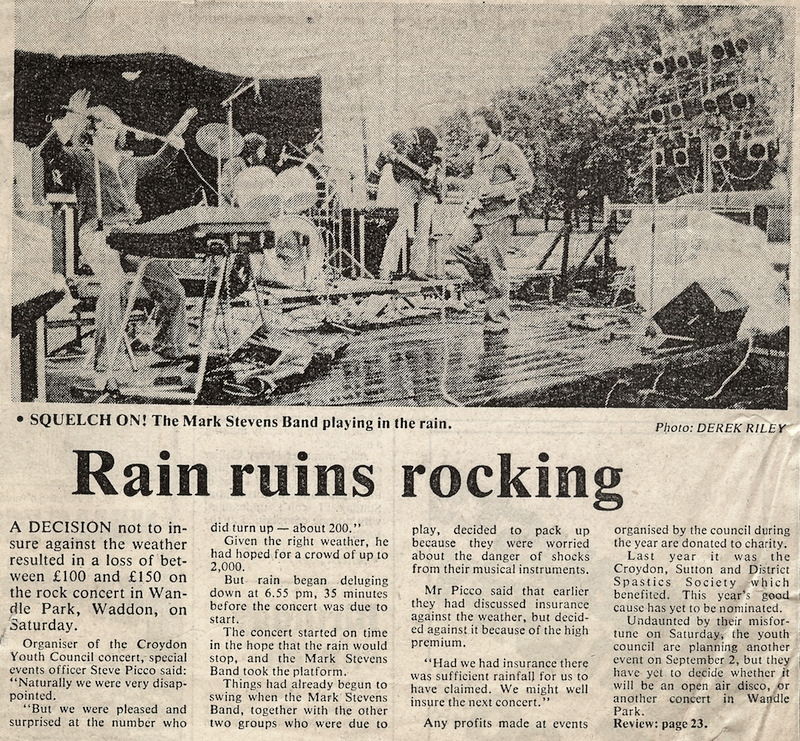
Local paper report on Wandle Park concert
It must have taken the Monday to organise my admission to hospital. I don’t remember how I spent the day but can only assume I was in a high state of anxiety, wondering exactly what lay ahead and how long I would be “detained”. My other concern would have been what I needed to pack for my stay.
Tuesday 18th July 1978 – First Time in Hospital – I was admitted to the dreaded Croydon Mayday Hospital at 11am, three months after my 22nd birthday. I use the term “dreaded” as it did not have a good reputation. I know the precise details of my admission because they are recorded on the ward and doctor’s notes that I have subsequently obtained. The nurse’s first impression was: “looks pale and thin”.
The ward sister must have taken pity on this “young lad”, only in there for tests, as instead of being given a bed on the main ward I had my own side-room. This was a great boost as I was allowed to have a television brought in and it was so much nicer when my girlfriend came in to visit.
The next three days were spent undergoing observations and giving samples.
It has been interesting to read the consultant’s thoughts from his first examination. A lot of them were written in medical shorthand or diagrams, which I have been unable to decipher, but on the fourth page there are the words “probably Chron’s (sic) and U.C., exclude infections”. I would need further tests before he could give me the definitive diagnosis. I looked very anaemic and blood tests confirmed this.
Friday 21st July 1978 – an X-ray followed by a sigmoidoscopy (a camera that only looks at the rectum and lower large intestine). During the latter procedure a number of biopsies were taken from the walls of my colon, then it was back to another few days of resting.
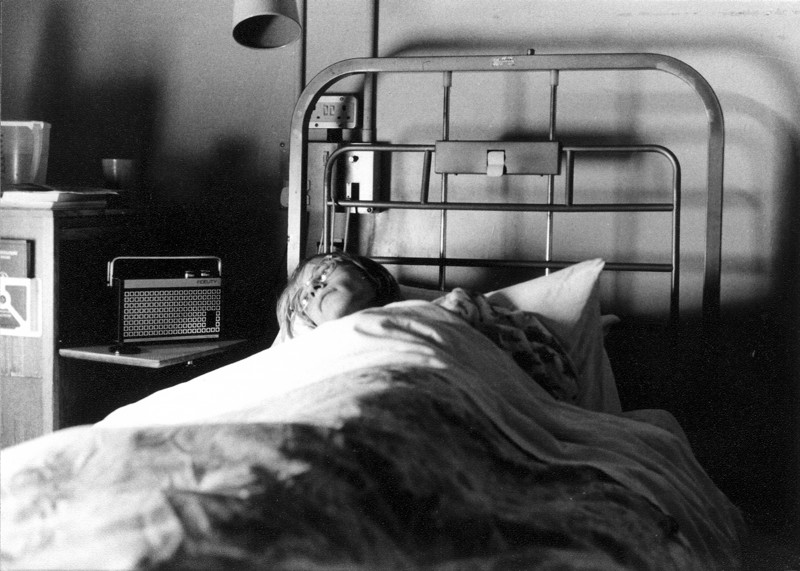
A particularly pathetic sight
Monday 24th July 1978 – a busy day with various X-rays, including chest, abdomen and a barium follow through. The conclusions were whilst my chest X-ray showed no abnormality, the one taken of my abdomen was showing a tubular gas shadow in the R.I.F. (right iliac fossa – that includes the area where the appendix sits), suggesting I had an abnormal bowel.
The barium follow-through proved the most conclusive. The upper part of my small bowel was quite normal but working down towards the terminal ileum, where the small intestine joins the colon, less barium was showing up as the area was so inflamed it would not tolerate holding any liquid. There were also signs of a long stricture (narrowing) in the same location. It appeared that part of the colon was also abnormal.
I read this for the first time going through the records, nearly 35 years on from the event, and was surprised that they didn’t decide to operate there and then to remove the strictured section of the terminal ileum. They chose to try drugs instead. I know that surgery is often considered a last resort but in this instance I would have thought my condition was sufficiently advanced to make it worthwhile. Maybe I was just too underweight, under nourished and anaemic to take the risk.
Tuesday 25th July 1978 – It was decided I should be transfused with four units of blood to try to bring my haemoglobin (Hb) levels nearer to normal. It worked because the reading jumped from 9.5 to 13.3.
Wednesday 26th July 1978 – The results of the biopsies were back :
“Severe focal chronic inflammation with occasional multi-nucleated giant cells. This would do well for Crohn’s disease” . Using this information the consultant decided upon a treatment plan. The ward note adds “…and is to commence on chemotherapy”!
Thursday 27th July 1978 – Commenced treatment – salazopyrine, a disease-modifying anti-inflammatory drug, together with codeine phosphate, to slow my digestive system down, and iron tablets to boost my blood.
Friday 28th July 1978 – the consultant had written up his notes and reported that the biopsy had confirmed: “Crohn’s as well” . He also noted that I had started to feel stronger after the transfusion but he was not in any hurry to discharge me from hospital. I stayed in Mayday until 3rd August, my mother’s birthday. I assume that this length of stay was to give my digestive system time to recuperate and allow them to monitor the start of my treatment.
At some point I had asked one of the doctors what caused Crohn’s disease. He responded that nobody knew but he had heard some odd theories including cornflakes and stray bristles from toothbrushes. Unfortunately there was no cure.
You might now be expecting to read a few paragraphs expressing how I reacted to this diagnosis. Feelings of shock, total devastation, outright fear or maybe anger. These are some of the emotions other sufferers have written about. I don’t recall any of those feelings. I never became angry at having Crohn’s. Maybe it was a case of “ignorance is bliss”. I simply did not understand the long-term implications of what I had been told. There was no internet to consult and, potentially, scare myself witless. The overwhelming emotion was one of relief. I finally had a physical explanation and name for my condition. It was not “all in my mind” or “nerves” after all. I wasn’t going mad.
Nowadays it is accepted that many patients will need some level of emotional support at diagnosis and beyond. Was it even a consideration in the 1970s? It was never mentioned or offered to me.
Whilst the internet was waiting to be invented there were, of course, medical books to refer to. My girlfriend was working at Medi-Cine, a company specialising in animated medical films. One of the team was a doctor and she mentioned my diagnosis to him. He found a section in a reference book that described Crohn’s Disease. Being a medical tome it was written in fairly incomprehensible terms and concentrated on describing locations and symptoms rather than the likely affect on the patient’s quality of life. Whilst it didn’t make pleasant reading it wasn’t unduly concerning. Maybe it would have been more daunting if we had understood those medical terms.
Back to being an Outpatient
In September I went to my first outpatients’ clinic since discharge. After the appointment the consultant’s registrar wrote to my GP summarising my condition on leaving hospital and my current state :
“On examination we thought he was pale and anaemic and felt the probable diagnosis was Crohn’s disease. A rectal biopsy was performed and confirmed the diagnosis histologically. He was treated with a blood transfusion, salazopyrine and codeine phosphate and appeared to make a reasonable recovery.
However, when I saw him in the clinic he was worse again and felt he had relapsed to his pre-admission state. His haemoglobin had dropped to 11.5“.
As a result of this relapse the salazopyrine was stopped and another long term relationship started, this time with steroids (prednisolone) – 10mg three times a day. The letter ends with :
“He is aware of his diagnosis and appears to understand the disease“. Really?
The new drug worked well. The general public had heard of steroids. They were those illegal drugs used by body builders and had nasty side effects. One Friday night I was having a quiet drink in my local pub when one of our friends rushed up to me in an agitated state. She shouted: “You fool. It’s not worth it. Why are you doing this to your body?” I was rather taken aback but then it dawned on me. Someone must have mentioned I was taking steroids. Not one to miss the chance of a wind-up I explained that I wanted to change my physique and this seemed the obvious way of doing it. (I did eventually put her out of her misery).
All seemed to be progressing well and I was able to start reducing the dose by two thirds to a target of 10mg a day. In March 1979 I completed my finals and during that period my digestive system behaved impeccably. It was once the exams were over that I noticed I was again having to rush off to the bathroom more frequently. I made an appointment to see my consultant but was seen by one of his registrars instead. By now we were into April. He put me on loperamide instead of the codeine phosphate and said he would see me again in a month’s time. I had forgotten that I had been on that drug before. I do however remember taking the prescription into the chemist’s and the pharmacist saying: “Four weeks? You shouldn’t take these for more than two days“.
I saw the doctor again at the start of May and reported that I felt a little better. He told me to continue with the drugs I was already on and added a steroid suppository to be “taken” (inserted) every night. He would see me in another four weeks. At that next appointment I was able to tell him that I had improved vastly over the last four or five days so the medication continued as prescribed.
I had started my first real job since leaving college, working on a large construction site in King’s Cross, North London. In those days the area had not been gentrified and the walk between work and the Tube station was “educational”. I couldn’t work out why there was always a group of “ladies” waiting at the bus stop but never boarded a bus. It wasn’t until a colleague came in one morning and said that he’d been offered a “quicky standup in a doorway for two quid” that the penny dropped. I viewed them with renewed curiosity and on cold days I would see their pimp bring a tray of hot drinks and sandwiches over to them from the local cafe.
I must have been feeling well enough to take the train to London every day and then board the Tube to King’s Cross without any worries about being “taken short”. I settled down to a life of pill popping and commuting. I don’t recall much about those first months on site or whether there were any warning signs as to what would happen next.