
My medical “experience” was about to go into overdrive. I would be introduced to unfamiliar disciplines, consultants, tests and procedures.
I was pleased that I had continued writing my blog as it took on a new significance for recording the complex issues that lay ahead and, on many occasions, provided a valuable memory jogger for subsequent discussions. The narrative necessarily became more detailed.
The act of “reporting” on these new experiences allowed me to become one step removed, almost as if they were happening to someone else. Rather than worrying about some new test I found myself wondering how best to explain it to a reader. This enabled me to maintain a degree of objectivity that has formed a major part of my coping strategy.
Saturday 26th May 2012 – I was starting to feel rough again and would see how it went over the weekend. Fortunately I was due to see my gastroenterology consultant the following Monday. Towards the end of dinner my body told me not to eat any more, not another mouthful. Normally the message is: “you’re starting to get full, slow down” but this was a definite: “stop immediately“. I had never experienced such a clear signal before.
Sunday 27th May 2012 – I had a simple breakfast but afterwards didn’t feel like eating anything else. I could only manage a little stewed apple for lunch but reassured myself that this would all be sorted out when I saw my specialist.
Monday 28th May 2012 – Guy’s Hospital – Gastroenterology – the original intention was to go into work, as usual, then catch the Tube down to London Bridge in time for my ten o’clock appointment. When I woke up I was feeling unwell and decided to catch a later train, going directly to the hospital. I was used to an early start with virtually no traffic so rather underestimated how long it would take to get to the station from home. By the time I arrived I could hear the train pulling into the platform. I didn’t know that it would wait there five minutes before leaving so tried to run for it and realised just how bad I felt. My chest started heaving and my heart pumping. I really thought I was having a heart attack. Once on the train I managed to take deep breaths and gradually returned to some type of normality. The rest of the journey was uneventful.
I made my way to the Outpatients’ department in time for the appointment but then had a long wait before seeing the consultant. When I was finally called in it was a relief to be seeing the top man, not one of the registrars. He apologised for the delay.
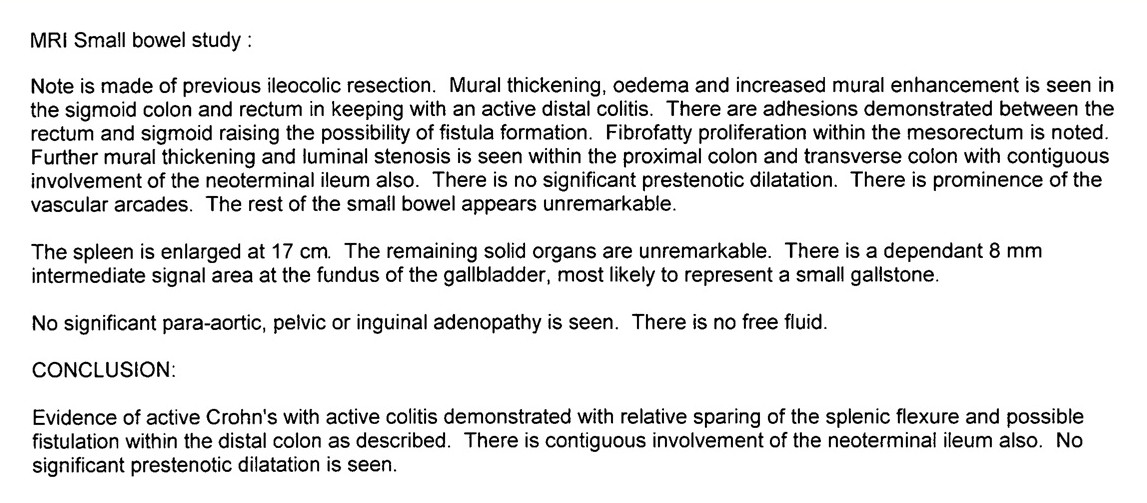
I went through my list of queries starting with the big one: “what did the MRI scan in April show?” He replied that contrary to the colonoscopy, that he had carried out just before Christmas, this test appeared to show that the inflammation had returned to both my small and large intestines. Naturally I was disappointed as I wasn’t expecting that outcome. I wondered why I was feeling no pain apart from the area around my operation scar. We weighed up the options for medication to combat this return of Crohn’s disease and decided that I would go back onto steroids, in the form of Budesonide, once the results of a blood test were known.
(I only obtained a copy of the MRI report in 2015 and it did not make comfortable reading with mentions of adhesions and fistulas. If it wasn’t for the reference to the enlarged spleen I could almost think that the radiologist had been looking at someone else’s scan.)
We went on to discuss my experience of passing a jet black liquid from my back end. He asked me to get a sample for analysis ,which I thought would be easy, but no luck. He also asked me to book a repeat colonoscopy to verify the results of the MRI scan. I went off to get a date and was surprised to be offered one on 6th June, just two weeks away. I needed to collect the necessary bowel preparation and that involved another long wait, this time to see the endoscopy nurse.
Eventually I was homeward bound and, by now, the day had become very hot. By the time I arrived home I was feeling exhausted and went to have a lie down to recover. Around six o’clock I started to feel sick so disappeared into the toilet and then it happened….
I brought up a large amount of what looked like redcurrant jelly but was clearly freshly congealed blood. I must have gone into shock and just sat there looking at the mess for a few minutes, thinking “What do I do now?” (Not like me at all. I usually react quickly to these little set backs, decide the best action to take and get on with it, but this was something I hadn’t experienced before. I will admit that for a while my brain simply froze).
When my senses returned I decided that this was definitely a 999 moment. I heard my wife coming back from feeding the ponies. I called out to her to ring for an ambulance. She made the call and I could hear her responding to the long series of questions that you then get asked by the operator. The decision to send an ambulance was made and my wife then hurried to put some things into an overnight bag before the ambulance pulled up our driveway. She hadn’t quite finished as it arrived. Five minutes from call to arrival. When she opened the door she recognised the paramedics as the ones who had taken me into hospital the last time we had reason to call 999. They came in to see what state I was in, took one look at the blood covering the floor and told me that it was only a small amount! It didn’t look like it to me.
I was loaded into the ambulance and then went through various tests before we set off. They were obviously concerned that my blood pressure was very low. They put me on a drip and the driver said: “I think we’ll go for the siren”.
A few minutes later we arrived at East Surrey Hospital. I was taken into the A&E assessment area and immediately seen by a doctor to make sure I was stable. Over the next hour I was seen by two further doctors who would decide the best ward to send me to. One of them said “we need to take a blood sample”. OK. “…but in needs to be taken from an artery”. OK. He then added, helpfully, “many patients find these tests very painful, I’m sorry”. Luckily I felt nothing.
The decision was made to send me to the Medical Assessment Unit (MAU) for further examination and two units of blood. Each time I saw a new doctor they wanted to run through my medical history. It was at this point I realised how useful a universally accessible, NHS wide record system would be.
Now that I was stable and had made it to a ward there seemed little point in my wife staying. I had spent long enough in hospital environments to be perfectly happy to cope on my own. My sister had turned up to give her a lift. We said our goodbyes and she returned home to clear up the blood from the floor. I’m so lucky to have someone tough enough to support me when things are going messily wrong. As she always points out: “Women get all the good jobs”.
Back in the hospital they decided to move me to the gastroenterology ward so I was wheeled off to this new location where I was seen by the duty doctor and, guess what, she wanted to run through my medical history! She then made sure I was comfortable and worked out what drips were needed.
Tuesday 29th May 2012 – The rest of the night was spent undergoing regular checks on my blood pressure and temperature. I didn’t get much sleep but was just happy to be in the best place given my recent experience. The ward was in the new section of the hospital and had only been open for three months.
It was arranged in four-bed bays. Each bed had its own entertainment unit giving free access to TV, Radio, Internet and local phone calls. At St.Thomas’ they charged for the services but there was the advantage of the spectacular views over the River Thames. Anyone who was in there during the forthcoming Queen’s Diamond Jubilee weekend would have had a grandstand view of the River Procession rather than the car park and brick wall at East Surrey.
I quickly discovered that Charlwood Ward was close to the nurses’ accommodation block. I can guess where your thoughts are leading at this point but my joy was triggered by having unlocked access to their wi-fi.
In one of the other bays there was a patient suffering from extreme cerebral palsy and spent a lot of his waking hours making loud, involuntary grunts and screams. The way the nurses treated him was amazing, trying to make him as comfortable as possible.
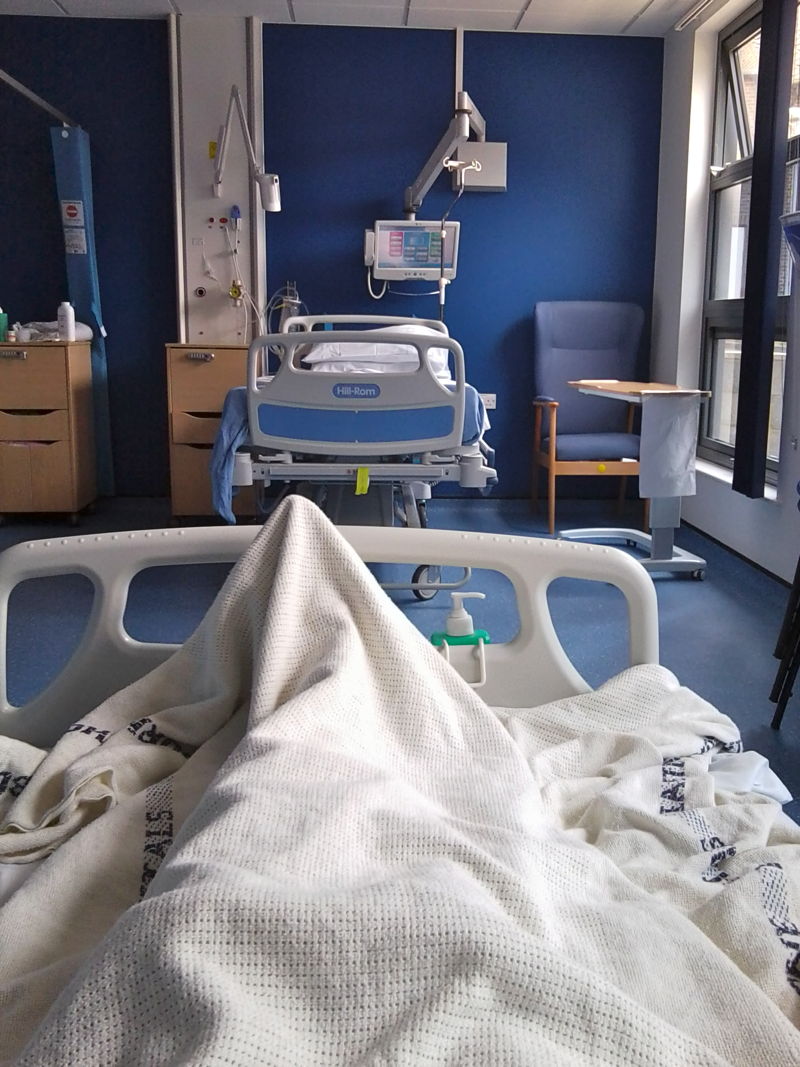
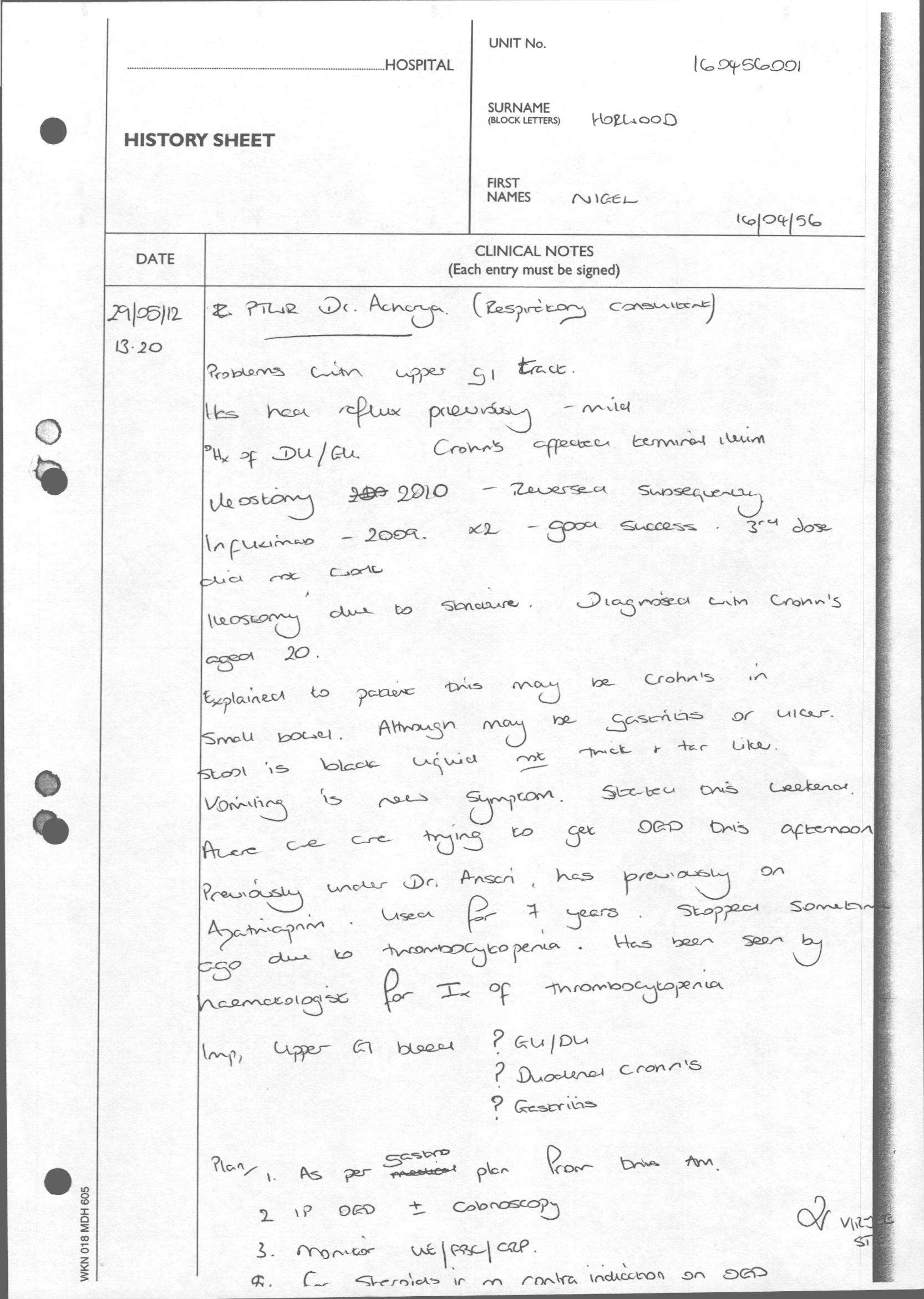
During the day I saw various doctors who were trying to decide the cause of the problem and which tests I should undergo. Their initial thoughts were that my Crohn’s could have started up in my small intestine or that it could be gastritis or even an ulcer that had burst. The immediate priority was to have a camera down my throat (an OGD – oesophago-gastro-duodenoscopy) to see where all that blood had come from and, depending upon the result, follow up with a colonoscopy. They tried to get me onto that day’s endoscopy list so I wasn’t allowed to eat anything.
Unfortunately an emergency case took priority and at six o’clock I was told that I could eat some supper. The doctor was very surprised at how calmly I reacted to not having the test done that day. She said that she wouldn’t have been so laid back. I can only think that my attitude was driven by realising that I was in the best place if I were to suffer from further blood loss, and that an extra day in a “safe” environment should not be seen as a problem.
In hindsight I would have thought that being brought into A&E by ambulance; with its siren blaring; having lost a large quantity of blood; and with an Hb of 6.5, would itself have been classed as an emergency case.
It was decided that I needed to have a transfusion to bring my blood count to a safe level. A second drip was added and fed into the cannula in my left arm.
A cannula can be inserted anywhere there is a good vein so is usually placed in the back of the hand or the forearm at the wrist or even further up, close to the elbow. My one had been inserted in such a way that if I bent my arm it closed off the flow. The regulating pump saw this as an obstruction and set off an alarm. I spent most of the day forgetting to keep my arm straight which in turn lead to the alarm sounding and the nurses having to reset it each time.
Wednesday 30th May 2012 – I didn’t get a good night’s sleep as the patient with cerebral palsy had a very disturbed night and the nurses had left his radio on to try to settle him. I will admit that the lack of sleep and the constant noise does lead one to some very dark thoughts and left me questioning the morality of sustaining life in some situations. I think that’s enough said on that subject.
To try to alleviate the boredom I started reading the one book I had managed to bring with me from home : “Freddie Mercury – The Definitive Biography”. I’d been a Queen fan for many years and had seen them in concert a number of times so this book proved particularly interesting.

When the doctors turned up for the ward round I asked them to ensure that I was on that day’s endoscopy list and that, whilst I had accepted that yesterday’s cancellation was due to circumstances beyond anyone’s control, I wouldn’t be so relaxed again. I was back to being “Nil by Mouth”. The blood transfusion had brought my blood count up to 8.6, still low but improving.
One of the doctors noticed the book I was reading and said that her maternal aunt went out with Freddie Mercury before he moved to England. That sparked an interesting discussion before we started talking about my situation.
I had learned from previous experience that it is important to make a list of any questions you want answered. I had written down a dozen or so items and we went through them one by one. The answers to many of them would depend upon the outcome of the endoscopy and she also wanted to discuss some issues with the consultant. As luck would have it he appeared and I was able to ask him what the prognosis was. Again it would really come down to what the ‘scope showed.
Just after noon I was wheeled down to the endoscopy unit, adjacent to the ward, and into the new waiting area. When I entered the procedure room the doctor asked if I’d had a gastroscopy before. I replied: “about 12 years ago“, to which he responded: “you’ll be pleased to know that the tubes have got smaller and the drugs more powerful“.
There were the usual risks to run through before signing the consent form. The main ones being perforation of the gullet and bleeding. With the paperwork out of the way the procedure could start. I didn’t take in much of what was happening and the next thing I knew was waking up ready to be wheeled back to the ward. I couldn’t feel where the tube had been passed down my throat. Definitely an improvement over my previous experience.
Back onto the ward and the wait to find out what the gastroscopy had revealed…..and another disturbed night.
Thursday 31st May 2012 – in the morning came the good news that the noisy patient had now completed his treatment and was being discharged that day. It may sound terrible but it was a great relief as the constant noise was really stressing the other patients and probably the nurses. It was not conducive to everyone else’s recovery.
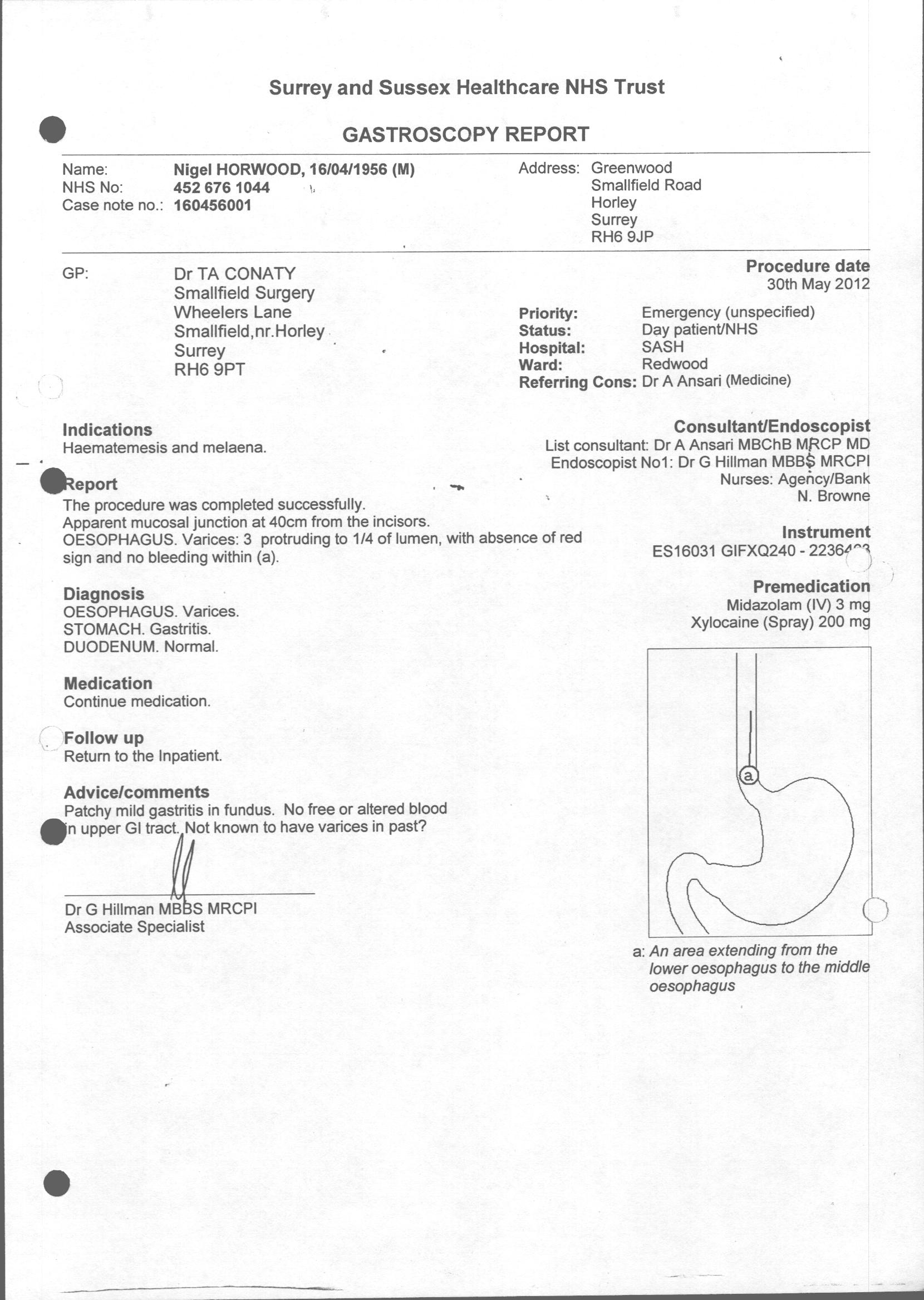
As ten o’clock approached it was my turn to talk to the doctors on the ward round. They were expecting the gastroscopy to have shown that I had an ulcer, which had burst, or that the Crohn’s inflammation had spread. What they found surprised them – oesophageal varices. Prominent veins growing in the lower third of my esophagus and usually related to alcoholism! I looked the issue up on the internet and found that there is a possible link with the azathioprine drug that I had been on for many years.
The next step would be to have an ultrasound scan to look at my liver so they could rule out portal vein thrombosis. Portal Vein what? The doctor explained that a clot forms in the main vessel carrying blood from the gastro-intestinal tract, gallbladder, pancreas and spleen to the liver. The body compensates for the blockage by growing new veins to relieve the pressure and these may appear in the esophagus. They were hoping that the scan could be done the following day.
Not wanting to lose more time I made sure that the nurses knew I was expecting to have the ultrasound that day, not the following one. It worked. They gave me lunch early as I was on the list for the scan at 6:30pm.
Meanwhile one of the registrars spoke to my consultant at St.Thomas’ to appraise him of the situation and sound him out regarding starting steroids should it turn out that Crohn’s had re-emerged. He explained to the registrar that he had planned to carry out another colonoscopy before making that decision and wondered whether the suspected liver damage could be due to the azathioprine. That drug, potentially, has a lot to answer for.
As usual the nurses were tremendous. It wouldn’t be fair to name them but one came in to see us in the early afternoon to check that our ward was OK and she looked very upset. She said that it had been a hard day as one of her patients had suffered a heart attack from which they did o’t recover. Even after all her years of nursing she had to go outside and have a cry.
I had also been reacquainted with the IBD Nurse that I knew from before my surgery. She had now relinquished her role, and returned to being a nursing sister, in an attempt to regain some private life as the growth in the number of IBD patients had become unmanageable. It was nice to see a friendly face and a kindred spirit.
At a quarter past six the porter turned up to wheel me down to ultrasound. I was happy to walk but he had a chair so I got onboard and off we went with him singing away and saying hello to everyone we encountered, all of whom he seemed to know personally. We even passed a pregnant woman to whom he commented: “it’s a girl, luv“. When we got down to the ultrasound area there were two women waiting. He left me in a position so that I was facing them and said: “I’m sure you’re man enough to handle two women” then promptly disappeared. At least it broke the ice and we all saw the funny side of the situation.
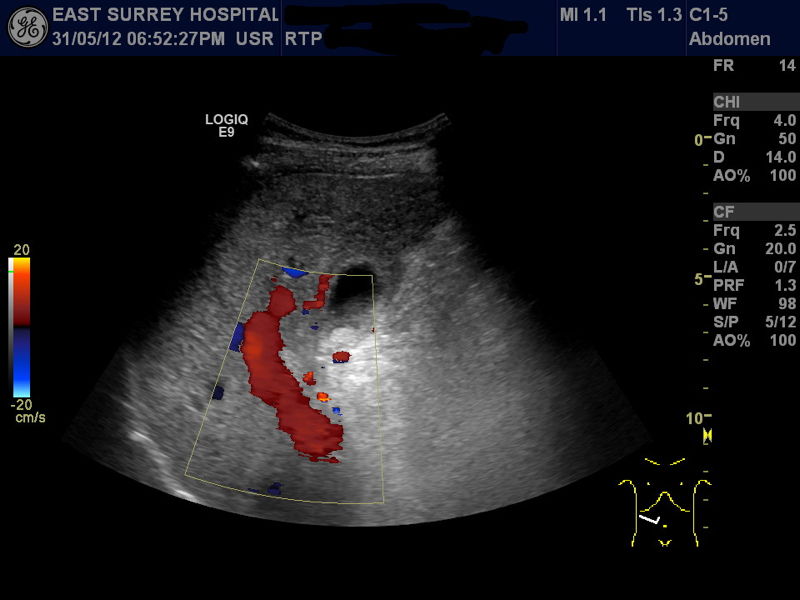
It was soon my turn to go into the scanning room. After a few minutes’ I was laying on a table, covered in lubricating jelly with a scanning head being run all over my body. (I’m sure some people would pay good money for that. Imagine the cost in the West End of London). The scan was expected to show some damage to my liver but didn’t appear to. I would need to wait until I saw the doctor to go through the full results, in the meantime I could to return to the ward. Visiting time was due to start in five minutes. I hung around for a while waiting for the porter to reappear but there was no sign of him. The X-ray nurse took pity on me and said I could walk back, taking my notes with me.
It meant that I had some much-needed exercise and was back in my bed for when my wife turned up. It wasn’t the last time I saw that porter. When visiting time came to an end we walked down to the entrance to find my sister and young nephew waiting. He was only eleven and petrified of hospitals. It was an emotion I knew so well at his age. My sister was keen that he should at least set foot inside the entrance. Just then I caught sight of the porter and he came over. He asked me if I had been able to “handle” the two women. It was a good thing that I had already told my wife about this or there might have been some awkward questions! I explained that my nephew didn’t like hospitals. He put his hand on his shoulder and said: “you don’t want to worry about hospitals, son, especially dead people! Anyone might go to sleep tonight and not wake up“.
We all looked at each other in amazement. Were we really hearing this? Luckily my nephew took it in his stride and the porter waved goodbye. I’m pleased to say that this comment had a positive effect, believe it or not, and my nephew said that he would be prepared to come all the way down to the ward next time.
Friday 1st June 2012 – with the extended Queen’s Diamond Jubilee holiday weekend nearly upon us I knew everything would go into limbo. Staving off the boredom was going to be difficult. I asked if I could at least spend Sunday at home to watch the Jubilee River Procession on television and had been told there shouldn’t be any reason not to.
At weekends there was a team of doctors that covered the wards but only saw patients that were causing concern. Already there was a much-reduced number of doctors on the daily ward round. When they arrived at my bed I asked what the ultrasound scan had shown. There was slight splenomegaly (enlargement of the spleen), a 14mm gallstone but no hepatic or portal thrombosis. The doctor’s notes finished up with: “Explained to patient unknown cause for liver issues. We need to further investigate”.
Some time previously I joined the, now defunct, UK Crohn’s Forum. One of the moderators lived locally and had suggested we had a coffee and a chance to “moan about Crohn’s”. We had met up a couple of Fridays previously and got on very well. When I was taken into hospital this time I posted on the Forum that things hadn’t quite gone to plan and that I had ended up in East Surrey Hospital. He contacted me to say he would like to come in for a visit. It would make a nice break from the boredom.
Mid-afternoon he arrived bearing gifts – chocolates, a newspaper and a copy of Private Eye. It was much appreciated and we spent a good couple of hours chatting. I think he was impressed by the ward and the staff. It’s always nice to make new acquaintances even if the circumstances are less than ideal.
After my visitor had left one of the doctors came to see me. I told him that I was planning to spend Sunday at home. He was concerned that my blood count had decreased to 8.0. The decision on being allowed home for the day would be made tomorrow when the next set of blood test results were available. I pointed out to him that there would only be a skeleton staff of doctors on duty and asked if they would have time to check my results. He wasn’t sure. When my wife turned up in the evening I had to tell her that our plan for Sunday was in jeopardy.
Saturday 2nd June 2012 – I had my blood sample taken as usual but never saw a doctor. I remarked to the sister that there was some doubt as to whether I would be spending Sunday at home. She replied that there was no reason to stop me and that some doctors always “dithered”. My day of freedom was back on.
In the afternoon my oldest friend, who had been my best man, came in to see me. We spent the time putting the world to rights and reminiscing about the time we spent, during school holidays, working in Earlswood mental hospital to raise the money to buy amplifiers and a drum kit for our fledgling group.
Working there clearly had a lasting impression on us as, 40 years on, we could still remember some of the patients, including two members of the Royal Family. We worked in the kitchens and our first task each day was to sweep up the poisoned, half dead, writhing cockroaches!
The hospital stood a few hundred metres from where I was currently lying. The patients were long gone and the buildings had been converted into posh flats and apartments.
Sunday 3rd June 2012 – the plan was for my sister to pick me up at ten but then I realised that I would have to get blood samples taken beforehand and being a Sunday the “vampire” round might be later than usual. Fortunately I was wrong. The phlebotomist turned up, took some blood and I was allowed home.
The afternoon was spent watching the Queen’s Jubilee River Pageant which I had originally thought we might go up to see. I know that the weather didn’t help but I found the whole event rather underwhelming and far too drawn out, rather like the BBC’s coverage. It was nice to spend a few hours at home with my wife. Our dog seemed pleased to see me, as well, and I even got to fill the haynets and make up the dinners for the ponies.
When I returned to the hospital, dinner was being served – “pasty dans une mer haricot” or pasty and beans. Crohn’s patients are supposed to avoid high fibre foods but it looked very appetising and the ward was well ventilated so I thought “what the hell” and enjoyed every mouthful.
Monday 4th June 2012 – Spring Bank Holiday – the limbo continued and I discovered that I could have spent another day at home.
The phlebotomists did their usual rounds but again I didn’t see any doctors. The sister said that they would be doing a full ward round the following day which meant I had plenty of time to get a list of questions together in readiness.
My sister, her husband and nephew came to visit in the afternoon. Having not been put off by his recent encounter with the porter he made it all the way to the ward. When it was time for them to leave I walked down to the hospital entrance but on the way back felt wobbly so clearly I was not ready for discharge yet.
My evening was spent watching the Jubilee Concert. We had applied for tickets in the ballot and would have been disappointed if, having been successful, had then needed to cancel. As it turned out the concert left me distinctly uninspired and wondering if certain performers might be past their best before dates.
Tuesday 5th June 2012 – The Queen’s Diamond Jubilee – I didn’t get a particularly good night’s sleep as the patient next to me had his overbed light on all night. I couldn’t be bothered to get it switched off. I knew that whatever sleep I had missed could be made up for during the day. There was always a lull in Ward activity after the beds have been made and before lunch was served. By having a shower as soon as the fresh towels were available I could keep out of the way of the nurses. When they had finished there would be a nice, fresh bed to doze in.
I suspected that at some point I would meet my former consultant. That’s the one I had emailed, about a year ago, telling him that I was now being treated by St.Thomas’ and not to bother to make any further appointments. I had a very good reason for doing this and subsequently found the chain of email correspondence that backed up my account.
I’m not going to go into all the details of this encounter but suffice to say that initially he would not look me in the eye and my decision was clearly still bugging him. The atmosphere could be cut with a knife. I reiterated my original reason for leaving his care and this may not have helped the situation. (His point of view was recorded by one of the junior doctors in the ward notes). At one point he suggested that maybe it would be best for me to be put in an ambulance and sent straight up to St.Thomas’. When I had taken the decision to move hospital it had not been done lightly. It was far easier to get to the local hospital, just 10 minutes from home, than to catch a train to London but now I was more convinced than ever that I had made the right choice.
At the end of a long and detailed discussion on what may have caused my current situation, and whilst the junior doctors listened on, we ended up agreeing that we should do what was best for my long-term health and shook hands. Subject closed. It was time to move onto the tests required and the best place to have them carried out. Clearly I was not in a position to think about discharge yet.
The recurring terms he used were primary sclerosing cholangitis (PSC) and portal hypertension. He thought that they were symptoms of a malfunctioning immune system and also linked to my thrombocytopenia (low platelet count) and enlarged spleen. Previously we thought that the platelets issue had been brought on by the azathioprine but he was now sceptical at this. There was then mention of needing a liver transplant. My ears switched off at that point and my brain went into overdrive. Internally I was saying to myself. Liver transplant? Liver transplant?? What would that involve? Wasn’t there usually a waiting list? More major surgery? Would my body cope? How soon? Liver transplant? Anything else I was told simply wasn’t being absorbed.
After the ward round was complete I called one of the junior doctors over and asked: “how do you spell that primary thing the consultant mentioned as I want to look it up on the internet”. She replied that it might not be a good idea at present. I decided to take her advice but happened to mention it to my sister who immediately researched it and rang back. It was all a little scary (understatement). The simple definition of PSC was a chronic disorder of the liver, of uncertain cause, in which the bile ducts within and outside become inflamed, thickened, scarred, and obstructed.
Ultimately, if it was diagnosed, the long term prognosis was the liver transplant he mentioned! The only way of getting a definite diagnosis would be to carry out a biopsy which would involve passing a long needle between two ribs into the liver and taking a core.
I don’t even remember discussing where the tests or subsequent treatment should be carried out. My head was filled with so many other thoughts by then. Fortunately the doctor’s notes record that, due to the complex nature of my Crohn’s, I would be better off remaining under St.Thomas’ who had more extensive facilities. They were also equipped to investigate my latest problem. I would revisit that subject the next morning during the ward round.
I try to keep a cool head at all times so it didn’t take long before I started to rationalise the information I had just been given but a little voice at the back of my head kept saying: “you’re only keeping calm because you don’t understand the full implications of what you’ve been told“. When I caught sight of the former IBD Nurse I asked her if she could answer some questions, including translating all the long words the consultant had used. She could tell that nobody had ever sat down and gone through some of the basic concepts of Crohn’s and their implications.
I thought about this later. She had hit the nail on the head. It was one of her many skills, which included an encyclopaedic, some said Wikipaedic, knowledge of medical terms and conditions.
No one had ever talked through the bigger Crohn’s picture. For years I thought it was simply an inflammation that caused diarrhoea and pain, controlled by taking steroids. Some years later I ended up with a stricture so I was then aware of another possible complication. The 2009 CT scan had introduced me to the concept of fistulas and having a stoma. It would be good to be able to spend some time talking this through with a specialist and understanding other possible symptoms. Ultimately I wanted to get a clear understanding of the likely effect on my potential quality of life and life expectancy. I could then use the information to decide when to retire. Would it be best to talk to an actuary?
Back in the ward it was decided that I should be given another two units of blood. Since I hadn’t had any for a week another crossmatch was needed as they only last seven days. It was all part of ensuring I ended up with the right blood type.
One of the young doctors said he would insert a cannula so that he could take the blood sample and then use it for the transfusion. I asked him, in all seriousness, if he was an expert with cannulas. He replied that they were one of his routine tasks. My previous experience had always been if you want it done properly ask a nurse. I wasn’t wrong. He took three attempts to get a needle into my right arm. The third attempt resulted in a working cannula but it was in a very small vein and close to my hand. Very inconvenient when eating or reading.
Later in the afternoon the first unit of blood was delivered to the ward. The nurse connected up the pump and switched on. It hurt. She decided that I would be better off having a new cannula put into my left arm. Without any fuss or need for a second attempt she inserted it in just the right position, reconnected the blood and removed the old one. From this experience I formulated my first law of cannulation – “Don’t let a doctor anywhere near a cannula!”.
In the evening my wife came to visit. I had already rung her in the morning and told her the potential diagnosis so she had a number of questions. When the former IBD nurse came into the ward we called her over and my wife was able to ask some of the things she had thought of during the day. It was great that she had this opportunity as I didn’t have many of the answers.
Wednesday 6th June 2012 – it must have been the quietest night so far on the ward. I slept until about 3am but then lay awake for several hours. The phlebotomist turned up after breakfast, to take more blood samples. She was followed by the registrar and junior doctors on their round. I had quickly made a list of things to ask them – the top question was “plan for escape”.
I was somewhat taken aback when the registrar said that as long as today’s blood test showed an Hb higher than 10 then I could go home, today. I really hadn’t been expecting that. I had told everyone I was in until at least the weekend or possibly would be transferred to St.Thomas’. I now had to wait until around one o’clock for my score.
I discussed various things with the registrar, including revisiting what the gastroscopy and ultrasound tests had shown. For my long term care they were suggesting that I remained under St.Thomas’ and would be liaising with my consultant there to make sure the necessary test results were passed over. One of the junior doctors had been tasked with making this contact.
I rang my wife and then my sister to arrange to be picked up in case the result of my blood test was high enough. I then decided to contact St.Thomas’ to make sure they were aware of what was going on and to ask if I should start taking the budesonide that I had been due to commence. I emailed my consultant’s secretary and received a prompt reply telling me that the dialogue between the two hospitals had started and to hold off the budesonide for the time being.
I didn’t want to tempt fate so didn’t change into my going home clothes. Just after lunch I had the good news, escape imminent. I just needed Pharmacy to sort out my medication and for the doctors to write my discharge letter. I thought: “that can only take a short while”. How wrong I was. If I had known the previous day that release was imminent I would have found the pharmacist and ensured that sufficient quantities of the drugs, with the right labels on, were ready for me. I started to wonder if they deliberately chose to employ the slowest of the slow. Could the criteria for getting the job be turning up late for the interview?
I kept making trips out to the ward reception desk to see if the drugs had arrived. By four o’clock my frustration was getting the better of me and then I caught sight of the pharmacist. Had she got my drugs? No. She had just started going through them. When I told her that I was waiting to go home and it all revolved around her she said that it wouldn’t be much longer, probably another 90 minutes because a porter had to go down to Pharmacy to collect them! I retired back to the ward before I strangled someone. When I asked the sister if anything could be done to speed up the process she said: “basically, no” and admitted that she had been avoiding me as I had started huffing and puffing. Wise move!
By five o’clock I decided I would wait by the reception desk until the drugs appeared. Another half hour went by. One of the other sisters took pity on me and personally walked down to the Pharmacy. A few minutes later she came back with the drugs. I thanked her profusely and then all that was left was the discharge letter. That only took five minutes and I was done.
I finally got away at around six o’clock. It took close to five hours to get the drugs out of Pharmacy. If I had known it would take that long I would have gone home and returned later. I try and avoid “wound up” but this was an exception.
I was now resigned to yet another string of appointments and procedures to try and get to the bottom of my latest crisis. Was a liver transplant a real possibility?
Rising to the challenge
During the long wait for my medication I did at least achieve something that would make my wife proud. I took the long standing challenge she had set me – to ask one of the doctors what the “bleeding time” was. (Another reference to the scene from the film “Doctor in the House” that I mentioned in an earlier chapter).
I was standing at the ward reception desk when I saw my opportunity. One of the doctors that had been treating me appeared. I asked her a few questions then slipped in the “what’s the bleeding time?” She said it depends on your platelet count to which I replied that the clock behind her said twenty past five.
A sense of humour doesn’t seem to be one of the prerequisites for becoming a doctor nowadays. My witty comment went completely unnoticed but at least I tried and I’m treating it as a brave first attempt.