
As part of the checking process for this book I re-read my old blog posts to make sure I hadn’t missed anything important and to look for any loose ends. One comment in particular, made by one of the surgeons several weeks after the ileostomy, piqued my interest. He remarked on how well I looked considering: “what they had done to me”. That sounded intriguing He had gone on to describe the operation as a “classic” and one of the “most complex they had ever carried out”. (see Chapter 8)
Reading these words made me emotional, and still does, as it brings home just what Crohn’s Disease can put us through, even though I tend to make light of it, and know that I have escaped relatively easily compared to many. It shows the skill of that surgical team who wrestled the octopus and won, leaving me to enjoy a prolonged spell of remission.
The ileostomy was the most significant event in my medical story and sowed the seeds for writing this whole narrative. It was a major milestone and a life-changing, fascinating experience. I was curious to understand exactly what they were confronted with when they opened me up and why the operation was considered so complex.
I started by re-reading the letter written by the lead surgeon on my discharge.
“He underwent laparotomy, ileocaecal excision of locally perforated Crohn’s mass/stricture and excision of enter-enteric fistula. The intra-operative findings were of chronic small bowel obstruction due to terminal ileal stricture/inflammatory mass. There was gross right para-colic and midline fibrosis with terminal ileum drawn into a chronic abscess/fibrosis. An inflammatory mass was fistulating into a more proximal ileal loop, closely adherent to the recto-sigmoid colon. There was a redundant long sigmoid loop in the pelvis. Given the severe ongoing inflammation, partial chronic obstruction/oedema and localised perforation n the lower abdomen/pelvis, a primary anastomosis of the bowel was contra-indicated. This risk had previously been discussed with the patient.
A double barrelled ileo-colostomy was formed in the right iliac fossa. In the post-operative period the patient remained stable and made good progress with feeding and mobilisation. Post-operative anaemia was treated with blood transfusion and high stoma output was managed by electrolyte replacement.“
The letter helped but what I really needed was some input from one of the surgeons. I wondered if they kept their own records of the surgeries they carried out. The lead surgeon had left the NHS so I decided to email the “guest” surgeon who now worked at my local hospital. He replied that if I could obtain a copy of the Operation Note from St.Thomas’ he would be happy to translate it into layman’s terms.
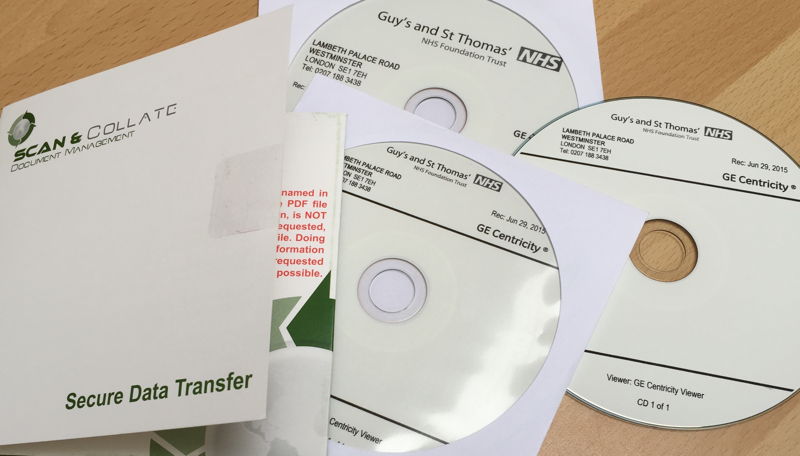
That was the trigger I needed to obtain copies of all my GSTT records. After filling in the necessary request form, and paying the fee, I received a message that they were ready for collection from the Information Governance Department. There were 4 CDs in the packet.
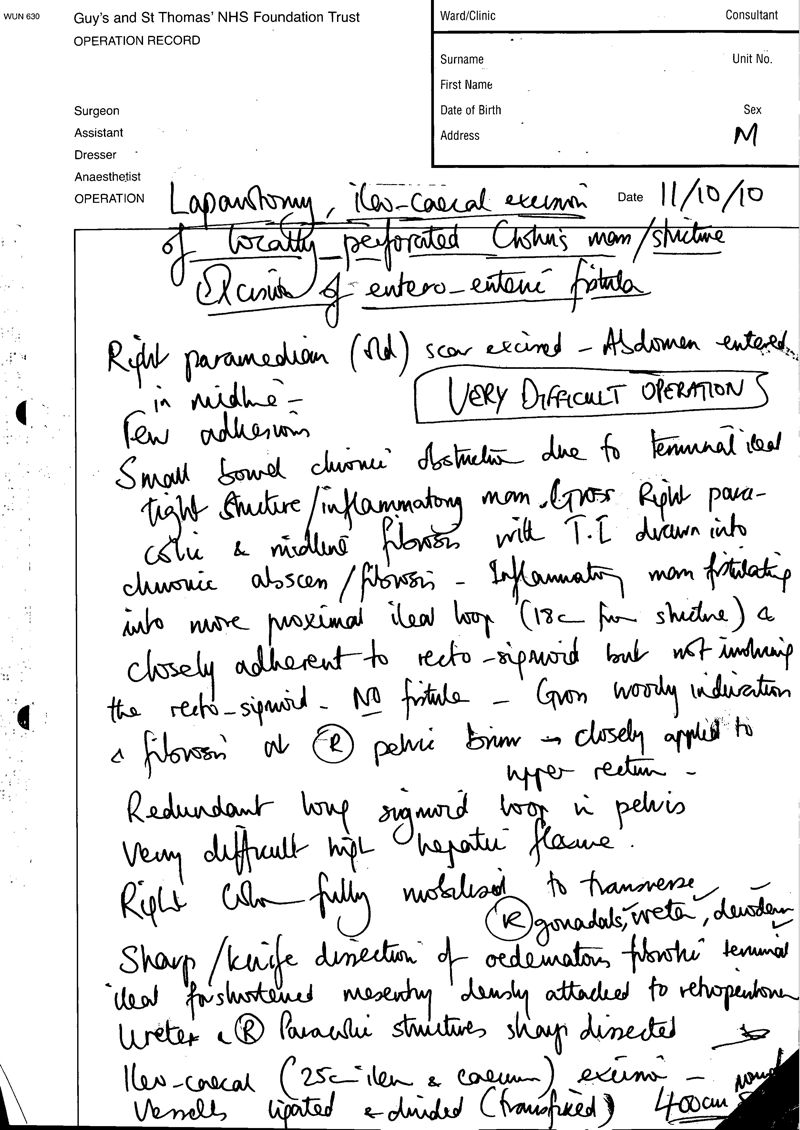
One contained scanned images of the hand-written or typed medical records. Amongst more than 700 pages I found the handwritten Operation Note together with a pathology report on the tissue that had been removed – 140mm of intestine including the terminal ileum and ileocaecal valve. Why did the removal of such a small section take so long? The pathologist’s report made it clear that the Crohn’s inflammation had caused a great deal of damage.
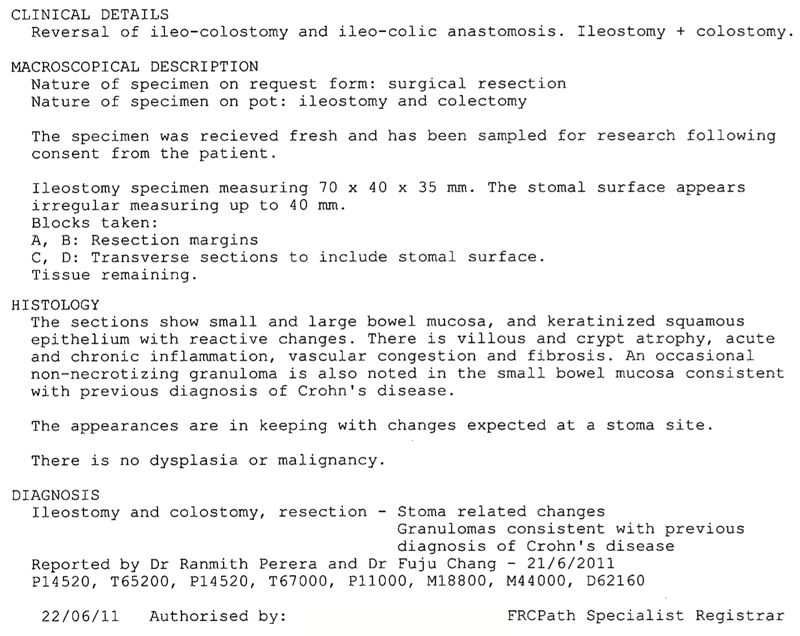
I hadn’t realised that it was routine to send the tissue to the pathology lab to check for cancer. The result, negative, was relayed back to the anaesthetist within minutes.
I sent copies of the two reports to the surgeon and the next morning received the following response :
“Thank you for your last email. I have translated the operation note into a drawing as best I can, but you’ll appreciate that this is not from memory!
From the pathology report the measured specimen was 140mm between the two cut ends and the length of the stricture/mass causing all the trouble was 85mm. In the op note it states that 25cm of ileum was resected, but this shrinks in the formalin during preparation for pathological assessment.
Particularly with fistulating Crohns’ masses the normal tissue planes are lost and layers of tissue which would normally separate easily become very fibrosed and need very careful sharp dissection to safely free things that need removing from the critical anatomy to be left behind (gonadal vessels, which is the blood supply to the testes, ureters and the duodenum for instance)”.

The drawing enabled me to visualise the challenge the surgeons faced and, finally, I understood the comment “one of the most complex operations”. Whilst the stricture itself was relatively small, the Crohn’s mass, that had built up around it, was adhering to surrounding tissue, causing it to fuse together. It had even attached itself to my back muscles which accounted for the pain I was getting in that area. The surgical team’s skill was separating the bad from the good without damaging vital blood supplies and muscles.
Piecing it all together
For the first 30 years plotting my medical history would have been a simple timeline recording the varying types and dosages of the drugs I was taking and showing periods of flare-ups. The complications started in 2008 when thrombocytopenia was added into the equation. More conditions followed and so did the explanations at consultant’s appointments.
When I had assembled the full set of medical records my initial reaction was “information overload”. What could I do with this huge quantity of very detailed medical data? I methodically sorted it by type and date order, picking out the “interesting bits”. (It was fascinating to read the ward notes as they were not usually documents that you got to see.)
I wanted to understand how the various conditions related to each other. As someone who had spent much of their career communicating using diagrams it seemed like the ideal medium for the problem and using the jigsaw metaphor very relevant. The diagram has been constantly refined and now enables me to represent 40 plus years of medical history on a single page.
Having produced the diagram for my own benefit it then struck me that it could prove useful when meeting a new consultant or surgeon as it would enable them to quickly get an overview of the patient who was sitting in front of them without having to plough through reams of medical notes.

