
Tuesday 19th June 1979 – I started getting terrible pain in my lower abdomen, right hand side. It became progressively worse until it was unbearable. By late morning the pain had reached such a level that my mother called 999. When the ambulance arrived the crew suspected that I was suffering from appendicitis. We sped down the main Brighton Road through Purley and on to West Croydon. I was expecting to go to Mayday again but this time it was Croydon General Hospital. My first trip in an ambulance and with the added bonus of “blues and twos” – flashing lights and two tone siren.
My biggest fear had been realised. I was heading to hospital, almost certainly to go under the knife. I thought about the alternative – refuse to have the operation, discharge myself and, quite simply, die. At that point I knew I really didn’t have a choice and that I must accept my fate without trying to fight it – the first time I had been confronted by my own mortality. I decided that it would be easier if I made the experience as stress-free as possible. That was a turning point in my life and has governed how I have since survived numerous visits to hospital, for appointments, procedures or longer stays. Focus on a positive point in the future, beyond your current situation, then suspend normality and adjust your behaviour and attitudes to fit with the regime you find yourself in.
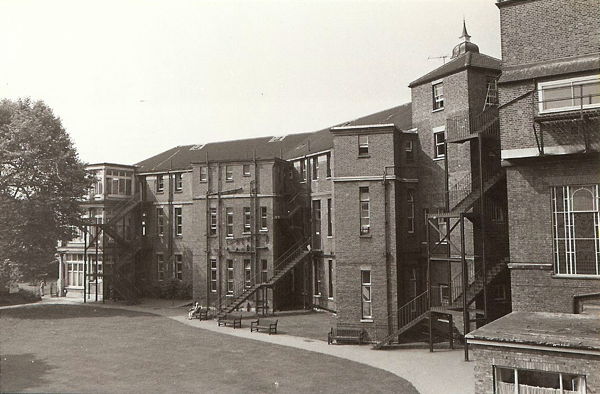
I was admitted to Princess Alexandra of Kent Ward at lunchtime but can recall little about the preparation for the operation other than one experience that sticks in my mind.
[Before we go any further I’d like to call a time-out whilst I work out how to explain the following without straying into the realms of political incorrectness. Describing someone, of whichever sex, as young and pretty was perfectly acceptable then.]
An attractive (pretty), student (about my age) nurse appeared with a bowl of warm water, shaving foam and a razor. She (a female nurse in this instance) told me: “You need to be shaved before your operation“. I realised that being so unwell I looked a mess, with quite a stubble growing, but couldn’t work out how smartening me up was going to help. Whatever. If they wanted me to look better that would be OK. Then I realised that it wasn’t my face she was going to shave. Suddenly I had something to take my mind off of the pain and the imminent operation. I might have been feeling very poorly but I was sure something would start “stirring in my loins”. I thought it best to confront the situation head on, so to speak, and asked the attractive, student nurse what would happen if something “popped up”. She produced a biro from her top pocket and said: “a short, sharp tap with this usually solves the problem”. The threat was enough to ensure good behaviour.
At 6:15pm the pre-meds were administered and an hour later I was put on a trolley ready to go down to theatre. My sister had rung my girlfriend to say that I had been admitted to hospital. Making her way down to the ward she arrived to see me being wheeled past her on the trolley and genuinely thought that it would be the last time she saw me.
I was taken into the anaesthetic area. The anaesthetist introduced himself and explained what he was about to do. No doubt there was a consent form to sign. As he injected the first sedative he said: “I want you to count to ten but you won’t get past three!” Yeah, right – “One, two…”
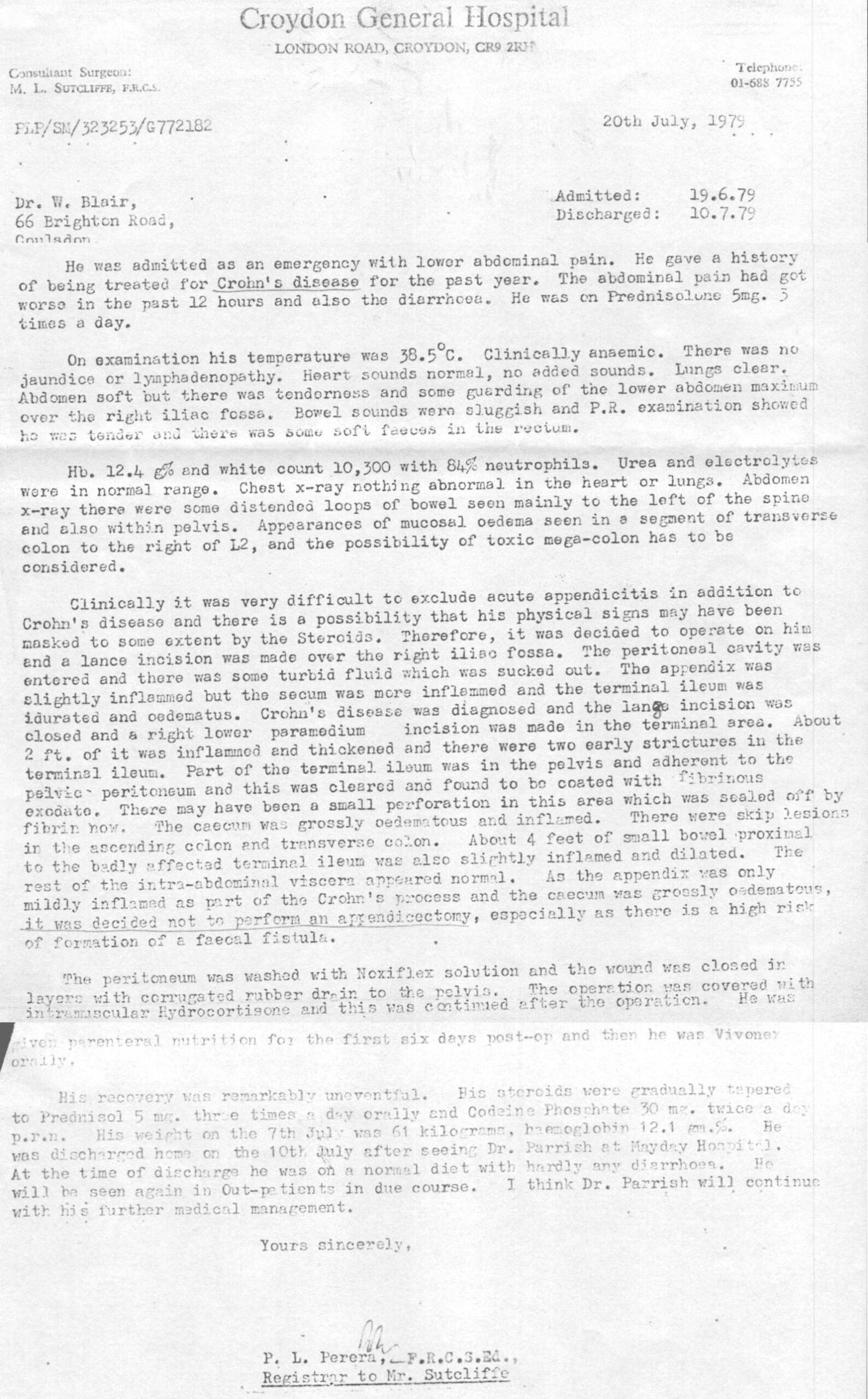
The surgeons prepared to do an appendectomy and made the first incision. I have a very neat appendix scar, about three inches long, to prove it. When they looked inside, however, they found that I had a hole in my bowel that had leaked into the abdominal cavity. The appendix was left in position as they didn’t want to risk septicaemia. A new, much larger incision was made just to the right-hand side of my navel. They sewed up my bowel and cleaned out the cavity. The implications of that perforated bowel would come back to haunt me some 30 years later.
I was returned to the ward at 9:30pm after this exploratory laparotomy. There was a “C” drain in place and a NG (nasogastric) tube on continuous drainage. What I didn’t know, until recently, was whether my large or small bowel had burst and whether a section had been removed during the operation.
In the ensuing years I had often been asked by consultants and surgeons exactly what they did to me. Having now obtained a copy of the discharge letter all the gory details were set out in black and white. (It is reproduced towards the end of this chapter.) I had always blamed the prolonged use of Imodium for causing a blockage and the subsequent perforation but with hindsight I think that is unlikely.
Wednesday 20th June 1979 – I must have been in a fair amount of pain after the operation as I was given shots of morphine. Amazing stuff and I could understand why it was taken as a recreational drug. At one point I could see a circle of blue flames floating around the ward. I asked for some more, after all how often do you get a chance of taking Class ‘A’ drugs legally and for free? I should have kept my mouth shut about the hallucinations as that was the last shot I was allowed and that wasn’t the only thing withheld.
I was to be “Fluids Only” for most of the next three weeks, fed parenteral nutrition intravenously through a PICC line (Peripherally Inserted Central Catheter). It entered at my wrist, travelled up my arm inside a vein and over my shoulder into my chest. Getting it into position was another unforgettable experience. Just seeing the apparatus would be enough to make some patients faint. I like to think that I’m made of sterner stuff so the sight of a thin plastic tube, about 800mm long, and knowing where it was due to go, was more a curiosity than a worry.
The installation process did not go smoothly. The first attempt at insertion failed so the doctor tried the other arm. Still no luck. Go back to the original arm. Nope. By now I was surrounded by a small group of doctors and nurses making “helpful” suggestions. In all it took five attempts to get the tube into the correct position. I’m amazed I haven’t been put off cannulas and needles for life but maybe once you’ve had one that long, inserted the others pale into insignificance.
Thursday 21st June 1979 – Day Two after the operation and no signs of nausea. The only significant change was being allowed to take small sips of water.
Saturday 23rd June 1979 – I was starting to turn the corner after the operation. Another bottle was added to my drip stand and an additional tube fed into the catheter. This new bottle contained an intravenous feed that was a very bright yellow colour. The nurse noted that I had spent much of the day out of bed.
The first stand they gave me had no wheels and I probably wasn’t up to getting around anyway, so my days consisted of moving between bed, bedside chair and back again. Anywhere within the radius of the drip tubes. Once I was fit enough to move around, the stationary stand was swapped for one with wheels on. I quickly learnt to propel myself across the ward for trips to the bathroom or the TV lounge, treating the stand as a skateboard.
Saturday 30th June 1979 – The restriction on drinking had been lifted on the previous Wednesday and I was free to take in as much as I felt comfortable with. I was started on Vivonex, a powder mixed with water to provide nutritional support for those with severe gastro intestinal impairment. The downside was coming out in spots as my body reacted to the high protein content.
Tethered to my drips. The rosy cheeks suggest this was post-blood transfusion
I quickly became used to the twice daily routine of hydrocortisone injections. The chosen site for these jabs was my backside. The process was : drop your pyjamas, roll on your side, jab. The day had come when the doctor, on his ward round, decided I didn’t need any more hydrocortisone as I was recovering well. Brilliant. No more pin cushion bum.

That afternoon the rest of the band came to visit and spent most of the time eyeing up the nurses. There was a lot of good-hearted banter going on. A couple of nurses decided they would show just who called the shots, literally. Half way through visiting time they came over and said: “Time for your injection”. I explained what the doctor had said but they were having none of it. They asked my friends to move away from the bed so they could pull the curtains around and then proceeded to give me instructions in very loud voices. “Drop your pyjamas. No, lower. Right, roll over. Which cheek do you want it in? OK, you’ll feel a little prick….” And the effect this had? Much laughter and inappropriate remarks from outside the curtain. The nurse’s ward notes called it a “cheerful day” and remarked that I was “uncomplaining”.
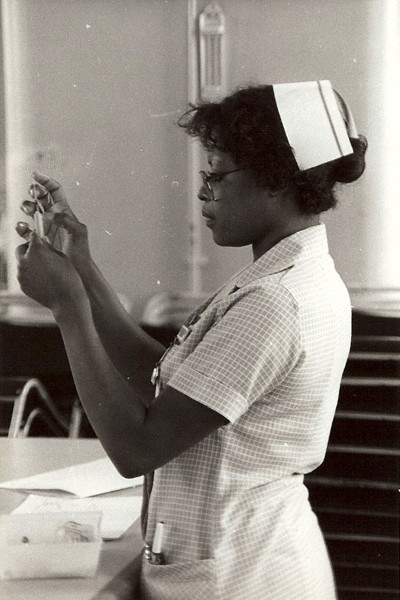
Later in the evening, once visiting time had finished, I called over one of the nurses and told her that I wasn’t joking when I said that the hydrocortisone injections were no longer needed. She just replied: “we know” and smiled broadly. I later asked if I could take her photo in her usual “I’m about to stick this needle in your backside” pose. I wonder if she’s still in nursing now.
Monday 2nd July 1979 – The lead consultant was on the ward round. He decided that the IV feeding could be stopped the following day and the Vivonex increased to six sachets daily.
Tuesday 3rd July 1979 – For the first time since 19th June I was going to be allowed a light meal that evening. My girlfriend was visiting when dinner was served, a bowl of chicken soup. Given how long it was since I had eaten I believe any food would have looked appetising but the smell coming up from the bowl was getting my tastebuds excited. As I lifted the spoon to take the first mouthful a nurse appeared and told me to stop. I was only allowed a liquid diet at this stage so she would have to take the soup away and strain out the pieces of chicken. I can laugh about it now…..
Friday 6th July 1979 – I was finally allowed to resume a normal diet. An appointment was arranged for me to see Dr. Parrish at Mayday Hospital the following Tuesday. As I was getting close to discharge it was decided that I could go home for the weekend. Quite a surprise.
Being the height of summer and with no air conditioning on the Ward the windows were often left open until the sun went down. That evening I could hear my name being called from outside, even though the Ward was on the third floor. Curiosity got the better of me. I poked my head out to see three of “my” nurses, all dressed up in their glad rags, heading off to go partying. They looked very elegant. “Just wanted to see if you’d like to join us.”
The rapport built up with the nurses certainly helped me through my time in hospital. I wonder if it was easier as a young, male patient given that I was mostly interacting with young, female nurses?
Weekend Leave – They weren’t in any hurry to discharge me from hospital. They knew that, providing I continued to make good progress, I would be going home the following week. The decision that I could have “weekend leave” was very welcome. When I returned to the Ward on the Monday morning the other patients said I had done well to be away. A guardsman from the local barracks had been brought in complaining of a bite in a very delicate place. He claimed that the wound had been inflicted by a dog to which the doctors had replied that, looking at the shape of the teeth marks, the dog must have been wearing human dentures at the time. The new patient had kept everyone up all Saturday night with his moaning and was discharged on the Sunday. I had a lucky escape.
Tuesday 10th July 1979 – Discharge day. I couldn’t go straight home in the morning as there was the appointment to see Dr. Parrish, after lunch. Once I had seen him I was free to go and finally arrived home.
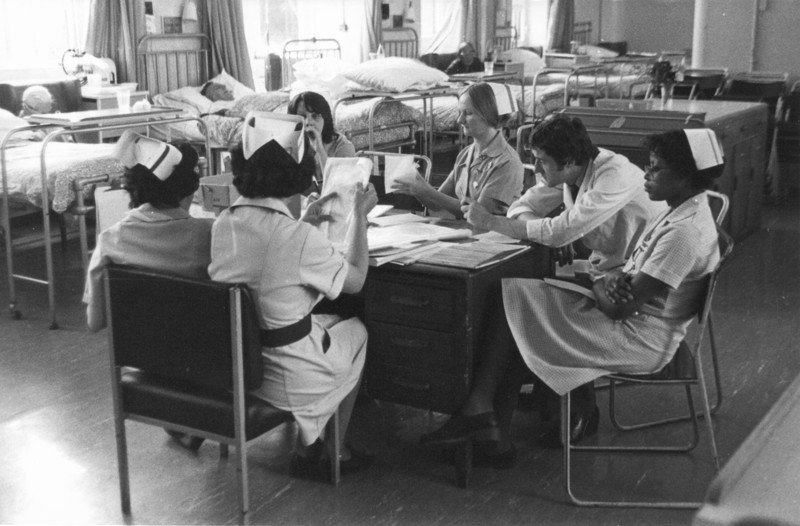
Photographs – from childhood I had been interested in photography. My grandfather was a keen photographer using the most basic of cameras and so for my 21st birthday I had been given a 35mm camera. I asked my girlfriend to bring it into the hospital so that I could take some pictures of the Ward and nurses in action. We’re not talking a small, compact camera but a full SLR. I sought their permission before snapping away. The nurses must have thought I was mad. I dug out the photos when writing this chapter and they brought back many memories; I can still recall some of the nurses’ names. My interest in photography has continued to the present.
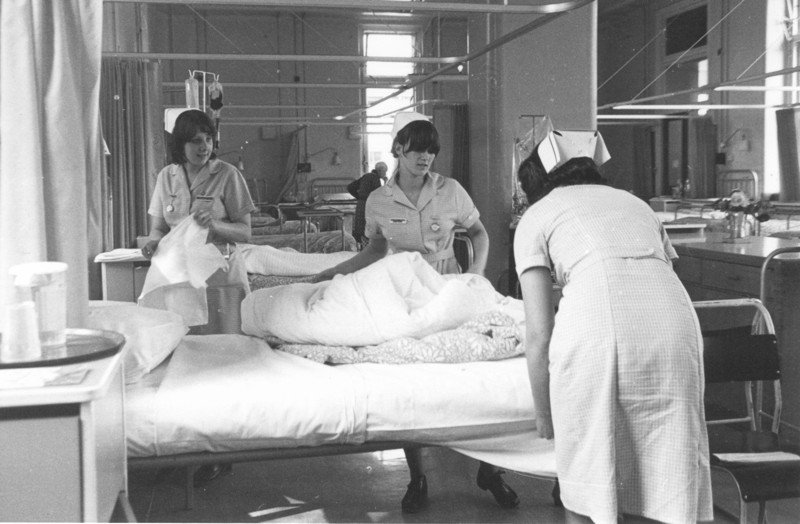
Hospital life – I lost any sense of embarrassment in hospital. Nowadays you would describe it as “what happens in hospital stays in hospital”. I found that by suspending my “normal life” mindset and replacing it with a “hospital life” mindset I could accept what was happening a lot more easily. (When you don’t keep to the “what happens in hospital” principle it’s a sure way of upsetting friends, colleagues and relatives with too much information.)
If you compare the very basic beds shown in the photographs with the hi-tech, all electric, adjustable ones of today with their overhead telephones, TV and internet access you realise just how much we’ve moved on. The things that have not changed are; the daily ritual of the ward round, in which the consultant performs his leading role; and the care and humour with which the nurses have treated me.
There is a well known clip from the 1954 film “Doctor in the House” that you can find on YouTube (just search for “Sir Lancelot Spratt”). If you haven’t seen it before, then please spend a couple of minutes watching. You will see that the ward environment in 1954 was very similar to the one I photographed some 25 years later. One thing that surprised me in that clip was the reference to “keyhole surgery”. I thought this was a modern innovation but clearly it was already in use in 1954 (before I was born), even if it was frowned upon by “proper surgeons”. I will refer to this clip again in a later chapter.
On 10th July I took a picture of what I hoped would be my last ever hospital meal.

The Memory Fades – I am struggling to remember the effect Crohn’s had on my everyday life. As part of the research for this journal I looked through some old 35mm slides. Many were labelled with the date taken and have helped work out how some of my “non-Crohn’s” activities related to the ups and downs of my health.
In May 1978 we went to see Queen at Wembley Arena and a month later were back there for a spectacular Electric Light Orchestra concert. I don’t recall that my declining health or the possibility of having to find a bathroom quickly was ever a consideration in going or not going. A month further on and I had been admitted to Mayday Hospital for tests.
Similarly, on 17th June 1979, we had been to a concert at Fairfield Halls in Croydon. Just two days later I was undergoing emergency surgery in the General Hospital for the perforated bowel.
My own musical efforts had to take a back seat. The band had temporarily stopped gigging until I had regained my health. It was around a year later that we started playing again and had lined up such choice South London venues as the Thomas a Beckett in the Old Kent Road; The Castle in Tooting; the Walmer Castle in Peckham; and The Blue Anchor in South Croydon.
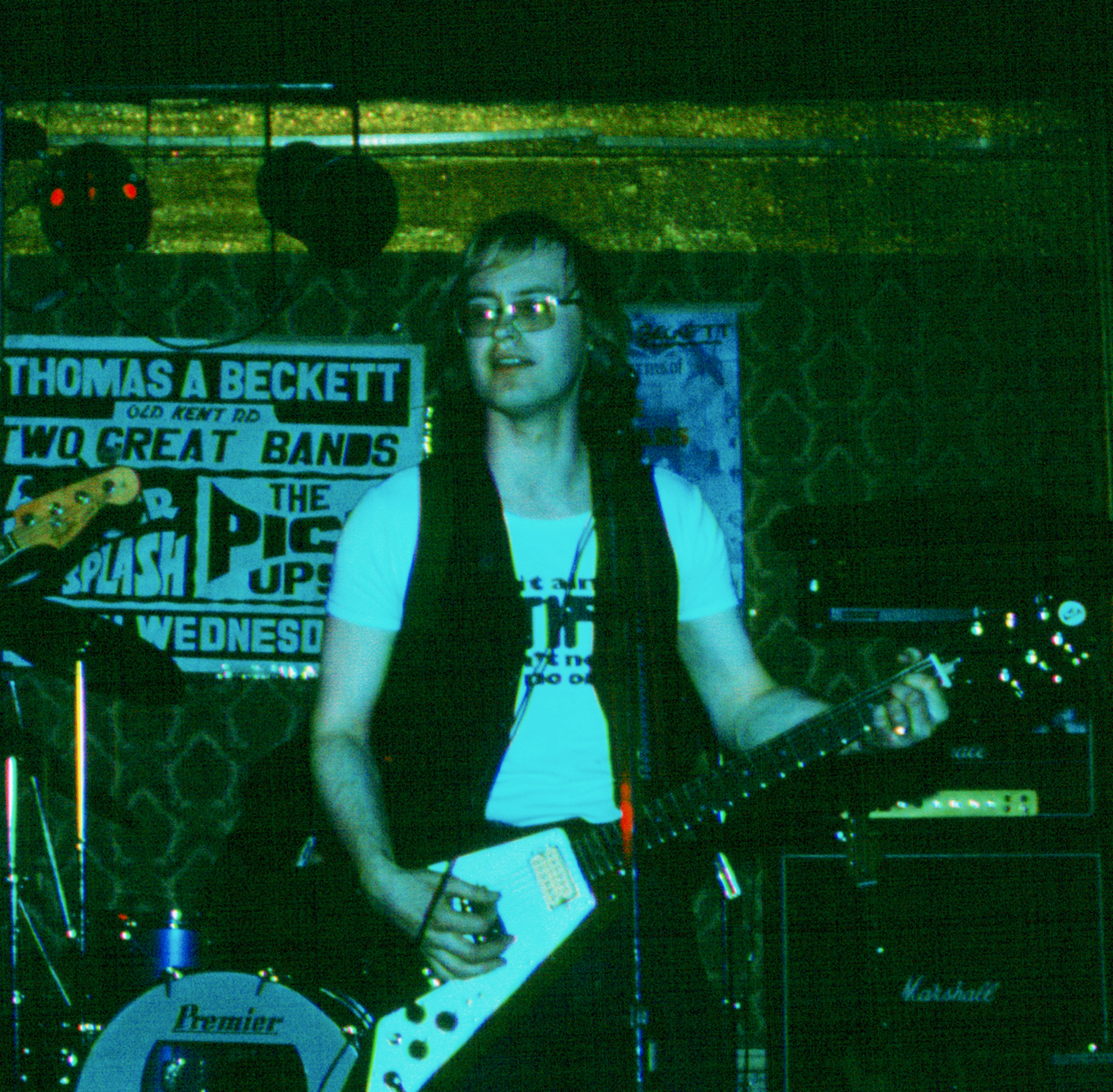
I have discussed with my wife the inability to remember many of the bad times. She then reeled off a number of occasions when I had rushed off to the bathroom whilst out or felt bad enough to consider A&E. I’m starting to wonder whether my subconscious has deliberately suppressed some of the bad memories.
The Drugs – when I was discharged from hospital I was still taking the prednisolone and codeine phosphate that I had first been prescribed in 1978. Prednisolone, a steroid, was the first choice for reducing inflammation. Unfortunately it has a number of potential side effects including weight gain, behavioural changes and osteoporosis. The plan was to hit the inflammation with a high dose and then progressively reduce to a safe level as quickly as possible.
Codeine phosphate is an opioid used in the treatment of Crohn’s disease for its painkilling and antidiarrhoeal actions. Being opium based it can become physically and psychologically addictive.
The summer of 1979 had turned out to be an eventful one. My future was now uncertain. Would I be able to return to a normal life? Would I need further surgery?