
Thursday 7th June 2012 – as usual, returning home from a hospital stay meant the first decent night’s sleep for several days. Time to take stock. The discharge letter made interesting reading but took a fair amount of translation. The bulk of it listed what they did not find so I was rather confused as to what was wrong with me. The only definite observations were the varices, enlarged spleen and a gallstone.
I read through the leaflets that came with the new drugs I had been prescribed. Propranolol – a beta blocker which slows down the heart and as a result lowers blood pressure; Omeprazole – a proton pump inhibitor which reduces the acid in the stomach. The possible side effects of these two drugs could end give me insomnia and nightmares. Fingers crossed.
The hospital asked me to make an appointment with my GP to bring him up-to-date. I booked one for a week’s time. In the meantime a letter from St.Thomas’ arrived asking me to contact their Endoscopy department in order to re-book the colonoscopy cancelled on 6th June. When I spoke to them I explained that an appointment was needed quite urgently as the consultant wanted to see if my Crohn’s had flared up again. A slot was found for two weeks time. I already had the preparation drinks from the cancelled procedure.
Thursday 14th June 2012 – I went to see my GP and took a copy of the hospital discharge letter. That was the one marked “Copy sent electronically to GP” which he had not received. We talked about the way forward. The blood test results, from the hospital, showed that my B12 level was on the low side. I booked an appointment to see the nurse the following day.
Friday 15th June 2012 – time for my first B12 injection. I would initially need a course of six “loading” doses at two-day intervals. The nurse warned me that some patients found these injections uncomfortable as they were administered into a muscle in the upper arm using a long needle. It did sting. I wasn’t looking forward to another five shots. As I was intending to return to work the following week, fitting in the remaining injections was not going to be easy.
Saturday 16th June 2012 – time to start the pre-colonoscopy measures culminating with the senna liquid and two sachets of Citrafleet on the Tuesday.
Wednesday 20th June 2012 – Guy’s Hospital – Endoscopy Unit – having not eaten anything since 8 o’clock the previous morning hunger was getting the better of me. At least I was allowed to drink water up to three hours before the colonoscopy.
My wife accompanied me so that I had an escort to get me home safely. The hospital stipulated – no escort; no procedure. We arrived at Guy’s ready for a half past one start.
Within 10 minutes I had changed into a surgical gown; had my blood pressure checked; and answered the questions on current medications and allergies. I was taken to a waiting area and half an hour later moved to a corner of the recovery room where I had a cannula inserted into the back of my hand. At 2:30pm I was told that an in-patient was going in in front of me but only for a five or ten minute procedure.
I had been hoping that my usual consultant would be carrying out the scoping as we could discuss the way forward with both the Crohn’s and PVT. It would pre-empt the next gastro appointment.
Finally, at 3pm, an unfamiliar doctor appeared and led me to the procedure room. Before starting he asked me various questions about my medical history and the medications used. I explained that the recent MRI scan suggested that the Crohn’s had flared up again in both my large and small intestines and that the colonoscopy was expected to confirm this. He went through the list of potential risks of the procedure; I signed the consent form; and we were ready to start.
I asked for mild sedation so that I remained conscious and could watch the monitor to see if any inflammation was present. I lay on my left hand side, with my knees drawn up towards my chest, and the camera was stuck where the sun don’t shine.
It all started well. Surprisingly there was no sign of any inflammation. The camera continued on its way but then reached the splenic flexure (the sharp bend where the colon turns to run horizontally across the body). He could not get the camera to go any further. He tried withdrawing it a little and then pushing again. He asked me to lie on my back to see if that helped. He asked one of the nurses to press down hard on my abdomen to ensure the large intestine was laying flat. Nothing worked. Not wanting to risk perforating the bowel the procedure was aborted.
There had never been a problem before so I was puzzled as to what went wrong. The “camera experience” lasted about 50 minutes. I was surprised I didn’t feel any after effects following all that manipulation.
I would need to have the colonoscopy repeated with another, smaller camera. In the meantime there was the fallback of a calprotectin test (stool sample), which would give a good indication of whether the Crohn’s was active or not. Maybe they would opt for this rather than another camera job. The other alternative would be a capsule endoscopy where a small camera, enclosed in a capsule, is swallowed and transmits pictures of your digestive system as it passes through. I would have to wait and see what the plan was.
The following day a letter arrived from Guy’s with the date for the MRI scan of my liver and spleen. It was set for 5th July. My consultant had asked me to let him know when the date had been agreed. I emailed it to his secretary and took the opportunity to ask if I should have the calprotectin test done and where I should send the sample.
On Friday I had another trip to my GP’s surgery, this time for a blood test. The results would be ready on Monday.
Monday 25th June 2012 – time to go back to work. I received a very warm welcome. I think my colleagues had accepted that every so often I would have to disappear into some medical establishment to get sorted out.
Mid-morning I made my way over to St.Thomas’ to drop off my calprotectin sample at the Central Testing Laboratory.
It was a beautiful day. As I crossed Westminster Bridge the tide was turning giving the river a real serenity, something I hoped I would be able to achieve myself. The last four weeks had rather dampened my mood and left me wondering what lay around the corner. My next encounter with the medical profession would be from inside an MRI scanner.
Thursday 5th July 2012 – Guy’s Hospital – MRI Suite – as this scan was to look specifically at my spleen and liver there was no need for fasting beforehand or drinking any special fluids. The appointment was at 10 o’clock and the letter said to arrive 15 minutes early. I checked in at reception and was given the usual questionnaire asking about medication, recent operations and any implants I might have. With that out of the way I went into a cubicle and changed into a hospital gown.
I was taken into the imaging area and cannulated ready for the marker dye required later in the process. I entered the scanner room and lay down on the trolley. This time I was laying on my back, going into the machine head first which was a lot more comfortable than the previous scan where I had to lay on my front with my arms above my head.
Once the radiographer was happy that I was in the correct position the scanning sequence started. Instructions were given via a pair of headphones. The main one being to breathe in, half breathe out and hold. Because I knew what to expect I found this a lot easier to cope with than before. Some patients become claustrophobic but I suppose it depends on the size and length of the tunnel of a particular machine. I had no problems as this one was relatively short and you could always see out of both ends.
The procedure lasted about twenty minutes and was slightly less noisy than previously. Halfway through, the radiographer said they were now going to inject the marker dye. Usually you can feel this cold liquid coursing through your veins but this dye must have reached room temperature as I felt nothing.
The scans could be monitored in the control room to make sure the required images were being captured. The interpretation and report would be put together by a radiologist and available in about ten days. I had a follow-up appointment booked with my consultant for Monday week so I was hoping the result would be ready by then.
What were they expecting to find? If I was now suffering from the early stages of PSC they would see some cirrhosis (formation of scar tissue) in the liver and damage or enlargement of the bile ducts. This was probably linked to the oesophageal varices which caused the internal bleeding and prompted this whole investigation process. I had read an article about the condition. It was rather depressing and concluded that the prognosis was not good.
When I checked my phone I had missed a call from my GP. He wanted to discuss the recent colonoscopy report as it recommended an upper GI gastroscopy to be carried out locally. Since I had already had this done in East Surrey Hospital, during my recent in-patient stay, we agreed I should discuss it with my consultant at the forthcoming appointment and we could then decide how to proceed.
He raised the subject of who would be best managing my treatment. As the provider of Primary Care he could argue that it should be him. Given my fairly unusual combination of conditions my first choice was to deal directly with the individual specialists at St.Thomas’:
Crohn’s – gastroenterologist
Low platelets and PVT – haematologist
Oesophageal varices and potential PSC – hepatologist
….but who would co-ordinate the three of them. Would one consultant take the lead? It was a question for the following Monday. By keeping all my care in one place my notes would be held on a common data system and my case would be discussed at the regular MDMs (multi-disciplinary meetings)
Monday 16th July 2012 – Guy’s Hospital – Gastroenterology – I had been looking forward to this day with a mixture of anticipation and trepidation as the MRI results might confirm PSC. If that was the case there would be a lot of new factors to be considered and my future would take on a whole new direction, potentially needing, yes you’ve guessed, a liver transplant.
The appointment was for late morning. There was time to go into work first. I knew I would have an hour or so to wait as the clinic always ran late. There was a very good reason – the consultant took his time with each patient. You never got the feeling that he was just going through the motions, so to speak, and wanted you out the door as soon as possible.
I signed in at reception and waited to be called for weighing. That took around 30 minutes and I was then ushered into the inner waiting room. After a further 30 minutes one of the registrars called out my name. I told him that I wanted to see my specific doctor to which he replied “no problem” and put my notes back on top of the pile. Five minutes later I was called in by my consultant.
I had made a list of all the questions starting with what did the MRI scan show. I had re-read the discharge notes from East Surrey Hospital and whilst they suspected PSC the tests they had carried out showed nothing. The radiologist at St.Thomas’ had been asked to compare the results of the latest MRI scan with the one carried out at the end of April.
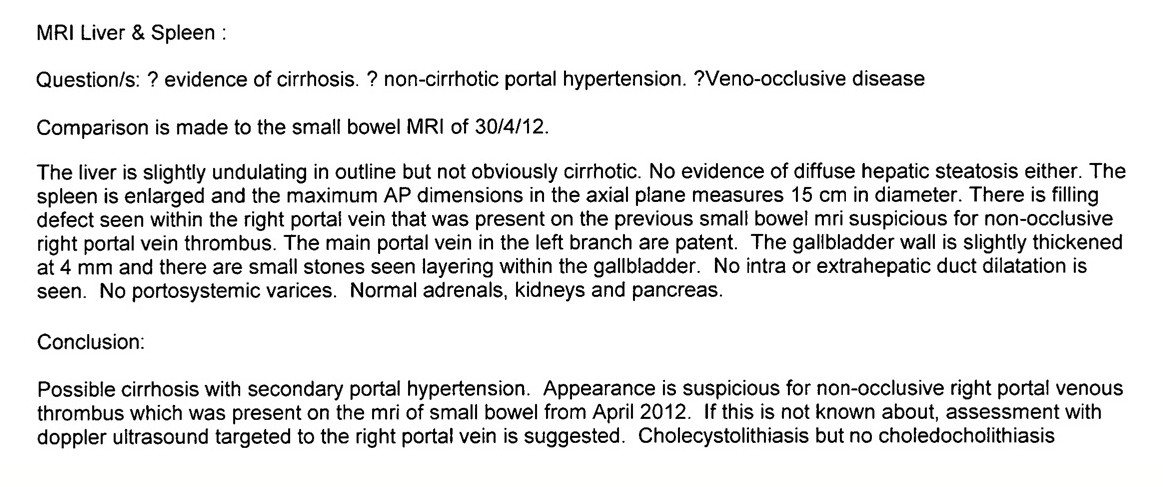
The scan did not show PSC – a great relief. It did however mention a blood clot in the right portal vein (running through my liver) which was present on the April 2012 scan. This was the main vessel in the portal venous system that drains blood from the gastro-intestinal tract and spleen to the liver. I wondered why it didn’t show up on the ultrasound scan carried out at East Surrey Hospital?
The result was a restricted flow through the portal vein which, in turn, caused some of the blood to be diverted into surrounding veins. They were unable to handle the increased pressure and grew new ones in my esophagus. These failed and burst. My consultant said he would refer me to a liver specialist and the haematologist, already looking into the low platelets, would be asked to sort out the clot.
This neatly took us to the question my GP had asked – who would manage my treatment so that the various disciplines worked in a joined up way? Answer – my gastroenterologist. One less thing to worry about.
A few days prior to the appointment I had taken a sample in for calprotectin testing. This prompted my second question – did it show anything? Answer – only slight inflammation. This was odd because the MRI scan at the end of April suggested there was a lot of inflammation. The upshot was that the Crohn’s was fairly dormant and I wouldn’t need another colonoscopy just yet.
Next we moved on to the gallstone that the ultrasound scan had shown up. Should I worry about it and did it need to be removed? No to both of these.
Now for the most contentious one – low platelets. I mentioned that I was confused as my former specialist, who was a “world expert” in azathioprine, had written in a letter, back in 2010, that he had asked me to stop taking the drug because of its effect on my platelet count. When I had encountered him again recently, he had told me he was not convinced that azathioprine was the cause of the problem, hence my confusion at these apparently diametrically opposed statements.
I wouldn’t usually discuss one doctor with another but I felt I should mention the very frosty reception I had received and why the bare minimum of tests had been carried out locally during my recent admission. Just enough was done to patch me up and discharge me back into the care of St.Thomas’. My current consultant looked very surprised and apologised. I replied that it was not his problem and that I was big enough to deal with these things myself, as indeed I had. Subject closed.
He had a look through my file to find out when I had last seen a haematologist. There was a record of the appointment in August 2011 but no follow-up letter. I was not surprised as I had previously contacted Haematology about the missing letter. I knew that I had attended that clinic as I found photographs taken in London that day. It looked like it had slipped through the net and was an issue that needed addressing at my next appointment.
The final question was regarding the ache I was experiencing around my anastomosis. He told me that following major surgery you would expect some discomfort and not to worry about it. Since he was clearly quite happy to be answering my questions I took the opportunity to ask two that were not on my list :
Firstly, is there an average time, following Crohn’s surgery, that you would expect to go under the knife again? He replied that studies showed the mean to be 10 years but he stressed everyone is an individual so it doesn’t necessarily follow that you will need a further operation at all.
Secondly, was the life expectancy of Crohn’s sufferers affected by the disease? I wanted to time my retirement so that there were plenty of years to enjoy my hobbies, but enough savings to pay for them. He responded that Crohn’s patients have the same life expectancy as the rest of the population.
I said goodbye and made my way back to work. When I arrived home that evening I suddenly became very tired. I wondered if the lifting of the emotional stress I must have been under, thinking that sooner, rather than later I would need a liver transplant, had allowed my body and mind to finally give in. When I came to get up to go to work the next morning I was still exhausted so took the welcome option of working from home. I was a little disappointed that I should feel such fatigue as the recent course of B12 injections seemed to have given me my old energy back.
The next medical hurdles would be meeting with Haematology and the liver specialist. Hopefully I wouldn’t have to wait too long as my consultant had written to both of them requesting appointments.
Wednesday 1st August 2012 – There was a call from Haematology asking if I could make 8th August? I was surprised that I would be seen so soon and to make another step along the road to understanding the aetiology of the new issues or at least deciding what further tests were needed.
Overall I was feeling positive. I wasn’t on any Crohn’s medication but did need to sort out the blood clot in my portal vein. It shouldn’t have been difficult to get an appointment with hepatology as they were part of the gastroenterology department but I was not making any progress. My consultant’s secretary was on holiday, which was not helping, so I contacted the hepatologist’s secretary directly and left a message on her voicemail.
Wednesday 8th August 2012 – Guy’s Hospital – Haematology 2 – it was worth arriving early to allow for the pre-appointment blood test which was a prerequisite of seeing the consultant.
My usual doctor called me in. I started by asking about the confusion over last August’s appointment for which I had never received a follow-up letter. She apologised for this oversight which was down to an administrative mistake. She clearly remembered me as, when I produced my iPad, she said: “you’ve got your blood test graph on there, haven’t you?” and I felt like a nerd.
We discussed the low platelet count and PVT. She recommended that I start taking warfarin to thin my blood and try to disperse the clot. This could conflict with my low platelet count but she had a number of patients, in the same situation, who successfully took blood thinners so was not concerned about prescribing it. However, she didn’t want me to start until I had seen the hepatologist and undergone another gastroscopy to check the varices. Getting the hepatology appointment, as soon as possible, took on a new significance
My final question was whether I needed to change my lifestyle, at all, to take into account the PVT. “No“, she replied.
Thursday 9th August 2012 – GSTT had a policy of sending their patients copies of the follow-up letters from outpatient clinics. I received such a letter referring to the gastro appointment back in July. It wasn’t from my usual consultant as he had already written a letter immediately after the appointment. This new one mentioned ulcerative colitis (UC) and noted that the MRI scan showed adhesions and some neo-terminal inflammation. UC was news to me! Having undergone two MRI scans that year I wondered which one was being referred to. It must have been the one in April but the subsequent colonoscopy showed no inflammation. What was going on?
I emailed my consultant and received a prompt reply stating that the letter resulted from the multi-disciplinary meeting where they had reviewed my scans. UC was a typo but I guess it does mean they still saw some adhesions. That struck a chord as I was experiencing pulling sensations around my reversal scar. The email also let me know that I would be seeing the hepatologist on 10th September.
Monday 13th August 2012 – over the weekend I had been working out the likely timing of commencing PVT treatment. Back in July I had commented to my gastro consultant that by being referred to other disciplines it could easily end up being six months before starting. Maybe it was time to give the system a kick. I sent another email to ask if there was anything I could do to speed up the process.
Tuesday 14th August 2012 – the response confirmed that a gastroscopy had already been requested and that the hepatologist did not see the need for any further tests before starting warfarin. Later that morning I had a call from Endoscopy Appointments asking if 3rd September would be convenient for the procedure. Another result! I would be able to discuss what they found with the hepatologist when I saw him a week later.
This may well have fallen into place without my intervention, but I was pleased that I left nothing to chance. It reinforced my view of the value the patient can add to the process if they are allowed to take an active part in the management of their treatment. The advantages are not just one-sided as I would, potentially, get to start the treatment sooner and possibly prevent my health becoming worse and requiring even more NHS resources.
Wednesday 22nd August 2012 – I did not get a good night’s sleep as the back pain from long ago had returned. I hadn’t felt like this since before surgery in 2010. It was difficult to tell if it was Crohn’s or PVT related or as a result of lifting cobble stones into the new pond we were building. I couldn’t face dragging myself up to London so it was another day working from home. This was proving to be a very welcome option and was very productive.
London 2012
As the London Olympics grew ever closer my lunchtime walks brought with them many new sights and sounds. Venues were being prepared. London was in the grip of Olympic fever. The atmosphere was carnival like and the Capital was looking at it’s best.
Curiosity
2012 had been the year when my health concerns broadened from just Crohn’s Disease. I became curious to know more about PVT, and potential PSC, the possible links with IBD and whether there were any indicators in my medical history that could have predicted them. I made the decision to look deeper into that history to see if I could find any answers.
As a first step I called in at my GP surgery and requested a copy of my medical records. Now I just needed to find out how far back my hospital notes went and how I could obtain them.