
Monday 24th June 2013 – Guy’s Hospital – Gastroenterology – a gloomy day for the trip to see my gastro consultant. I entered a virtually deserted waiting area. Rather ominous. Within a couple of minutes I was called in to be weighed and had lost a couple of kilos, which pleased me.
The scales were the passport to entering the inner sanctum where there were a few more people but nothing like as full as I had seen it. It was approaching my allotted appointment time and as usual a registrar appeared and called my name. I told him that I would like to see my usual consultant in order to keep some continuity. He didn’t think that my doctor was in clinic that day but went off to check. After a few moments he was back. He had found my consultant and passed my notes over to him.
I had to wait another 30 minutes, but it was my choice. I explained that I had asked to see him in person as future appointments might just be routine check-ups from now on and there were a number of questions I wanted to get answered before then. My list of questions was ready but rather than go through them one at a time we talked generally about remission, how to maintain it and the need for future tests.
Whilst I had not been taking any Crohn’s medication I knew that this was not standard practice. He explained that usually I would have been kept on a maintenance dose of azathioprine but due to the low platelets, and the fact that my colonoscopies were clear, he would not suggest any drugs at present. He noted that thirty years had passed between my first operation and the ileostomy in 2010. It was possible that it might be this long again before needing more surgery. I would be happy with that but reminded him that I spent many years on prednisolone that may have helped keep surgery at bay. He replied that steroids do not contribute to remission, they just make you feel better.
The ache around my anastomosis had recently returned and appeared to be worse after standing for a long time or doing physical work. He concluded that since the two post-reversal colonoscopies had shown no inflammation he was still of the opinion that the cause was purely “mechanical” and not something that could be treated with medication. Nothing too much to worry about.
He had read the follow-up letters from Haematology and was aware of the decision not to start anti-coagulation treatment as the evidence pointed to the PVT being caused by a single incident rather than a general, underlying problem. Like the hepatologist, he agreed with the decision.
I was trying to lose 5kg and get down to a more comfortable 85kg. That would be OK. Generally he liked to see his Crohn’s patients on the slightly heavy side as it showed their digestive systems were working. (I had been as low as 54kg in the past so I knew what he meant).
Was the long-term use of loperamide safe? I was only taking two capsules a day and an extra one, as an insurance policy against getting caught short, if I was going out. He said it was fine and that I was taking the right approach. I told him that the output from my digestive system was quite variable. He thought this could well be down to certain foods not agreeing with me but could also be down to losing my terminal ileum which meant the body no longer absorbed salts properly. That could also cause looseness. (I didn’t understand the full implications of this comment. We’ll return to this subject later on).
I asked what constitutes a “flare-up” as I knew that other patients ended up being hospitalised, not something I had experienced. We concluded that what I referred to as a “flare-up” was more likely to be one of the other issues mentioned above.
That took us neatly onto diet. Was there something that would help with the bloated feeling that seemed to be getting worse? He was an advocate of the low FODMAP diet but I had read it was only useful with IBS. Could it also be useful for IBD sufferers? Yes, it would be worth trying. He would refer me to the dieticians although I might have to wait a while for the appointment because they were amongst the world leaders in this diet and in great demand.
I asked what ongoing tests or procedures I would need from now on. Did I need to continue with yearly, pre-Christmas colonoscopies ? The alternative would be a calprotectin test and if that highlighted any concerns then a colonoscopy could be used as a follow-up. If I had any GP blood tests then I should ask to have a full blood count with liver function, kidney function and CRP recorded.
Since I had been discharged from the liver clinic, back to Gastroenterology, who would decide if I needed to continue taking omeprazole and propranolol? He responded that I would need to keep taking propranolol permanently as it had the effect of reducing the pressure in my portal vein. For a decision on the omeprazole I should ask the doctor who was carrying out the next gastroscopy.
Now it was time for the hypothetical question that I had been wondering about for a while, more out of curiosity than “if only I had…“.
If I had undergone surgery in 2000 to remove the stricture in my terminal ileum, instead of taking medication, would the surgery have been easier and without the need for a stoma? I had seen other Crohn’s patients asking if they should have surgery sooner rather than later. Here was my chance to ask.
He thought it was probable that earlier surgery would have avoided the loops and fistulas forming and, yes, it would, most probably, have been less complex.
As I prepared to leave he asked if I was getting regular B12 injections. I was able to confirm that I’d had one the previous Friday. Our next appointment was set for six months’ time but always on the basis that if I needed to be seen sooner I was to contact his secretary.
On the walk back to work I gave his answer about surgery some further thought. I might have ended up having keyhole surgery in 2000 rather than the full monty in 2010 and the need for the subsequent reversal in 2011. Recovery time would likely have been a lot quicker both because the operation would have left much smaller scars and I would have been ten years younger. I may also have escaped a few years of pain.
Time for some cod philosophy. I work on the basis “regret nothing”. (Overstating it slightly). Most of the time it saves me from spending hours running and re-running things in my mind. Things I can do nothing about. The question on early surgery was based on curiosity, not regret. I wouldn’t have wanted to change anything as, by the time the knife became unavoidable, I was far more prepared both mentally and from a work/life perspective for the surgeries and recoveries than I would ever have been a decade previously.
Monday 16th September 2013 – it was one of those days when you realise the psychological effect of Crohn’s can be as bad as the physical symptoms.
I was in a bad place with my Crohn’s, assuming that was the cause. I was sitting on a train to London that was being held up because someone had been hit further up the line.
I knew before boarding the train that there was likely to be disruption. A similar incident had recently happened during the evening rush hour and trains had been brought to a standstill for two hours. I was in two minds as to whether it was a good idea to travel or return home and try again later, but that would make it difficult to find a parking space. Over the weekend I had been doing a lot of fairly strenuous digging in the garden and was feeling decidedly fragile around my anastomosis.
The train appeared on time and I decided, having bought my ticket, I would risk it. We set off towards London as usual. It wasn’t until it reached Purley station, a few miles below the incident, that we were finally held at a red signal and the driver announced that he would keep us informed as to what was happening. The train was already crowded with a good number of people standing in the aisle.
It was at that point I felt a sinking feeling in my abdomen. Not a metaphorical one but an “everything is on the move” feeling. That lead to some mild anxiety which, of course, made me feel worse and brought on further “sinking feelings”. A vicious circle. What to do? I had a look round and there was a toilet at the far end of the carriage. To get to it would involve squeezing my way down the crowded aisle. When I reached it would it be vacant? Would I have to stand there like a lemon waiting? I decided to try mind over matter and it worked. We were only held up for around 30 minutes in the end but I’ve no idea what would have happened if it had been a lot longer.
So what, you might ask? Or probably would ask if you’re not a Crohn’s sufferer. Nothing happened. Why even bother to mention it? But that is the point. My journeys were usually fine but every time I stepped out into the big wide world there was ALWAYS the thought that I might end up in a bad place with an uncontrollable sinking feeling and unthinkable outcome. This is one of the psychological impacts of the disease. I had been lucky so far and never had an accident. I know that others are nowhere near as lucky and it causes great distress, not the least because of the reaction of others.
I had been in clinical remission for just over two years at that point. People kept telling me how well I looked. That was great, physically, but I didn’t believe I would ever be in total mental remission. I had been “Crohn’s Patterned” and it could never be completely undone.
No Parking
This was to have been the sign-off appointment where I was discharged back to gastroenterology. The “elephant in the room” however was the low platelet count. We had originally agreed to park the issue but my gastro consultant would not put me on the usual maintenance dose of azathioprine because of it.
I had been mulling this over for a while and concluded that there would be one less option available if I needed to start drug therapy again. I had emailed my GI consultant to ask if he was happy that this issue remained unresolved and copied in my haematologist. Early the next morning I received a response, from the haematologist :
“Having read this email – I think we do need to go ahead and finally do the bone marrow test to see if we can be more definitive about the cause for your low platelet count as this is having an impact on your treatment options. We can discuss it when I see you on Wednesday.“
We had a further email exchange and agreed that I should undergo a bone marrow biopsy to see if it was the cause of the problem.
Wednesday 25th September 2013 – Guy’s Hospital – Haematology 2
By now you will have realised that I always arrive early for outpatient appointments. To be honest it’s just about the only thing I am on time for. Within five minutes I was called to have a blood sample taken. It was then back to the seating area, ready for a long wait. After another 10 minutes I heard my name being called and yet another new doctor introduced herself and apologised for keeping me waiting (even though I was being seen 15 minutes early). My usual consultant was on holiday so no point in asking for continuity and I had already decided that I would be happy to be seen by another doctor as sometimes a different perspective on a problem is worth having.
As we entered the consulting room I showed her my list and explained I had a few questions to ask. She had started reading my notes but they didn’t include a copy of the recent email correspondence. She was unaware that I was to have a bone marrow biopsy. Luckily I had a copy of the emails on my phone.
We went through the possible causes of low platelet counts – increased destruction – the body is producing sufficient but then “something” was destroying a proportion of them; possibly drug induced; or decreased production – the body not producing the right number in the first place – which could be down to bone marrow failure. The biopsy would help to focus the investigation.
We also discussed some other factors which I was still struggling to understand. What were the implications of my splenomegaly? Enlarged spleens can hold increased numbers of platelets and therefore the number released into the bloodstream is lower which leads to a reduced count. Then there was the blood clot in my portal vein. Did this cause the spleen to enlarge? The doctor remarked that blood clots in this location were common in Crohn’s patients and it was very plausible that it had been there since my emergency operation in 1979.
I asked why it hadn’t shown up on the various X-rays and scans that I’d had over the years. She replied that unless the radiologist was specifically looking in that area it would be easy to miss it. Unfortunately the X-rays up to the year 2000 were no longer available. I did have a CT scan from 2009…..but this was all rather academic.
The results from that morning’s blood test appeared on the system – platelets 60, another all time low, but white cell and red cell counts normal. This suggested a platelet specific problem, not a general blood disorder. We continued my list :
What was involved in a bone marrow biopsy? “….carried out under local anaesthetic by introducing a needle into the hip bone and taking a small sample of the marrow liquid and then using a slightly larger needle to take a small core.”
Would it hurt? “You’ve got Crohn’s disease. You’ve had surgery. You’ve dealt with pain. The most uncomfortable bit is injecting the local anaesthetic. Some patients don’t even feel the biopsy needles being introduced.”
With low platelets did I need to take any special precautions if I have teeth extracted? “Unless your platelets fall below 50 then extraction should be OK. You might want to have a clotting gel available to stop your gums from bleeding. If your dentist is worried they might want to refer you to the specialist Dental School at Guy’s.”
How regularly should I be having blood tests and are there any special things to test for? “Six monthly at your outpatient appointments is fine. You could ask your GP for more frequent ones. The only special test would be for clotting.”
Is there any possible link between low platelets and diet? (A bit of a long shot this one but I was due to see the dietitian in a couple of weeks’ time). “No.”
Back to reception to book the biopsy and a follow-up appointment. I was offered a slot for the next morning but I had other plans and would not be in London so had to decline. “We have a gap at three o’clock next Wednesday, is that any good?” Excellent, and the follow-up appointment was set for the week before Christmas.
The next day the doctor telephoned me to request a copy of the email correspondence for inclusion on my file. I told her that the biopsy was planned for one week’s time and she sounded genuinely surprised that it was so soon.
On the way home I was running through our discussion, or rather one particular section, the mechanics of getting the sample. Pushing a needle through the hipbone into the marrow did not sound either easy or painless. How do you physically push a thin needle through tough bone? Surely you would need to drill a hole. Time to think about something else…..
Wednesday 2nd October 2013 – Guy’s Hospital – Bone Marrow Biopsy
The procedure was planned for three o’clock which gave me a chance to go into work as normal. In the morning I had told various colleagues that I wouldn’t be around after lunch and explained why. Every single one of them uttered the same three words “that sounds painful“. After you’ve heard it for the umpteenth time a few nagging doubts set in. That tied in with the haematologist’s remark about Crohn’s and being used to pain.
I made my way to Guy’s, checked in and waited to be called. A nurse came over and gave me an identification wristband as the procedure would be carried out in the Day Hospital section. She said that I shouldn’t have to wait too long.
At around half past three the doctor appeared. Her first reaction was: “Have you come alone?” That sounded a bit alarming. I asked why I would need to be accompanied and she replied that most patients were nervous about the procedure and liked to have someone with them. I replied that my days of needing someone to hold my hand were long gone.
She showed me into a treatment room. All the equipment was laid out ready. I took off my shoes and lay on my right-hand side on the bed. She explained what she was going to do, where the needles would be inserted and then did the usual risk assessment talk. There was not a lot that could go wrong as the needles enter straight through the skin into the hip bone and nowhere near any vital organs. I signed the form and she was ready to start.
I asked how long it would take for the results to be available as my follow-up appointment was planned for mid-December. She replied that they should be available in four or five weeks and they would contact me if anything untoward was found. I asked to be informed even if nothing showed up as I didn’t want to wait until the appointment to find out.
I was asked to pull my knees up to my chest and adopt a fetal position. She felt around to find the best location for the needle and cleansed the area. This was followed by a series of shallow injections of local anaesthetic and, as previously predicted, were the most painful part of the whole experience. It really wasn’t too bad. Certainly nothing to get hung up about. Some deeper injections were made but by now the local anaesthetic was working so I felt very little. A few minutes later it was time for the first sample needle to be inserted.

Instruments of Torture
The aim was to get a sample of the liquid (aspirate) that could then be spread onto microscope slides for an initial examination within the department. She was having problems getting a good sample that wasn’t contaminated with blood as it kept clotting (which goes completely against what you would expect from someone with low platelets).
Because I was tolerating the needle so well she took some more samples but explained that as long as she could get a good core then the quality of the liquid samples would not be so important.

The slides
With the aspirate taken it was time for the coring needle, which was quite a bit larger than the previous one. If you’ve ever seen one of those food programmes about cheese production no doubt there will have been a scene where the cheesemaker inserts a tool into the cheese and pulls out a nice sample. Same principle here!
It takes a fair amount of force to push the larger needle through the outer layer of the bone. I could certainly feel it as it went deeper in. It wasn’t so much pain as a dull ache that travelled into one leg. After a couple of minutes of pushing the needle in to the right depth it could be withdrawn to release the sample. She was very pleased with the resulting core and set about dressing the puncture wound.
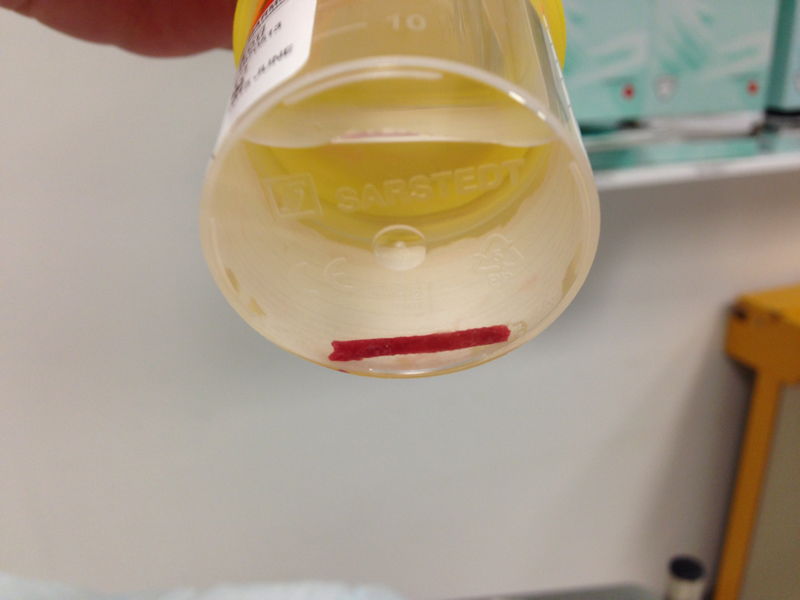
Bone marrow core sample
I then had to lie on my back whilst the blood clotted and sealed the wound. A nurse would come to tell me when I could go. After 20 minutes or so the nurse appeared and examined the wound. It was fine so back on with my shoes and down to the station to catch the train home.
Throughout the procedure we talked about low platelet counts, possible causes, what the tests would show, the fact that my red and white cell counts were normal, my Crohn’s history, and empowered patients amongst other subjects. It was very informative and kept me at my ease. I would now have to wait at least a month for the sample to be analysed under a microscope.
Wednesday 2nd October 2013 – St.Thomas’ Hospital – Dietitian
The wait to see the dietitian turned out to be shorter than I expected. The purpose of the appointment was to give me greater understanding of the low FODMAP diet and how it might help to decrease bloating.. This diet has been written about extensively and the detail is beyond the scope of this book.
I came away with two booklets – one listing how foods were categorised; the other giving examples of low FODMAP recipes.
Thursday 24th October 2013 – an email arrived from Haematology: “your bone marrow is being discussed with the histopathologist and the doctor will write to you with the results. We will see you in clinic in December”. I had to look up histopathologist – someone who carries out microscopic examination of tissue in order to study the manifestations of disease.
I replied asking if they would give me an indication of what they had found once the discussion had taken place. The response said that it would be easier to discuss the findings in clinic. What did that mean? Nothing to worry about, it can wait, or it’s serious and we want to tell you face to face?
My health had provided enough shocks along the way to get into the mindset of “whatever will be will be” but now I was starting to get an uneasy feeling. There was no way I would relax over the weekend knowing that the results had been assessed but I was being kept in the dark. Time for a short email along the lines of “…I wonder if you could just put my mind at rest that you haven’t found anything too serious otherwise I won’t be able to relax this weekend!“
Within a few minutes this reply came back :
“Please relax this weekend. We have reviewed your bone marrow in our multi-disciplinary meeting and there is nothing sinister to report. The findings suggest that your marrow is underproducing platelets rather than it being an immune cause that we had presumed secondary to your longstanding history of Crohn’s. This may be due to previous azathioprine use…….I look forward to seeing you on 20th November and we can discuss this in person and in more detail then. In the meantime – I hope this reassures you.” I thanked the doctor for her prompt response.
I could relax until the next procedure, the annual gastroscopy, which would show if any new varices had grown over the last 12 months.
Tuesday 12th November 2013 – St.Thomas’ Hospital – Endoscopy Unit
An early morning trip to London, accompanied by my wife. The walk from Waterloo station took us past a number of brightly lit cafes with the smell of bacon wafting out of their doorways. Inside, customers were tucking in to breakfast. It reminded me that I hadn’t been allowed to eat anything for many hours.
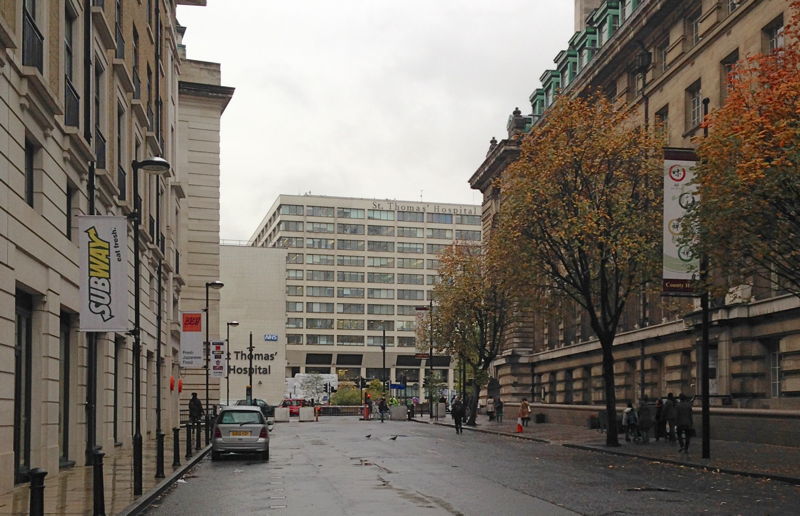
The walk from Waterloo Station to St.Thomas’
We made our way up to the first floor and found the new Endoscopy Suite which we had not been to before as it had only been open since May. The waiting area looked north across the River Thames to the Houses of Parliament, a view I had become used to when recovering from my last operation.
At the danger of sounding like an old, cracked record – it’s always worthwhile arriving a bit early, especially if you are one of the first appointments of the day. After a few minutes one of the nurses came to collect me. I recognised her from my previous endoscopies. We quickly went through the preliminaries and she asked if I wanted sedation. “Yes. Definitely“. I signed the consent form and was told I would be first into the procedure room. Wristband attached, cannula inserted, ready to go. I said goodbye to my wife who was told, as usual, I should be ready for collection in two hours’ time.
The doctor appeared, asked me if I was aware of what the procedure involved, explained that the risk of something going wrong was 1 in 10,000 and got me to sign another consent form. A few seconds later I was shown into the procedure room at which point I was sad enough to ask if I might take a picture of the equipment to illustrate my blog.

The endoscope (black tube on the left) and its support equipment
This was all very familiar – a few squirts of xylocaine spray to the back of the throat; the cold feeling in the arm as the sedative entered the cannula; and finally the dreaded gag.
I must have been under for around 30 minutes. The next thing I heard was the nurse in Recovery asking how I felt and telling me the good news that I didn’t need any banding. That was doubly good news as it meant I could have a coffee and biscuits straight away.
She gave me a copy of the gastroscopy report to read. Three short varices had been found but they did not warrant any treatment. This time the report had no pictures but noted that I didn’t need to be seen again for 12 months.
Wednesday 20th November 2013 – Guy’s Hospital – Haematology 2
The appointment to go through the bone marrow biopsy results. Even though I had already had an email telling me that there was “nothing sinister to report” it was always at the back of my mind that there might be something they were holding back until we could discuss it face-to-face.
With the obligatory blood test out of the way I settled down to wait for one of the consultants. After 15 minutes my usual doctor collected me and we went into a consulting room. She started our conversation with: “Your’s is not a simple case.“
She had printed out two biopsy reports – one for the recent bone marrow procedure and the other for last year’s liver biopsy, which I had not seen before.
The bone marrow results had been discussed at their MDM and the initial conclusion was that they were “in keeping with early/low myelodysplastic syndrome, histologically suggesting MDS-RCMD“. She knew that I would have looked this up on the internet and then probably have been worried or distracted by the potential links with leukemia. That’s why the report hadn’t been emailed to me. If I had Googled MDS I would have found the following: “The disease course is highly variable, from indolent to aggressive with swift progression to acute myeloid leukaemia (AML) in 30% of cases”. I think she was right to want to discuss it in person.
She went on to say that she was not completely happy with the MDS conclusion. A bone marrow biopsy looks at two substances – the marrow itself and the aspirate. The doctor who carried out the procedure was not getting good aspirate slides as the blood in the samples kept clotting.
“It’s like having a three piece jigsaw from which two of the pieces are missing.” At the next MDM they had discussed the results again and decided that, in my case, it was unlikely to be MDS but would recommend a further biopsy to get useable aspirate samples. “How would you feel about this?” I replied that I really wasn’t fussed. If it would help narrow down the diagnosis then the sooner the better. She explained that this time they would use heparin, a blood thinner, in conjunction with the sample needle as this should prevent the clotting.
If the diagnosis wasn’t MDS then why the low platelets? The most likely cause was a combination of long-term Crohn’s and taking azathioprine. The biopsy had shown that the marrow was under-producing platelets rather than being over active and eating them up. I was unaware that there is a potential link between Crohn’s and bone marrow issues.
They had then gone on to discuss what the implications for treatment would be if it was or was not MDS. In either case the preferred course, at this stage, would be “do nothing” unless I was to have any procedures that could cause bleeding or that required surgery. If either of these were needed then a supply of platelets should be made available The difference in approach would be the monitoring regimes and we would discuss this further after the next biopsy results were available.
I went back to reception and booked another bone marrow biopsy for 9th December and a three-month follow-up appointment.
On my way back to work I started reading the Liver Biopsy report. If I thought blood was complicated then reading this text was mind boggling. Here’s a sample :
“… features of cholangiopathy, with slight cholangiocyte disarray, occasional juxtaportal hepatocytes containing copper-binding protein deposits, and scattered ceroid-laden macrophages in portal tracts. Patchy mild portal-tract fibrosis with perisinusoidal extension and early spurring. Macrovesicular steatosis of hepatocytes (5% of parenchyma). Slight centrilobular sinusoidal ectasia noted. An early stage of primary sclerosing cholangitis is a possibility. Correlation with imaging-study findings appears in order ….“
It would be interesting how all these strands would come together when I next saw my gastroenterologist. I would also be getting the result of the recent calprotectin test that should provide a good pointer as to whether my Crohn’s had re-activated and consequently what the future treatment plan was likely to involve. If it still showed remission then would it be better to continue without any medication or to start taking precautionary doses of anything? I was pretty sure that the answer would not be a simple one.