
We had known for the last two years that I was unlikely to escape the surgeon’s knife. It had now become inevitable, just a question of when. Having exhausted all the non-surgical options in 2009 there would be a point in the New Year when I would be admitted to hospital.
As the turn of the year approached my condition was getting worse and I was finding working five-day weeks a problem. I eased the situation by stopping work for one of my clients leaving just a three-day week with the other. Sometimes I was able to work from home, a real bonus.
Towards the end of January 2010 I saw my consultant and told him that I didn’t feel quite ready for surgery yet. With the re-introduction of azathioprine, blood test results had shown my platelet count dropping again but then subsequently rebounding. He suggested the dosage should be doubled, provided my platelets held up.
During February I began to feel a little better and restarted a limited amount of work with my second client on the basis that sooner, rather than later, I would need to be away for an extended period. By April 2010 the abdominal pain had worsened again and was symptomatic of a bowel obstruction. The follow-up letter read: “…I think we are almost certainly heading towards surgery. It would be nice to have him on an adequate dose of azathioprine prior to this to reduce the chance of post-operative recurrence. He is currently tolerating azathioprine without any signs of bone marrow suppression.”
It was decided to repeat the CT scan and a month later I had a follow-up appointment with my consultant to discuss the way forward. The scan showed no improvement from the previous one. He told me that I should expect to have the operation, at East Surrey Hospital, within four weeks, and would then need to allow a couple of months for recuperation. Even though I knew what was coming it was still a shock to finally hear those words and the timescale. I went back and told my clients that I wouldn’t be available for three months over the summer period.

A meeting was arranged with the consultant, his boss and their surgeon to talk through the plan for the next few weeks. My wife came with me so she was fully informed about the process. Because we had been invited at short notice they had been unable to find a suitable room so we met in their office. It was a small space with little ventilation and just three chairs. It quickly became very stuffy. We sat on two of the chairs, the boss on the third. My consultant was standing eating a Mars Bar; the surgeon was perched on the edge of the desk. All very laid back.
I was starting to realise that the NHS was changing, and for the better. Patient involvement was now being actively encouraged. This particular meeting was the weekly, multi-disciplinary get-together and we had been specially invited along. After the initial pleasantries they cut to the chase. Having looked again at the CT scan they concluded that the operation and aftercare were just too complex for the facilities at East Surrey and that they were referring me to St.Thomas’ Hospital in Westminster, part of the Guy’s and St. Thomas’ NHS Foundation Trust (GSTT).
The surgeon that would be operating on me was one of the top men in the country and two of them knew him very well as they had been former colleagues when they also worked in London.
This was a bit of a bombshell. We had gone along expecting to get a date for the operation only to end up with more uncertainty. I would need to go up to London to meet the surgeon, discuss the operation and then be “accepted” onto his list. They couldn’t say how long it would be until surgery took place as it depended upon finding a slot in his diary. It would certainly be months, not weeks. This was all rather a lot to take on board in one go, having already started to prepare mentally for an operation in the next month. I went back to my clients and explained that I would be available over the summer after all. They were both very understanding, even though one of them had brought in a new resource to replace me. I continued to work for them for as long as possible.
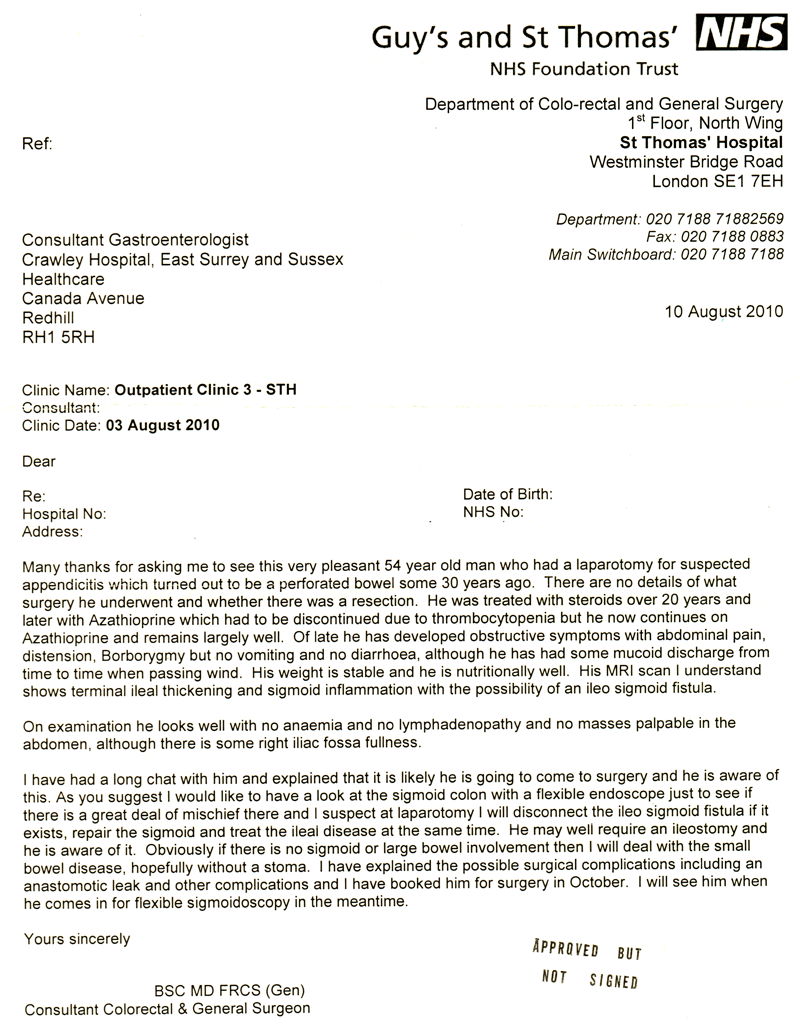
There had been a degree of waiting throughout this process, usually for a letter to be written or a referral to be made and I had learned that you really need to take matters into your own hands to drive things along. Under the NHS, if you were referred to another hospital, they had a two-week target for you to get your first appointment. I hadn’t heard from St.Thomas’ within the timescale so decided to find out what was happening. I dug down into their website and found a number to call. As it turned out it wasn’t the right one but the person on the other end said that he would still be able to help me. Refreshing. He realised that they had exceeded their two-week target so he double booked me into the next possible outpatients’ clinic with the surgeon. I did a little more research on the internet and found, as I had been told, that he was indeed one of the top men in the country specialising in colorectal surgery and, er, hemorrhoids.
On 3rd August I went up to London to meet him. My wife accompanied me. It was our first visit to St.Thomas’. We knew roughly where it was but hadn’t appreciated it’s prime location on the South Bank of the River Thames opposite the Houses of Parliament. Walking up from Waterloo Station we passed the Millennium Wheel and then caught sight of the modern building that sits in front of the original hospital.
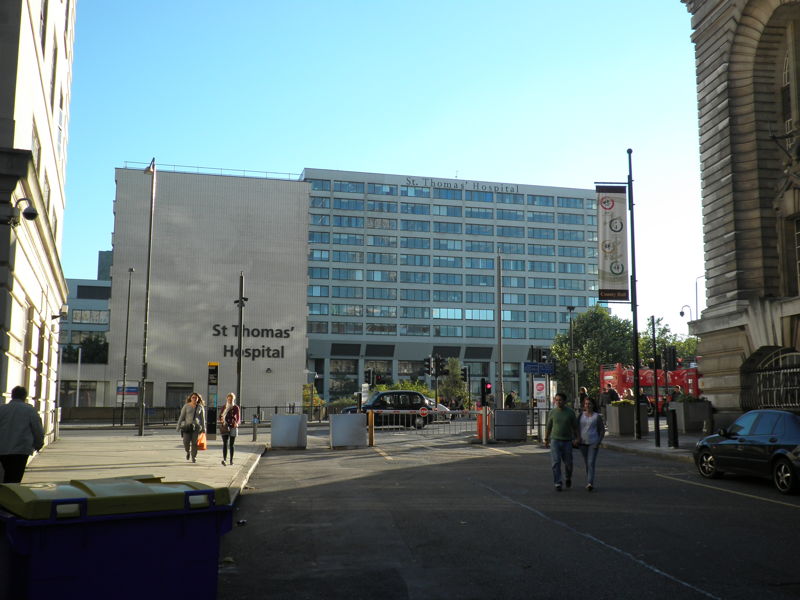
I had always been treated in smallish, local hospitals that were only two or three stories high so, to me, the 12-storey block looked impressive. We made our way into the main reception area and there was another surprise – branches of Marks and Spencer, W H Smith, a coffee shop and other retail outlets. I hadn’t seen a hospital like this before, it looked promising. We wended our way down one of the large main corridors and checked in at Outpatients reception. That’s when the surroundings started to look more familiar. We sat in a large, windowless waiting area with rows of chairs facing a number of consulting rooms. A couple of televisions were showing daytime TV but few seemed to be watching them.
When it was my turn I was shown through to the surgeon’s own office. He was dressed in a maroon uniform which seems to be the standard outfit for surgeons when they aren’t operating. The full reality of the situation was starting to dawn on me. I was sitting opposite someone who, in a few week’s time, would be “wrestling with the octopus“. My future, and my intestines, would be in his hands. I would be depending upon the surgical team’s skills.
We briefly went through my Crohn’s history, all the way back to the beginning, and talked through the planned operation. He explained that he operated on a Monday but always went on holiday in September. With that he pulled out his diary and worked out that the earliest date for my operation would be 11th October. He stuck a barcoded label onto the page and the date was set. His team would be contacting me with all the details of the admission process.
The CT scan showed that I would need major surgery but one detail wasn’t clear so he wanted to carry out a flexible sigmoidoscopy to “see if there was a great deal of mischief there”. He was concerned that the small bowel had joined onto my colon and perforated. If I was lucky the colon was just an “innocent bystander” and could be left alone. It might however be necessary to have a temporary stoma with a bag. I just thought: “Whatever. I haven’t heard of stomas but I have heard of ‘bags’. I wonder what they involve”.
I subsequently remembered where I had heard of bags before. Many years ago there was a story in the “Strange but True” section of the satirical magazine “Private Eye” about a local authority who had closed down and sold off a set of public conveniences. It was happening even then. The building was subsequently converted into a cafe. The closure made a local disabled man so irate that he decided to protest. He propelled his wheelchair into the crowded cafe, removed his bag and launched it at the wall. You can guess the rest…
I went to see the surgeon again a couple of weeks later and he carried out the scoping himself as he liked to see just what he would be dealing with. This time it was a flexi-sigmoidoscopy and all done without the aid of sedation which meant that I was able to watch in glorious, living colour on a strategically positioned monitor. Fascinating. He was pleased with what he saw and it did look as if the colon was unaffected. “There is certainly no evidence of a fistula to ileum as suspected from the MRI.”
He explained that, as a precaution, I might still be fitted with a temporary stoma. He wouldn’t know one way or the other until he opened me up. Our whole conversation was in very “matter of fact” tones, even though we were discussing life-changing actions. I found this laid-back attitude helped me keep very calm. I started to think of what lay ahead as an experience rather than an ordeal. This was another turning point and I have managed to maintain this approach throughout the whole hospital experience and beyond.
We now knew the operation date and I could tell my clients when I would be stopping work. My colleagues were asking me to keep in touch with updates on my progress so I decided to bite the bullet and start a blog, something I knew nothing about. If anyone wanted to know what was happening they could log on and read all about it. An old colleague of mine, who was now working for a pharmaceutical company, said other Crohn’s sufferers might also find it useful to read of another’s experiences and so I began writing.
Oddly enough I started to feel a lot better. I don’t know whether this was relief at finally knowing when the operation would be or the fact that I had a bit longer to get everything in order before going into hospital. Whatever the reason, I was able to get on with many outstanding jobs including finishing off the fencing I had been working on across the summer whilst listening to the World Cup.
I was also able to keep earning, paying the mortgage and planning for the future.

Final preparations for the elective surgery started at the end of September. At that point I was recording events as they happened and posted them on my blog daily. What follows is my pre-op diary, with a few comments added in hindsight.
Friday 24th September 2010
The previous day had been my last full day at work. There was just a half day the following week to do a handover and that was it. The final countdown started for going “inside”, as my other half called it.
Last time I went “inside”, 30 years ago, it was with blue flashing lights and sirens blaring. This time there had been months of anticipation and a chance to bore anyone who would listen. I considered suspending my writing until the operation was over but decided it might be enlightening for someone else who would be starting out on a similar path.
The to-do list for the following week was growing – get the car MOT’d, go to recycling centre, write our wills (you have to be ready for every eventuality), take a Lung Function Test and attend Pre-assessment Clinic with the Colorectal Enhanced Recovery Nurse (ERN). This last one sounded a bit of a mouthful so a quick internet search and all was explained. When you elect to have surgery it gives the surgical team a chance to plan the lead up to the operation, the procedure itself and the recovery programme. Plans and programmes – music to my ears. Of all the documents I found about Enhanced Recovery the one produced by Gateshead NHS Foundation Trust gave the clearest outline of what was involved.
Tuesday 28th September 2010 – Pre-Operative Assessment Clinic
Today’s visit to St.Thomas’ was to meet the colorectal ERN. I had learned that the Enhanced Recovery Programme was a technique first employed with patients going through bowel cancer surgery and had now been applied to other surgical areas. The essence of it was to accelerate the recovery process and in doing so alleviate some of the possible side effects of spending a lengthy period in a hospital bed such as pneumonia and DVT.
The team ask your wife or partner to accompany you so that they also learn about the process. We met the nurse in her office on the 11th floor. The assessment lasted around two hours. She took us through what was planned from now through to the second operation when I would lose the bag and the temporary stoma would be closed (referred to as the “reversal”).

The ERN co-ordinates the team of professionals that is dealing with you and keeps in contact once you’ve been discharged. It is entirely voluntary whether you choose to be on the scheme but to me it seemed a no-brainer as the advantages far outstripped any disadvantages.
A target date was set for my discharge with the caveat: “providing all goes well with both the operation and the recovery”. You don’t get sent home if you’re not in a fit state and I can vouch for that. You do hear horror stories of patients being discharged too soon so that a bed becomes free but I never saw that happen.
My planned dates were :
10th October – Admission – overnight stay to be ready for surgery in the morning
11th October – Operation – early morning
16th October – Discharge (with that big caveat about being sufficiently recovered)
The most surprising aspect was just how much had changed since I was last in hospital all those years ago. Admittedly that had been an emergency so there was no chance to plan anything but the level of information that the patient is now given is excellent. You are told exactly what to expect at each stage of your treatment.
The biggest changes in the regime :
No pre-op preparation any more. You can eat normally up to six hours before going into theatre and drink clear liquids up to two hours beforehand.
No more tubes up the nose (NG tube) or catheters in the arm (PICC line).
No more nil by mouth for three weeks after the operation. You are expected to drink as soon as you come round from the anaesthetic and eat a normal meal the following day.
Superglue instead of stitches or staples if possible.
The nurse was a little concerned that I had lost 10kg over the last 18 months. Whilst I was quite pleased to have shed a little weight she explained that in Crohn’s patients it is seen as one of the signs that their digestive system is not functioning correctly. The normal plan would be to take high energy drinks (Fortisip) on the two days preceding the operation, to give one’s body a boost, but in my case she wanted me to drink three bottles a day until 10th October. That would be an extra 900 calories daily. This drink would also be used throughout the recovery period.
…and the tests – MRSA (swabs taken from your nose, back of throat and between your legs), blood samples and an ECG. They must have all been OK as I didn’t hear to the contrary. The very final exercise was to measure around my biceps and then to squeeze a hand held device that records the muscle power in one’s arm. These measurements had been shown to provide a good indication of the patient’s condition and would be repeated, before I was discharged, so they could check that I had not deteriorated too much during my confinement.
She then took us to Page Ward, on the other side of the building, where they were expecting me to recuperate after the operation. Bear in mind that I hadn’t been in a hospital ward since the late 70s so what I was seeing was a bit of a culture shock. The Ward was light and airy, arranged in four-bed bays, but the overriding impression was created by the simply amazing views from every window. I left the hospital with a very warm feeling. The Nurse gave us her mobile number in case we had any questions over the next few days.

I returned home with a range of booklets to read and bottles of Fortisip to drink. That evening I started my “homework”, concentrating on learning about stomas, just in case. It was a subject I knew so little about. After a couple of hours I was much better informed and slightly shocked. It wasn’t the thought of having to wear a “bag” but one of the warnings I came across advising against the insertion of “objects” into the stoma. The “objects” in question being ones that are easily controllable by a sharp tap with a biro. Mind broadened, I continued my reading.
Wednesday 29th September 2010 – Guy’s Hospital
That day’s test was to check Lung Function as a gauge of one’s overall fitness level. I’d seen the first test on TV. Stick a tube in your mouth, inhale as deeply as possible and then exhale, squeezing every last bit of air out from your lungs. Repeat several times. I found it quite painful.
The second test was riding an exercise bike whilst wired up to a heart monitor, a breathing tube in the mouth, a heart rate monitor clipped to the ear and a blood pressure band round the arm. It wasn’t my heart and lungs that couldn’t cope, it was my legs that finally gave in. That left one more visit to London the following week to meet the stoma nurse.
I always tried to incorporate a bit of exploring when I had appointment in London. It was the first time I had seen “The Shard” close up. Very imposing, impressive and right next to Guy’s.

Friday 8th October 2010 – X marks the spot
My final visit to St.Thomas’ before the operation. I had to see the stoma nurse in case I ended up having a bag fitted. Obviously I was hoping that it wouldn’t happen but you need to cover all the bases. As the saying goes “Sh*t happens”, and it was quite relevant in this situation.
We started by discussing all the implications of being stoma’d. She told me they were not that difficult to deal with and it should only be a temporary measure, probably around six months. She then looked at my physique (bulges) and how I wore my trousers so she could position the stoma in the optimum place. Once she was happy with the location she marked it. I now had a large black cross on the right side of my abdomen, drawn with indelible felt pen and covered by a waterproof sticker. I was hopeful that it would be intact after the operation.

The actual mechanics of emptying and changing a pouch would be covered after surgery if I ended up with one. There was still an obvious question that needed answering – how do you dispose of the emptied pouch once you’ve returned home? I was surprised to be told that they could be put in with standard household waste. I made a mental note to get hold of a dedicated waste bin and some waste bags.
I told the nurse that I intended to keep a blog going whilst I was in hospital. She looked at me rather sceptically and said that for the first few days I would have an attention span of about five minutes and it was unlikely that I would feel like doing anything. She was partly right.
I asked what time my operation would start. Surgery usually began at 8:00am but until they saw the full list of operations they wouldn’t be able to tell where I would be placed in the sequence. They might have a better idea when I was admitted on the Sunday. When we saw the Enhanced Recovery Nurse the previous week she said that the surgeon liked to do his “interesting” patients early morning and that I was just such a case.
From then on it was a waiting game until Sunday when I would get the call telling me which ward I needed to report to.
Saturday 9th October 2010 – Last day of freedom
The last full day of being able to drive for at least six weeks so we decided to go out for the afternoon to see the autumn tints at the National Trust’s Sheffield Park.
In the evening I made a final list of chores that needed to be completed the following day before I got that call from St.Thomas’ telling me when and where to report to. I decided to see just how far down the list I could get. I was under strict instructions not to leave home until the hospital had rung but had been assured that they would find me a bed and that the operation would go ahead on the Monday unless the surgeon fell off his bike, again. They were hoping he had now learned his lesson.
Sunday 10th October 2010 – The waiting game
I always suspected that this day would be the worst in the process. The admission letter had reiterated that I should not leave home until the hospital had contacted me. All the chores were completed in the morning and then we waited for the call. It reached half past two and the tension was just too great so I rang the ward I thought I was being admitted to. Rather worryingly I was told that they had no record of me but would do some ringing around and let me know what was happening. About 10 minutes later they rang back to say that there wasn’t an available bed on Page Ward but I would be expected in Howard Ward instead. They would call me back to confirm when I was needed. We had a quick look at the St.Thomas’ website and couldn’t see Howard Ward listed. More worry.
I was then called direct from Howard Ward to say that I could come in as soon as I was ready and that I would be put in a single room in the private wing of the hospital but not to get too comfortable as it was for one night only. This was the most stressful time for myself and my wife but as soon as we set off for London I relaxed and then became positively chilled out. If anything, my laid back attitude made those around me more anxious.
My wife and my sister accompanied me and we arrived just after half past four. Howard Ward was on the twelfth floor with entry via a set of locked doors. Being a Sunday it took a while to find someone to let us in but eventually we were greeted by a friendly Ward sister who showed us to my room. The first impression was “Wow, what a view” as we looked south, down the River Thames towards Battersea Power Station, and then over to the Houses of Parliament.

Just before six o’clock I said my goodbyes to my wife and sister, wondering, at the back of my mind, if that would be the last time I would see them. I don’t want to sound over dramatic but it was a possibility and needed to be faced.
The Ward sister returned to check my details, blood pressure, heart rate and take some MRSA swabs. Her admission notes included the observation that I could: “suffer from anxiety due to the proposed procedure”, but in contrast I remained calm and collected. I wish I could pass the secret on to others. I had made a conscious effort to reduce my stress levels to the minimum and it worked.
A little later a doctor appeared and proceeded to stick a cannula in the back of my hand and take blood samples. I was allowed to eat up until midnight but after that it was to be fluids only. My dinner arrived. You might think I wouldn’t have been able to face anything but I ate the meal whilst watching the river traffic passing up and down the Thames. It was mainly pleasure boats packed with people out for an evening cruise, taking advantage of the autumn sunshine. When I had finished dinner I was connected up to a drip and told to expect another visit from a doctor at around 11:00pm.
I took the opportunity to spend the next few minutes watching the sun set over the Palace of Westminster. The next update to my journal would be after the operation. I was expecting it to be at least Tuesday before I would be in a fit state to write anything further. I still didn’t know exactly what time the operation would be and wouldn’t be able to find out until the surgeon arrived in the morning.
Into the unknown……..but what a view.
