
Monday 2nd December 2013 – Guy’s Hospital – Gastroenterology
The scales showed that I was 3kg lighter than the last visit – the diet was starting to work. Eventually my consultant appeared and showed me into the side room. I produced my list. Number one burning question :
Calprotectin test result? 59 – at the top end of normal, but suggested that the Crohn’s remained inactive.
Was there an alternative to azathioprine? The recent bone marrow biopsy results appeared to show that my low platelet problem was a result of Crohn’s and long-term azathioprine use. Were other drugs available? Plenty, ranging from methotrexate to biologics such as infliximab. I commented that it hadn’t worked for me. The circumstances were a lot different now, following surgery.
Would the plan be to start medication to maintain remission or to continue drug free until I noticed the Crohn’s starting up again? The aim was to monitor for signs of Crohn’s, not the symptoms, by having six monthly calprotectin tests, backed up by colonoscopies or capsule endoscopies as required. They would identify that the disease was becoming active and treatment could start before the symptoms appeared.
I mentioned the bone marrow biopsy I had undergone. You would think that a doctor who didn’t bat an eyelid at sticking a camera up a patient would be pretty much hardened to all medical procedures, but the mere mention of it was enough to make him squirm. He asked me if I was OK having the biopsy as it was the one test he really wouldn’t want to undergo himself! Funny, that’s what everyone said.
I would be back at Guy’s the following Monday for a re-run to get better aspirate slides. He was unaware of this and looked at my file again. “Ah! That’s why. I haven’t got a copy of the follow-up letter from your last haematology appointment.” Now that was a surprise. I explained the issues regarding previous follow-up letters.
When we discussed anastomosis pain previously he concluded it was purely mechanical. Given the amount of surgery carried out there could well be some adhesions or scarring formed. He examined my abdomen and could feel a small amount of scar tissue. Whilst he considered it was nothing to worry about, he gave me the option of an MRI scan if it would put my mind at rest. I had already said that I was trying to avoid endless appointments and procedures so we agreed that the decision should be put off until we had the results of the next calprotectin test in six months’ time.
Bowel Movements – not something I particularly want to inflict on readers so we’ll leave the detail in the consulting room. He did however say that after the surgery I had undergone he “wouldn’t expect my digestive system to behave normally” and using loperamide to regulate it was the right approach. That was news to me. He mentioned that there were some alternative drugs that I might want to try. (Afterwards I couldn’t remember the names and I didn’t take in the significance of his comment).
I had started following a partial low FODMAP diet, in particular avoiding onion, garlic, honey and apples. It seemed to be helping to reduce bloating and I was toying with the idea of trying to go gluten-free or maybe lactose-free. He stressed it was not necessary to go overboard with diet. You could choose which parts to follow. It should be treated as a tool to improve your quality of life, not something that affects the Crohn’s itself. If I wanted to go out for a curry one night and ignore the diet then fine, do so. It wouldn’t have a lasting effect, but I just needed to be aware that I might feel uncomfortable afterwards.
I mentioned, in passing, my exercise regime and its effect on my weight. He was happy to see planned weight loss, it was the unplanned variety that worried him with Crohn’s.
And that was it. Another appointment out of the way. Before leaving I picked up “on hold” request forms for the calprotectin and blood tests. It would be up to me to have them done in time for seeing him again in the summer. Pretty encouraging really, I just needed to get rid of the anastomosis pain and prepare for the final test of 2013.
Monday 9th December 2013 – Guy’s Hospital – Haematology Day Unit
I was wristbanded and then waited for the doctor. She appeared a short while later and took me into a cubicle in the day ward. We went through the usual risk review and I signed the consent form.
Then, yet again, the value of follow-up letters became apparent. The doctor had referred to my notes and found the latest letter on file, dated September. She was unaware of what had happened in the interim and that this was to be a second sample attempt but with no need for a marrow core this time.
It was a good thing that I had taken this all in, together with the plan to use heparin to stop the blood from clotting, otherwise I would have been back to square one and heading for a third biopsy.
She took onboard this new information and went off to find the heparin. When she returned she laid out the equipment – swabs, needles, instruments of torture and local anaesthetic. She asked me to arrange my clothes so she could access my hipbone and to ensure any “leakage” missed them. I rolled onto my left side and drew my knees up to my chest.
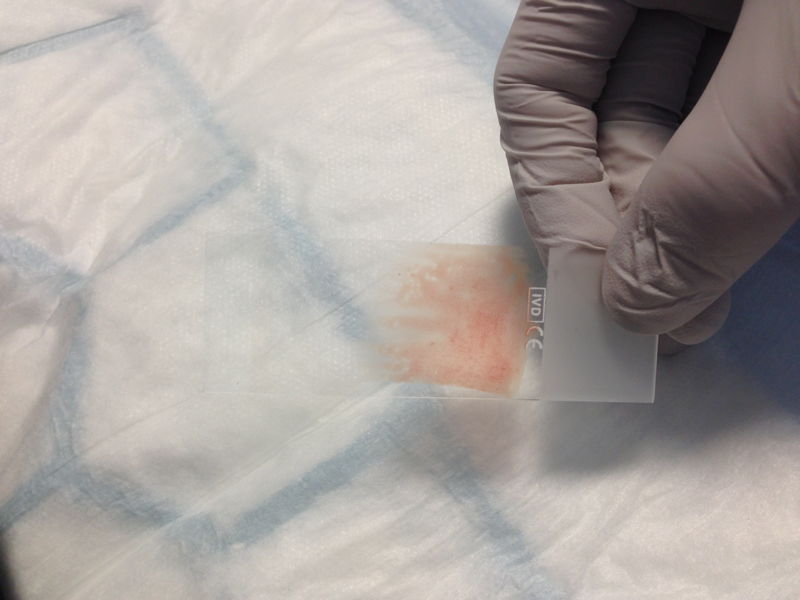
Last time it was the local anaesthetic injections that stung but this time they were outdone by the sample needle. Maybe a couple more minutes to allow the anaesthetic to work would have been better. She looked at the first slides produced but they weren’t quite as she wanted, probably due to the heparin. She asked if it was OK to go back in with another needle to get a second sample. This time I felt nothing apart from a liquid trickling down my back. Probably only blood but slightly unnerving. Clearly the heparin had worked. She was now happy with the slides and showed me what they were looking for. I explained that I wrote a patient blog and I asked if I could take a picture of one of the good slides. No problem.
She cleaned up the “leakage” and dressed the puncture wound. I then spent 15 minutes lying on my back to ensure everything had started to seal itself. She warned me that it was likely to need a new dressing before I left hospital due to the action of the blood thinner. After another 15 minutes a nurse came and changed the dressing and I was allowed to go back to work.
Wednesday 1st January 2014
I was hoping for a quiet year with even less time spent at the various hospitals. If I added up all the time getting to, waiting for, and attending appointments, it would make a large hole in the year, and that’s without taking into account any preparation or “thinking” time. One day I would do that calculation out of interest.
The gaps between the events were becoming longer. Six weeks into the new year and it was time to visit hospital again.
Wednesday 19th February 2014 – Guy’s Hospital – Haematology 2 – the first appointment of 2014 and I was strangely unprepared. Travelling up to London on the train that morning I realised I hadn’t even written out a list of questions. By the time I left work to set off for Guy’s I had managed to come up with seven things, on a good old fashioned Post-It note.
When the phlebotomist called me in she asked me if I knew why she was also taking an “histological” sample. Since I didn’t know what “histological” meant I was of little help. (Of course I now know that it’s the anatomical study of the microscopic structure of animal and plant tissues).
Back to the waiting area and at ten o’clock my usual doctor appeared, greeted me warmly and we set off to the consulting room. She introduced me to an American medical student, who was over in the UK to witness how things were done in the NHS and checked that I was OK with someone else present during the consultation.
She explained that after the last bone marrow biopsy one of the samples, which should have gone for histological testing, had either been mislaid or mislabelled so did not make it. I had forgotten that she had rung me a few weeks previously to explain the situation. She had, however, looked at the other slides from that second biopsy and these were fine.
The missing sample had been discussed with the chief histologist and he suggested doing a specific type of blood test which had proved to be 60% effective in spotting problems, if there were any. The results would be available in a week’s time. The alternative was to have a third bone marrow biopsy but they didn’t want to put me through it again. I could have made a fuss about the missing slide and the fact that I had already undergone a second biopsy but I couldn’t see what good it would do.
…and so to the list :
What was the long-term prognosis for the thrombocytopenia? Whilst it would not affect the other issues – Crohn’s, potential PSC, PVT, I must avoid the use of azathioprine in the future. My platelet count was sitting at 74, an increase of 18 from the previous test, but I was clearly asymptomatic and didn’t bleed profusely if I cut myself.
What could have caused the low platelets? There were no signs of any marrow abnormalities which could have pointed to the more sinister conclusion of leukaemia, therefore the cause is drug-induced from the long-term use of azathioprine.
Did I need treatment? No, but look out for any signs of starting to bleed more easily. Six-monthly blood tests and outpatient appointments would be sufficient monitoring. A platelet count of 50 would be the threshold for having minor surgery or tooth extraction. No need for any special measures at present.
Then we reached the thorny issue of follow-up letters. This was an area we had discussed in the past. I requested that they were sent out as soon as possible after an appointment as the last time I had seen my gastroenterologist he was unaware of the bone marrow biopsy. She promised to improve the timing in future and would write to me as soon as the histological results were back.
Twenty past ten, appointment completed and I was on my way back to work.
…and the implications for other azathioprine users?
This is just my experience. We all react differently to medications so you should not assume you will end up in the same situation. Would I have agreed to starting it back in 1998 if I knew then what I know now? Probably. For nearly ten years it kept surgery at bay so that when the knife became inevitable I was in a much better position both financially and mentally to cope.
Moving
At the beginning of April the project team I was working with moved offices to Holborn. It gave me an endless choice of routes for walking to and from work and many new areas to explore. My exercise regime stepped up a level.

Wednesday 7th May 2014 – St.Thomas’ PathLab – I had a sample pot and request form for a calprotectin test so I did the necessary and dropped it into the Path Lab on the way to work. It was clearly labelled with name, date of birth and Hospital Number and accompanied by the correct paperwork. So far so good.
Tuesday 20th May 2014 – I left it a couple of weeks for the test results to be sent to my consultant and then emailed him to find out what the result was.
The response came quickly. It started: “Rather distressingly…” at which point my heart sank and I feared the worst, but it continued: “…there is no record of it on the system“. I was surprised given that I had personally delivered the sample to the lab. I went online to see if there were any contact details.
On the Viapath website I found a link entitled “Ask Our CEO” , so I did. “Could he track down my test result?”. The next day there was a response from Customer Support saying that they were looking into the matter and then a little later on a further email telling me that they had found it, except “they didn’t know where to send it“. A rather feeble excuse given the paperwork that had accompanied the sample. Surely they would not have carried out a test without knowing where to send the bill.
Wednesday 4th June 2014 – after several days the result had still not appeared. I would try a different tack. Did Viapath have a Twitter account? Yes they did. Time to discover the power of social media. I asked the question again about the missing result and, miraculously, it was sent to my consultant. The calprotectin level was slightly elevated, something to discuss at the next appointment.
Monday 23rd June 2014 – Guy’s Hospital – Gastroenterology – I went into the appointment with two outcomes in mind – to have some comfort on what was causing the continuing ache around my anastomosis and to have revisited the long-term monitoring plan for my various conditions.
I knew there would probably be a long wait ahead as I specifically asked to see my usual consultant rather than a registrar. After a while one of the nurses announced that they were running around 45 minutes behind schedule but that stretched to an hour before I heard my name being called. My consultant apologised for the delay. His previous patient had been a particularly difficult case and couldn’t be hurried.
In the space of around twenty minutes we covered a wide range of subjects starting with the Calprotectin result – 73, slightly higher than before but on the overall scale (0 to 1800) still low. Nothing to worry about and no indication that the Crohn’s was returning. He explained that there was a new study into the correlation between calprotectin results and assessments by colonoscopy, specifically looking at the anastomosis, in predicting Crohn’s recurrence. Apart from a few “rogue” points the results closely agreed with the visually assessed Rutgeert’s score.
The recent blood test results were all within range except for platelets which at 59 were, yet again, the lowest ever. He asked me if Haematology were particularly concerned about this? I replied that they were not as I hadn’t showed any signs of abnormal bleeding.
He then said: “Sorry, we’ve been so busy focussing on your results I haven’t actually asked you how you are feeling!” That triggered our usual discussion on the ache I was experiencing and my concern that it could be the precursor of something more serious. It seemed to be worse after driving a long distance, wearing a tight belt or having a full gut. He gave me a quick physical examination, noting that hands are not a particularly sensitive diagnostic tool! He couldn’t feel anything that caused concern. Adhesions were still the most likely explanation. “And the implications of adhesions?” None. (I had read that other patients may have had a different experience).
I mentioned that on a couple of occasions recently, whilst travelling, I had to rush off to the bathroom, and luckily had made it OK, but only just. My digestive system was very variable, ranging from slower than normal to urgent. Back in December he had made a comment that, because of the surgery I had undergone, my digestive system would never return to normal. I queried how the removal of just 14cm of bowel would affect it so much. He understood my reasoning but it wasn’t what I was missing that had prompted his remark, it was the effect of a surgeon having been in my abdomen and rearranged my guts.
Urgency seemed to be worse on work days when I knew I needed to get to the station by a certain time. I wondered if this was a form of stress that was making it worse. He replied that stress was widely known to affect the digestive system so it was very likely a contributing factor. We then discussed the psychological aspects of Crohn’s which can have a very marked effect on patients’ lives. For instance, he had some patients who were now afraid to go on the Tube as they had suffered bad experiences and were not prepared to risk it again.
There was a theory that the ileocaecal valve played a part in slowing down the digestive system and acted as a break point but in his opinion this was groundless. (My valve was removed as part of the surgery in 2010.) It would be worth having a test for bile acid malabsorption (BAM) as this could affect the speed at which matter passes through the gut. It was the first time I had heard of this condition and, again, I didn’t take on board the significance of the remark.
He recommended I should have a SeHCAT test as this was the “gold standard” for diagnosing BAM. He asked me to contact his secretary for the result once I had been scanned.
We moved onto the subject of ongoing monitoring. I had read that Crohn’s disease gave an increased risk of bowel cancer and wondered whether this was an argument for having colonoscopies rather than calprotectin tests. He explained that the increased risk was due to inflammation in the colon and therefore more prevalent in ulcerative colitis. My last two colonoscopies, and now the calpro tests, showed that I was clear of inflammation.
I came away from Guy’s with a slight spring in my step if for no other reason that it was so good to find a consultant that listens and discusses your health concerns in detail. It was worth the one-hour wait. I was also reassured by his comment regarding cancer risk and inflammation, and of course the fact that, at present, the Crohn’s seemed to be held at bay. I just had to accept the ache in my side was not an indication of something more serious and that I could get on with life with added vigour.
Tuesday 29th July 2014 – St.Thomas’ Hospital – SeHCAT Test – as tests go this must be one of the least stressful that there is, unless you have problems swallowing pills and lying in X-ray machines. The procedure required three visits to the Department of Nuclear Medicine.
First visit – It was the hottest day of the year in London. I didn’t want to catch the Tube so decided to walk from Holborn down to St.Thomas’. I made my way through the throngs of tourists on the Embankment and arrived just before my allotted time, 12:30pm. After a short wait I was taken into a side room. A container was produced. It was clearly some type of radioactive shielding and inside was a single capsule, the same size as my loperamide tablets. I was given a glass of water and told to swallow the pill. First part over. The salts in the capsule needed time to dissolve and pass into the gut so I was told to return at 3:30pm. I retraced my steps to Holborn.

Second Visit – Walk from Holborn No.2. I arrived exactly at half past three. There were slightly smaller crowds of tourists to contend with otherwise I would have been late. As soon as I arrived I was shown to another waiting area whilst the X-ray machine was prepared. After a few minutes I went into the scanning room and lay on the sliding table, face up. The radiographer lined up the X-ray head and I just had to lay there for five minutes. I was then asked to roll over onto my front and had another five-minute scan. When they were complete I was told to come back the same time the following week for the final scan.
That was all there was to it and I was shortly on my way to Victoria station, homeward bound. When I arrived home I checked the app on my phone and had walked just short of 17km, an all-time record and in that heat. That must be good for losing a few more kilograms.
Tuesday 5th August 2014 – St.Thomas’ Hospital – SeHCAT 2 – when I arrived they were waiting for me. As soon as the X-ray machine was ready I had the two 5 minute scans and the test was complete. A computer would then compare the two sets of readings and work out how much of the bile acid had been retained in the body. The results would take a week to come through. Retention at 7 days is normally above 15% and values less than this are banded as mild, moderate and severely abnormal.
Tuesday 12th August 2014 – The Results – I emailed my consultant to ask if the results were available. His response included the conclusion from the report :
“SeHCAT Retention at Day 7=1% (Normal study: greater than 15%). Impression: Severe bile acid malabsorption“
I was given the option of bringing my appointment forward to discuss the result or he could write to my GP asking for treatment to start, or we could do both. I opted for both. The appointment came through for the end of September. Given that the malabsorption was described as “severe” I was surprised the effect wasn’t far more extreme.
Bile Acid Malabsorption
I had held off doing any research into BAM as I was hoping that the test might prove negative. It was time to dig a bit deeper into the subject.
The brief explanation was – bile is produced in the liver, stored in the gallbladder and then passes into the small intestine where the bile acids are critical for digestion and absorption of fats and fat-soluble vitamins and eliminating toxins from the body. When the bile acid reaches the terminal ileum the bulk of it is recirculated. If the terminal ileum is missing, in my case due to surgery, then it passes straight into the colon and interferes with how the bowel absorbs water. Excess water in the colon has a particularly nasty side effect – diarrhoea.
It was turning into my own “Donald Rumsfeld” moment. If you recall the well known US “philosopher” was widely ridiculed for the following quote, unfairly in my opinion, as it makes perfect sense.
“…as we know, there are known knowns; there are things we know we know. We also know there are known unknowns; that is to say we know there are some things we do not know. But there are also unknown unknowns- the ones we don’t know we don’t know.”
I was told that after my ileostomy the absorption of vitamins and salts would be much reduced due to the lack of a terminal ileum. The surgeon repeated this message after the operation. I took it at face value. I would need to increase my intake of salts to compensate and take supplemental vitamins. After all, I was being given rehydration salts and told to eat a salt rich diet. I would also need regular vitamin B12 injections. What could be clearer than that?
It wasn’t until I researched BAM that I found it has an alternative name “Bile SALT Malabsorption”. Suddenly the comment about not absorbing “salt” took on another meaning.
This is where Donald Rumsfeld comes in. I heard what the Enhanced Recovery Nurse and the surgeon told me. They were using everyday, medical terms to describe a potential problem to a patient. I understood what the words meant – to me. I didn’t realise that my understanding was different from theirs.
From this experience I have learnt, nowadays, to always question what I am being told and to get the doctor or consultant to explain, in simple, non-medical terms, exactly what they mean and what the implications are.
I kept coming back to those particular words in the quote: “there are things we don’t know we don’t know”. It would be worth repeating every time I entered the consulting room and I wondered what else I didn’t know. By the end of my research I came away with these overall impressions :
BAM is often overlooked as a diagnosis of diarrhoea and many patients, and more worryingly, health care professionals, are unaware of it. The SeHCAT test is not widely used in the UK and not even licensed in the US.
The medications to treat BAM are called bile acid sequestrants and come in powder forms or more expensive tablets. The powders are not well tolerated by patients leading to a high rate of non-adherence but GPs prefer to prescribe them due to lower cost.
NICE (National Institute for Health and Care Excellence) produced a study into the cost effectiveness of the SeHCAT test as a diagnosis tool. It included a paragraph that stopped me in my tracks and I have quoted it many times since :
“Crohn’s disease is sometimes treated by ileal resection. The prevalence of bile acid malabsorption among people with Crohn’s disease in clinical remission who have had ileal resection is high (97%)”
If the occurrence of BAM is so high then why aren’t all patients, who are likely to lose their terminal ileum, warned about this outcome and prescribed the relevant medication post surgery?
Saturday 27th September 2014 – today I had to do something I couldn’t remember doing before – setting off on a journey and then turning back. We left home to drive to Berkshire. As we joined the motorway I suddenly felt the need to visit the bathroom. At the same time a pain started in my lower left back. The pain became worse. We made it to the nearest services area and by now I was starting to get scared, and I don’t usually do scared. Off to the bathroom. An abortive visit and the pain was not improving. I went back to the car hoping that adjusting the seat to a new position might ease the pain slightly but no, it started spreading up the left side of my back. I decided there was no point in sitting there hoping for an improvement. We set off for home whilst I could still drive.
Was this the pre-cursor for some new issue?