
With a “big” birthday rapidly approaching I had an important decision to make. For some time I had been thinking about retiring to get the most from life before the Crohn’s reawakened or some new ailment reared its ugly head.
I had been told that making the decision to retire would be the most difficult part. I happened to mention the subject to my gastroenterologist and his response was not to allow my health to sway my decision. An interesting thought.
Tuesday 5th January 2016 – Guy’s Hospital – Gastroenterology
Just a routine appointment at the IBD Clinic and not much to discuss. My calprotectin level had dropped a little since last time. The consultant noted that I remained well and that the recent gastroscopy had shown only small varices that did not need banding. As I was due for a colonoscopy that year I suggested that we should not meet again for another 12 months, rather than the usual six months, and that I should have a repeat calprotectin test beforehand. As usual he stressed that I could, and should, get in touch in the meantime if the need arose.
Tuesday 3rd May 2016 – GP’s Surgery – I had an annual check-up with my GP and had pre-empted the appointment with a full blood test. The results came back within range except for lymphocytes and platelets, as expected. I emailed a copy to my gastroenterologist, mentioning that I had been getting abdominal pain for the last few weeks and rushing off to the bathroom. He replied that I should have a calprotectin test sooner rather than later and would have a sample pot sent to me.
The symptoms were a pain around the midriff; extreme tiredness – so much so that when I arrived home from work, I would have dinner, collapse on the sofa and wake up at eleven ready to go to bed. Most worryingly, and not wanting to get too graphic, let’s just say the phrase “through the eye of a needle” comes to mind.
I’ve known for some time that if you can visualize pain it is much easier to deal with. Mentally I lined up the usual suspects – a virus picked up from the train to London ; eating something dodgy (I had eaten out in a restaurant one lunchtime and the food was decidedly below par); wearing a very tight belt whilst doing a lot of physical work; or, the one that constituted the “elephant in the room”, five years of Crohn’s remission was at an end.
It was ironic that I had chosen to extend the gap between appointments from six to twelve months. I was now regretting it. My weight was dropping and the ache in my side was becoming more frequent. I dropped the sample into the IBD nurses at Guy’s and awaited the result.
It came back two weeks later. My consultant emailed: “interestingly it has risen from 179 to 436” and suggested that a colonoscopy should be the next step. “Would I be OK with that?” Not a problem but I was starting to wonder if I had been “crying wolf” as I had started to feel a lot better. Maybe it was wishful thinking. Something was causing the calpro results to keep rising and my weight was still falling, down from 91kg to 82kg.
The colonoscopy was duly booked for July but I wondered how that would allow my small intestine to be viewed. My consultant wrote back that the colonoscopy would be able to reach just past the anastomosis, the most likely place to find inflammation if it had restarted. If the scope showed nothing then I would need further tests by which I assumed he meant a scan. I was sure he would not want to risk getting a PillCam stuck.
Wednesday 13th July 2016 – St.Thomas’ Hospital – Endoscopy Unit
This would be my fifth colonoscopy so I’m not going to describe the whole process again. After the previous scoping I had decided to take the second sachet of Citrafleet a lot earlier than recommended. I woke up especially early and took it at 5:30am. I was glad I did as it had only just finished taking effect at half past ten, when I was due to leave home.
On arrival I was asked to change into a hospital gown. The usual, very flimsy paper briefs had now been replaced with some very stylish dark blue, paper boxer shorts with a large slit up the back. Modesty and good taste prevented me from taking a selfie, especially since I put them on the wrong way round to start with.
For the first time ever the nurse had problems finding a vein for the cannula. After two attempts with my right arm she handed me over to her colleague who succeeded with the other one.
One of the doctors came in to get the consent form signed. I explained that I wanted to keep alert throughout the procedure so that I could ask questions. I mentioned that my weight was a lot lower than for previous scopings so he decided to give me less sedative than before.
Whilst my main consultant watched on, the doctor started the procedure. As the camera made its way ever onwards it started to show mild inflammation in the colon but when it reached the anastomosis the inflammation disappeared. The doctor decided to see how much further he could push the scope into the small intestine.
Normally I didn’t notice the movement of the camera, the air used to expand the gut or the liquid cleaning the lens but that final push was the exception. I ended up being asked to roll onto my back which made progress a little easier. Once again there was no inflammation and the scope was withdrawn.
They concluded that there was mild, ongoing Crohn’s disease in the colon and that could explain the high calprotectin result. Of more concern was the weight loss, now down below 80kg for the first time since before my ileostomy, A request for an urgent MRI scan was sent.
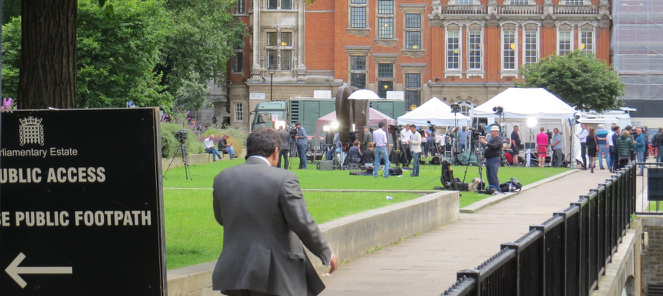
By half past three it was time to leave St.Thomas’, clutching a copy of the report. A fellow GSTT IBD patient gave up her time to escort me to Victoria Station. I chose our route back past the Houses of Parliament but found the path across College Green shut as the area was swarming with journalists and TV crews still caught up in the febrile atmosphere following the Brexit vote.
I left it a couple of days then rang the MRI Unit to see if they had allocated a date for the urgent scan. If I was to be seen within two weeks then surely I would need to be on their schedule by now. I was told that they were working through the bookings in order, which suggested they didn’t prioritise them.
When I called again a couple of days later I was told Friday 29th July, just 12 days from the request going in. There would be no need to be accompanied as no sedation would be used. In the meantime a date for the follow-up gastroenterology appointment to discuss the results also came through – 5th September.
Friday 29th July 2016 – Guy’s Hospital – MRI Suite
My first chance to visit the newly refurbished and extended MRI suite that had only been open a few days. There were now four scanners in operation.

New, “improved” MRI prep solution
Patients were asked to arrive 40 minutes before their appointment time as there was a prep solution to drink. I knew what to expect – a thick, lemony liquid with the consistency of wallpaper paste that needed constant stirring. Wrong! It was all change. Instead there was a one litre bottle of a clear fluid, Mannitol, and a glass of water as a “chaser”. The nurse told me to drink a cup of the liquid every 5 minutes. She mentioned that it was not very palatable and she wasn’t kidding. I had managed to drink about three quarters of the bottle before it was time to be cannulated. For the second time in 3 weeks the nurse had difficulty in finding a good vein. On her third attempt she was successful.
I’ve described MRI scans, in detail, elsewhere. They are noisy machines so I was rather surprised to have fallen asleep towards the end of the procedure. I think it showed just how tired I had been recently.
Wednesday 10th August 2016 – Guy’s Hospital – Haematology 2
Another routine appointment. I didn’t have a list of questions because nothing had changed since my last visit. The doctor called up my records on her screen and said, in passing: “just to put your mind at rest – the MRI scan didn’t show anything unexpected, just some mild stricturing in the small bowel which had been seen before.” Stricturing? I wasn’t aware of any strictures. None had been seen during the colonoscopy. Something to take up with my gastroenterologist.
Friday 12th August 2016 – A Major Milestone
I finally retired from work. The decision to take early retirement was not taken lightly. I put on my “objective” hat, the combination of conditions that I suffer from, the chances of leading a trouble free life until some ripe old age seems unrealistic. If I could retire whilst relatively fit then why not? I needed to make sure two things were in place. Firstly, that we had sufficient savings to bridge the gap between giving up an income and receiving a pension. Secondly, that I had enough outside interests and hobbies to keep my mind and body active.
The first one was a matter of judgement; the second one was never likely to be an issue given our plans for the garden.
In the end the decision was only partly voluntary. The London Underground project I was working on had reached a significant break-point and the client had decided to move offices to Stratford in East London. I was already finding travelling to Canary Wharf unpleasant, although some of the early morning sights were worth it. The thought of venturing even further east was the final straw.
Meanwhile, over in City Hall, the newly elected Mayor of London had decreed a large reduction in the number of contractors working on the project. Whilst I had been kept on for as long as possible my time was finally up. Having worked a 3 day week for several years the transition to a life of leisure was made easier.
Monday 5th September 2016 – Guy’s Hospital – Gastroenterology
The first appointment following my retirement so no opportunity to take an early lunch hour from work to attend. I arrived at Guy’s with only two minutes to spare. Almost immediately I was called for weighing. Nearly 6 kilos down since my last appointment. I asked the nurse to put a note on my records that I wanted to see my usual doctor.
Weighing was the passport to the inner waiting area, from where you would be collected by your consultant. A student approached me and asked if I would be prepared to take part in some genetics based research. I was happy to help so he left me a document to read and would talk to me after I had seen the consultant.
The waiting area was remarkably quiet, not jam packed as on previous visits. To pass the time I was re-reading the text of a talk I would be giving on “Living with IBD” as part of a course on living with chronic conditions. I was miles away, submerged in the section about weight loss and fatigue, when I realised my name was being called. It was my consultant. We would be reviewing the results of the last colonoscopy and MRI scan and mapping out the route to get my health back on track.
The results of the latest scoping were “ongoing mild colonic Crohn’s Disease” whereas the previous one, back in February, showed “mild, patchy erythema throughout the colon, however no ulceration seen”. Had there been a change? Did it need to be treated? The latest result suggested that the Crohn’s had returned albeit mildly. I mentioned that my last calprotectin level had been elevated – around 425. He called up all my results and drew a graph which showed that the last result did not follow the trend. “Collect a sample pot on your way out and we’ll re-run the test in case that was a rogue value. Let me know when you drop the sample in so that I can keep an eye out for the result“.
I asked about potential treatment for the inflammation. He mentioned a multi-matrix form of Budesonide (MMX/Cortiment) that is used to treat ulcerative colitis and formulated to release at a controlled rate to minimise absorption elsewhere.
The strictures in my colon, picked up on the MRI scan, weren’t apparent from the colonoscopy. Usually a scope overrides a scan so this was unexpected. He proposed to take the results of both procedures to the next multi-disciplinary meeting to try and come up with an explanation.
Given the very variable nature of my digestive system and recent weight loss I wondered if it was finally time to bite the bullet and start taking a sequestrant to treat the bile acid malabsorption. I had been trying to avoid taking yet more drugs whilst loperamide appeared to be working.
Would he be able to prescribe Colesevelam, the tablet form, rather than Questran powder, as I had read that many patients found the former easier to tolerate? I was aware that there was a cost differential. He said that for the good of the Health Service budget I should try Questran first but to discuss it with my GP. My next hospital appointment would be arranged once the MDM had discussed the results.
When my appointment was over I went and saw the student doing genetic research, spent 10 minutes answering his questions and intermittently spitting saliva into a sample tube.
…and then my mobile rang, It was an old client asking if I would be free to do some work for them. Retirement had lasted precisely 5 weeks.
Thursday 15th September 2016 – Kings College, London
Time to repay the favour to the patient who had escorted me to the station after my last colonoscopy. She was due to give a talk to 200 undergraduate nurses about “Living with IBD” but could not make that date. She had asked me if I would step in. It was the first time I had done anything on this scale. I was planning to talk without notes but then reality kicked in. I ended up with a carefully prepared script and a few props to illustrate the subject. It was a thoroughly enjoyable experience. I hope the audience felt the same. Given the opportunity I would jump at the chance to do it again.
Friday 30th September 2016 – out of the blue a letter arrived showing an ultrasound scan had been booked. I was curious to know what had prompted it so emailed my consultant. It would also be a good chance to see if my calprotectin result was available. He replied that the MRI scan had shown a slight thickening to my gallbladder wall so an ultrasound was recommended to investigate. The calprotectin level remained elevated at 512 but this could “just about” be explained by the mild inflammation seen in the colon. Why didn’t we catch up after the scan?
Monday 17th October 2016 – St.Thomas’ Hospital – Ultrasound Scan
An early afternoon appointment so plenty of time to visit a gallery first. I walked up through Green Park and headed for the Abstract Expressionism exhibition at the Royal Academy in Piccadilly. (I can do pretentious, but you may have already come to that conclusion.)
The scan itself only took a few minutes. I asked the sonographer if she had seen anything untoward and she replied: “only a gallstone”.

12th December 2016 – Guy’s Hospital – Gastroenterology
As the date for the appointment drew closer my stress level increased, not from the potential medical implications but the logistics of getting to London by 10:20am. It should not be a problem until you realise that it meant relying upon the ever worsening service provided by Southern Rail. It had become progressively worse since just before I retired.
As if to prove me wrong the train was exactly on time.
Having arrived at the hospital with five minutes to spare I was met by a nurse who explained that the clinic was running 45 minutes late which increased to just over an hour before I heard my consultant calling my name.
We started out by discussing the outcome of the MDM. Had they been able to reconcile the apparent contradiction between the colonoscopy results and the MRI scan? No, they were at a loss to explain the differences.
The MRI report noted a 100mm stricture in the transverse colon and another in the ascending colon. Neither had been apparent from the scoping. The scan also showed adhesions, one of which was between intestine and bladder. This could potentially lead to a fistula developing between the two. The tell tale sign would be gas when passing urine. That was a new one on me and certainly not something I had experienced so far. The word that had worried me was “fistula” but as he pointed out the report only said “possible”, it was not a certainty.
The options left were to repeat the colonoscopy, or the MRI scan, but a barium enema would be preferable. I wasn’t sure for whom. The last one I had was over 30 years ago but still fresh in my memory. Rather than going straight to another procedure he suggested that we carry out another calprotectin test and if the result was the same or higher than last time it would be time to start practicing the buttock clench, so vital with an enema.
He asked how I felt generally. My answer was “very well” apart from getting an upset stomach every couple of weeks for a day then back to normal. There was also an incident when I seemed to be leaking fresh blood but it only lasted 24 hours and I concluded it was purely mechanical, maybe a burst blood vessel. He agreed that it sounded plausible.
I explained that I was keen to remain drug free, having taken no Crohn’s medication since 2011. Was that an option with mild inflammation? Yes. The aim would be to start treatment early enough, to avoid surgery, should the inflammation worsen. In line with my aim of not taking any new drugs I still hadn’t been to see my GP about starting a sequestrant for BAM. For the time being I would remain on just loperamide and adjust the dosage accordingly.
The one question I forgot to ask was did my reaction to Azathioprine suggest that some of the other commonly used drugs may be unsuitable? That would have to wait for the next appointment.
I would be having my annual gastroscopy the following week and was wondering if we should also be monitoring my liver for potential stiffening, due to PSC. He said I should ask the endoscopist as it was their specialist area. The visit would also give me a chance to drop off the calprotectin sample to the path lab. I would then need to email my consultant in mid-January to get the result and hope it was less than 512.
After the appointment it was off to have lunch with a fellow GSTT patient and then on to meet up with an old colleague for a coffee before attempting to get a train home.

Four words in particular made me wonder what lay ahead – “stricture”; “fistula”; “adhesions”; “penetrating”. I had experienced them all before and they ended up with the surgeon’s knife. If I ended up needing further surgeries it would not be a surprise. My consultant had previously quoted the average time between surgeries, for Crohn’s patients, as being 10 years. I had already reached six and a half from the ileostomy.
Next time I saw my consultant it should be an informative conversation. How much of the report could have been expected, given my past history? Were there any pointers to the reawakening and progression of Crohn’s disease? What next? Did it point to surgery sooner rather than later?
21st December 2016 – St.Thomas’ Hospital – Endoscopy Suite
My ninth gastroscopy at GSTT since 2012. It was very much the same as the previous year and once again, good news, no banding needed. Coffee and biscuits before walking back to Victoria and the train home.
I was starting to get used to these relatively quiet years so I couldn’t help but wonder if 2017 would follow a similar pattern. Would there be some nasty surprise lurking around the corner.? I didn’t have long to wait…