
As we approached home the pain was becoming unbearable but we made it, just. I immediately took some painkillers and lay on the sofa with a hot water bottle against my back. Over the space of the next couple of hours the pain melted away and didn’t return.
Could it have been a small kidney stone? Was it an existing condition giving me a warning sign or was it something new? By Sunday I was digging in the garden and planting shrubs with no recurrence of the pain.
Tuesday 30th September 2014 – St.Thomas’ Hospital – Gastroenterology
It didn’t feel like the last day of September, more like mid-summer. The sun was shining and the 3km walk from work down to Westminster was enjoyable. This was made better by there being fewer tourists to dodge than usual.
The four o’clock appointment was the latest I had attended so I was wondering at what time I would be called into the consulting room. There was the usual false hope of seeing your name appear on the screen only to find it was just for weighing. I asked for a note to be put on the front of my file saying that I wanted to see my usual consultant. I was prepared for the long wait and just gone five o’clock my name appeared again. Off to the consulting room only to find one of the registrars.
I explained that for continuity I had asked to see my usual doctor and returned to the waiting area which, by now, had few occupants. After just five minutes my name appeared for the third time and now it was for the right consultant. After the initial pleasantries I produced the obligatory list and we worked our way through it.
The main reason for the visit was to discuss changing medication to deal with bile acid malabsorption. I knew that some patients struggled with the standard sequestrants but there appeared to be benefits over just staying with loperamide:
What about the advantage of lowering cholesterol? “Good point. Do you have high cholesterol?” No. “Well there’s no advantage then. How many loperamide capsules are you taking a day?” Two or three. “That’s very low. Some of my patients are on 20 per day. If you were to change to BAM medication the manufacturers recommend not taking any other tablets within four hours so you would need to change your tablet regime…….“
We concluded that I should continue managing the BAM with the existing loperamide dosage.
I went on to explain about the pain I had suffered on the previous Saturday. “Let’s get that checked out” and he entered a request for an ultrasound scan. I wondered if it would also be a good idea to have another calprotectin test done in time for our next routine appointment in January. He agreed and printed off the form to accompany the sample. He recalled that the last results had gone missing for a while. I explained the power of finding the “Contact our Chief Executive” page on the laboratory’s website. He sounded impressed and we then had a brief discussion on the IBD communities that had sprung up on social media.
I asked when the next colonoscopy would be due as I knew there was a recommended frequency for Crohn’s sufferers. My last one had been nearly two years ago. We agreed to review the question again at the January appointment, after the calprotectin results were known.
When writing the list I had asked my wife if she had any questions. “Yes. Why do you look like you’re pregnant?” Ever since the ileostomy my torso had taken on a bloated profile. What could cause this? He replied that all medical students are taught that bloating can be caused by the five Fs: Fat (obesity); Faeces (constipation); Fetus (pregnancy); Flatus (gastro-intestinal wind); Fluid (ascites).
The first three we could discount. The most likely cause was either wind or fluid. During the ultrasound scan I should ask the sonographer to take a look a little higher than my kidneys to see if any fluid showed up.
We then had our regular discussion about the ache in my side. Recently it seemed to be worse again with a full gut. He said that would make sense as there could be some scar tissue around the surgery that had become distended. I showed my ignorance by remarking that we had not seen any scar tissue during the colonoscopies. He replied that it would be on the outside of the gut and the only way to see it would be by a laparoscopy. Best leave well alone.
The next day I had a call asking if I could come in for the ultrasound scan on Friday week. That quick? I wouldn’t be available that day so they gave me the next possible slot on 4th November.
Tuesday 4th November 2014 – Guy’s Hospital – Ultrasound Imaging
Knowing I would be leaving work at lunchtime it only seemed fair to make the effort to get in extra early and make up the time.
For those IBD or BAM sufferers reading this, I have a question – what’s the first thing you do when waking up in the morning? Within the first few seconds I can usually judge how well behaved my digestive system will be that day. I can then work out how long to allow for breakfast and how long in the bathroom. My assessment that day was – digestive system OK but probably wouldn’t want to get delayed en route. With a little extra effort I managed to catch the 5:40am train.
The journey started out as normal but the train was gradually getting slower and slower. Eventually we came to a halt at the little urban hamlet of Norbury. The guard announced that there was a track problem ahead and he didn’t know how long we would be waiting there. Just like the previous time the train had been held up on its way to London I immediately felt my digestive system stir.
This was crazy as I had been fine until the announcement. Earlier in the book I referred to it as “Crohn’s patterning” and there seemed little I could do to break this reaction. I tried analysing my situation rationally but the “what if I need to get to the bathroom quickly?” thought overrode everything. Whilst I was wondering what to do, the guard announced that the train would be going no further and that we should all disembark, making our way to another platform.
That was enough to distract me and we slowly filed over to the new platform. Amazingly another London bound train arrived, with empty seats and the journey continued uneventfully but yet again this incident brought home just how easy it would have been for a normal day to transform into a very confidence-destroying experience. The Joy of Crohn’s and BAM…….
The instructions that came with the Ultrasound letter said drink one to two pints of water at least one hour before your appointment and arrive at the Hospital with a full bladder. For the previous scan, back in 2008, I had been asked to arrive one hour early and drink the water whilst there. A much more patient friendly plan.
I kept drinking water from mid-morning onwards and tried to retain as much as I could. I set off on the 45-minute walk to Guy’s on the basis that it would keep my mind off of my bladder. The gloomy morning had turned into a bright, sunny day and I made sure my route took me past St.Paul’s Cathedral. So far so good. Plenty of distractions.
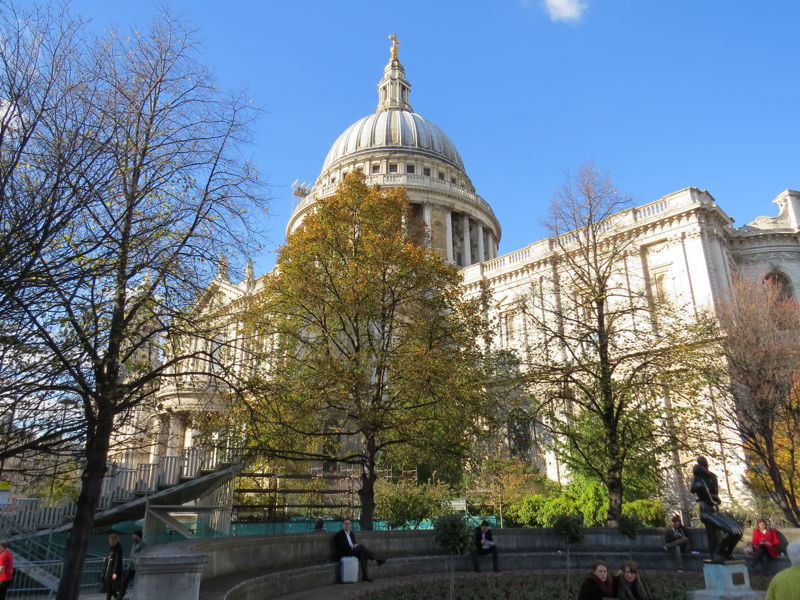
By the time I had crossed London Bridge and was approaching Guy’s I was getting desperate. A full bladder coupled with a 45 minute walk may not have been such a good idea after all.
I found my way up to the 2nd Floor Ultrasound Dept. and was asked to take a seat in the waiting area. I felt I was going to burst so asked one of the nurses if a full bladder was really necessary for the scan. She replied that it was and if I went off to the bathroom I would then need to drink more water and wait another 30 minutes. The doctor had just arrived and I heard her explain my predicament. In the meantime walking up and down the corridor seemed to help a little.
The doctor called me in and said: “I’ll scan your bladder first – should take 30 seconds – then you can go to the bathroom“. He quickly completed the scan, complimenting me on how much I had managed to hold in. I then dashed to the nearby bathroom with huge relief.
Back to the trolley and the scan continued around the rest of my abdomen. I remembered to ask about ascites – accumulation of fluid in the peritoneal cavity – so the search moved to a little further up. A couple of minutes later the procedure was over and the doctor revealed what he had found……”Nothing, apart from one gallstone.” Half of me was relieved; the other half was disappointed that no kidney stones had shown up. It left the questions of what had caused the original pain and the bloating unanswered. More questions for my next GI appointment.
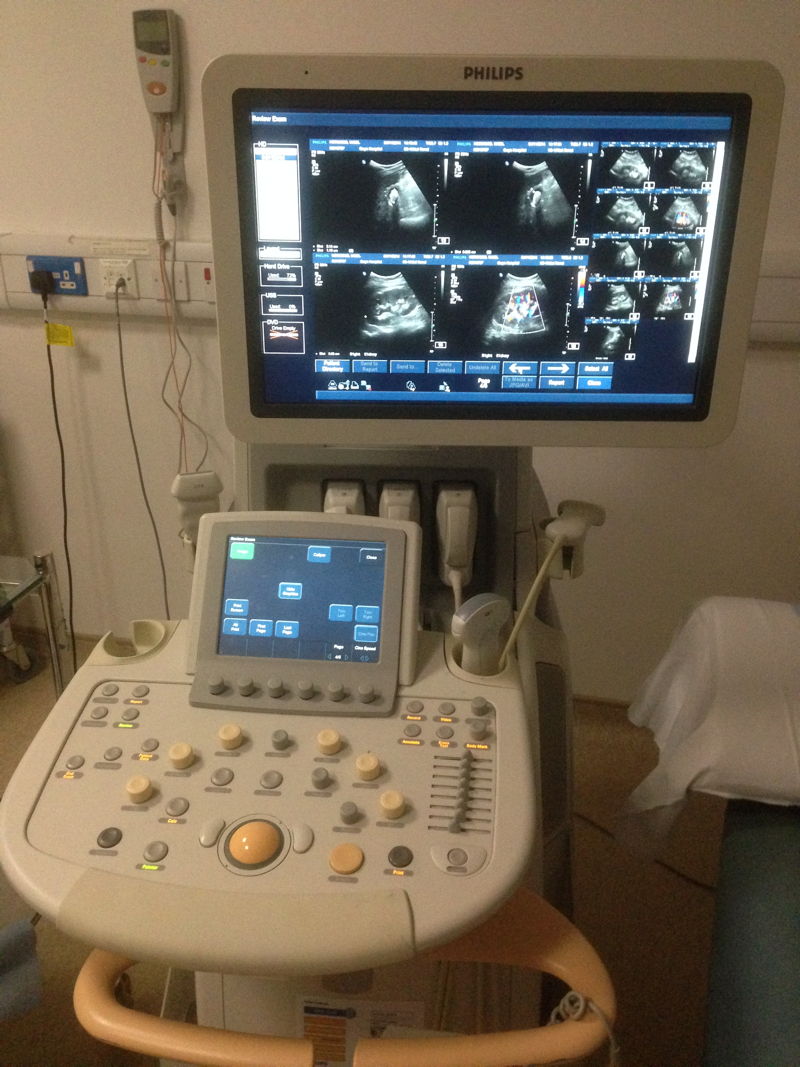
I asked if I could take a picture of the machine to illustrate my blog. He very kindly called up the screen showing multiple scans and commented that he liked patients that took an active interest in their treatment.

Monday 10th November 2014 – St.Thomas’ Hospital – Endoscopy Suite
All my previous procedures had been early morning affairs but this one was set for 2 o’clock in the afternoon. The new Endoscopy Suite was on the first floor, with the waiting area overlooking the Houses of Parliament. I booked in and we’d only been sitting there for a few minutes when I was called by a nurse to run through the pre-procedure checklist and get cannulated. She chose a good vein and it went in without any fuss.
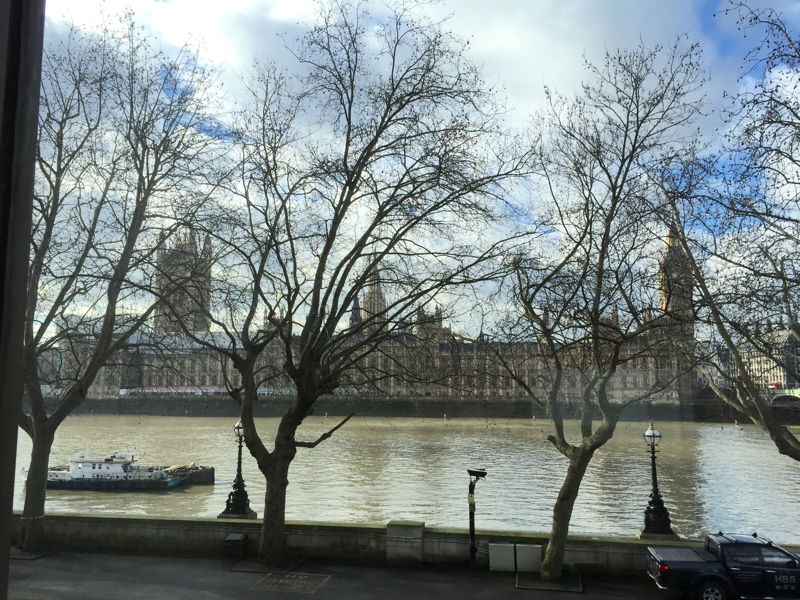
There was one other patient ahead of me but they were having both an endoscopy and a colonoscopy in one go and it would be quite a lengthy procedure. I said that I hoped the two cameras didn’t meet, which I thought was quite amusing. She replied that they were done separately and I wished I’d kept my mouth shut.
My wife was told to come back and collect me two hours later. She wandered off up Whitehall to the National Gallery to see some of her favourite paintings.
Back in the waiting room another nurse appeared to explain that there would be a delay to my procedure due to the patient ahead of me being “topped and tailed”. He asked if I had seen a doctor yet to which I replied “No”. After another few minutes the doctor arrived and ran briefly through the risks before asking me to sign the consent form. One thing he said, which I hadn’t been told before, was that the risk of the varices bleeding was at its greatest around a week after the procedure, at which point the banded section should have formed scabs.
In the Procedure Room three nurses were waiting. I remarked: “please don’t put the gag in until I’m about to go under“. One of the nurses, who was looking at me in a strange way, asked: “Gag? What gag?” I explained is was the green, plastic thing that protected your teeth and stopped you biting the endoscope. “Oh, the mouthguard. When you said gag… well, let’s not go there!“
With a few squirts of Xylocaine spray to deaden the back of the throat and the oxygen supply hooked up it was time for the “best” bit – sedation. The doctor injected the Midazolam/Fentanyl cocktail. One of the nurses was stroking my head, telling me to concentrate on my breathing and visualise something pleasant. I was expecting to slip away into temporary darkness….
For previous procedures I had been put out cold and then woken up in Recovery. This time I was aware of what was going on and must have been partially awake, although very drowsy. I don’t know how I managed it, and don’t even remember doing it, but somehow took a photo of the endoscope unit. Very sad.
After a while in Recovery I moved to the waiting area where my wife joined me. The cannula was removed and I was given a copy of the Endoscopy Report. They had found two large varices which had been banded. That was bad news as I was hoping there had been no growth since the previous year. The worse news – I would need a further procedure in four weeks time to see how successful this banding session had been and would need to follow a sloppy diet for a few days.
We made our way back home. I spent most of the evening asleep. I don’t know why I felt so weak this time but the whole procedure had hit me for six. I was pleased with the advice of not going to work the following day and then took a further day off as I didn’t feel up to travelling into London.
It’ left me wondering if the varices would continue to grow at their current pace and if the time between procedures would be reduced. A question for the doctor.
Thursday 11th December 2014 – St.Thomas’ Hospital – Endoscopy Unit
The endoscopy followed exactly the same pattern as the one in November with the exception of starting at 11am and the sedation putting me completely under. When I came round from the anaesthetic I was given the good news that the banding at the previous session had worked and that I didn’t need to come back for another 12 months. A good way to end my Crohn’s year.
Thursday 15th January 2015 – St.Thomas’ Hospital – Dietitian
The follow-up to the appointment in October 2013 when we had discussed the benefits of a low FODMAP diet. I was in half a mind to cancel it but with the new diagnosis of BAM decided it could be worthwhile.
We spent 40 minutes discussing many different aspects of diet. The dietitian recommended that I try to increase the amount and variety of fruit and vegetables that I ate. She also suggested taking multi-vitamins each day as the loss of my terminal ileum would mean not absorbing them properly from normal food.
I was now finding it difficult to get my BMI out of the overweight range (at the time it was 26.1) but she told me not to worry too much about numbers. I said that I had recently upped my exercise rate and tried to cover at least 10km each day by walking to and from the station to my office. I was attempting to achieve the balance between keeping fit and keeping my weight constant. I explained that the main driver was wanting to be physically prepared in case there was the sudden need to undergo surgery.
Tuesday 27th January 2015 – St.Thomas’ Hospital – Gastroenterology
The visit followed the standard pattern – get weighed; get called by a registrar; explain that you want to see your usual consultant then wait for him to become available. This time it was only ten minutes. When I entered the room my consultant had two other doctors sitting in with him, one visiting from Greece; the other a junior doctor working within the department. He asked if I was OK with that. I never have a problem with other doctors learning from “the master”. I produced the list and my consultant explained to the others that I always did this and that he liked working that way.
What did the calprotectin result show? “188”. Not good. Previously it had been around the 50 mark, the norm. This new result suggested that inflammation had returned but the blood test results were all fine. Even your platelets have now risen 20 points to 86.”
Did I need a colonoscopy? “Given the elevated calprotectin level the only way of checking for inflammation would be to go in with the camera”. I mentioned that, thankfully, St.Thomas’ used Citrafleet. The thought of downing four litres of the Klean-Prep, used by some other hospitals (and Greece, as it turned out), filled me with dread. The request was entered into the computer with a note about Citrafleet. It would be my consultant driving the camera.
We had a short discussion on the level of sedation patients are given. My preference was to be as awake as possible so I could ask questions there and then and not have to wait for the follow-up appointment to get any bad news. The Greek doctor said if he was having it done he would want to be out cold! It made me wonder just how many consultants had actually been through the procedures they inflict.
I went on to describe how rough I had felt over the Christmas period – lower back pain extending down the backs of my legs; an ache around my midriff and great weariness. As always, with Crohn’s, it was difficult to know the cause – the disease itself or some outside factor?
We ran through my discussion with the dietitian and that two, sometimes three, capsules of loperamide continued to keep the BAM under control. I then got my soap box out and observed that, given the prevalence of the condition in patients after ileal resection, it should receive a much wider discussion as the symptoms could appear to be the Crohn’s itself and get treated as such.
I asked if the gastroenterology department ever held open Q&A sessions that enabled patients to come along and ask general questions about Crohn’s/IBD to increase their own understanding of the disease. He replied: “not at present” but they had been discussing ways of engaging better with their patient base. He would pass my name on to the person charged with the task.
I explained that I was getting to the stage where I would like to give up work and devote some time to helping the Crohn’s community, although I knew very little about the disease. In the grand scheme of things I felt I had escaped very lightly compared to those who had undergone multiple operations or constant flare-ups. He felt I was doing myself a dis-service.
And that was it. Follow-up appointment for six months’ time but, as he pointed out, the next time he saw me would be from the wrong end of an endoscope. His list had now been moved to the new suite at St.Thomas’ which pleased him as the equipment was better than his old clinic.
I walked back to Victoria Station somewhat disappointed as I had hoped the calprotectin level would still be around 50. If the colonoscopy did show that the inflammation was returning the next decision would be how to deal with it. I knew that azathioprine wasn’t an option.
Monday 9th February 2015 – St.Thomas’ Hospital – Endoscopy Suite
An appointment with the endoscopy nurse to pick up the preparation sachets and to run through exactly when I needed to take them for a “successful evacuation”.
I had a long wait but when the nurse eventually appeared she did apologise. I recognised her from my very first colonoscopy at Guy’s several years previously. It was comforting to see the same nurses each year as I assumed they enjoyed their jobs and the department was a good environment to work in.
As an old hand at these things I went prepared with the timings already in my calendar. But no, since the last one I had in 2012, they had changed the regime. Instead of taking all the prep on the day before the procedure I would now take the final sachet on the morning as I was down for an early afternoon scoping. I was wondering how that would work for the train journey up to the hospital.
The advice leaflet had been rewritten and answered a question I had long wondered about – what decides the type of prep a patient is given? The answer – if the doctors are concerned about the kidneys or kidney disease they may choose Klean-Prep as it is less likely to affect your kidney function.
As I was leaving, clutching the senna tablets and two sachets of Citrafleet the nurse advised me to arrive early as my consultant always like to start on time and it would take a few minutes to attach the wristband and insert the cannula.
Wednesday 11th February 2015 – Guy’s Hospital – Haematology 2 just a routine appointment and I hadn’t prepared a long list of questions. The obligatory blood test showed all my levels were OK except platelets. No surprise there. My consultant reiterated her original advice of not getting hung up on the numbers.
She went on to describe my bone marrow as being: “a four cylinder engine running on only three” and therefore not delivering the right quantities of platelets. Next appointment in six months.
Tuesday 24th February 2015 – one day to go until the “camera job” and I chose to work from home. There was a call from Endoscopy Appointments saying that four patients had been booked in for one o’clock so they were putting me back an hour. This was somewhat annoying as I had carefully worked out who was going to collect me from the hospital after the procedure. Time for a rethink.
At four o’clock – I took four senna tablets followed, an hour later, by the first sachet of Citrafleet and awaited its effect. By early evening the solution had kicked in, you can guess the rest. Coughing to be avoided at all costs.
Wednesday 25th February 2015 – St.Thomas’ Hospital – Endoscopy Unit
I got up very early and took the second sachet of Citrafleet, drank lots of fluid until 11am, then nothing. The trip to London passed without a problem but I decided that next time I would take the second sachet a lot earlier, just in case.
I arrived at the Endoscopy Suite 15 minutes early and booked in. Forty five minutes later I was still sitting in the waiting room when the fire alarm started sounding. One of the nurses announced that it was a fault and there was no need to move. The alarm finally stopped but it was now gone three o’clock. My consultant appeared, and said: “I hope you bought something with you to read“. I knew then I would have a long wait until it was my turn. He made some comment about having to leave the building to which I replied: “that would have been the second evacuation of the day for me”.
Finally, at four o’clock, the nurse called my name and it was time to get changed into a surgical gown. I’m pleased I took a dressing gown with me because I can never get the tie-ups to knot properly. For a change, the cannula was inserted into my right arm, and it was off to the pre-procedure waiting area.

I was the only person in there so at least there wasn’t a queue. A doctor working on an IBD research project appeared and asked if I would be prepared to take part. She would like a blood sample and some biopsies. There was a leaflet to read about the project and said she would return shortly with a consent form. When she came back I said that I was happy to help with the research but it was not certain that I would need any biopsies taken and that I didn’t want to risk upsetting my gut unnecessarily. I agreed that should routine biopsies be required then she could take additional ones and signed the consent form on that understanding.
Shortly afterwards my consultant appeared and explained that he had a young registrar training with him who was showing a particular aptitude for scoping. Would I mind if the registrar drove the camera whilst he watched. I was happy with that, it was just another procedure. Of more interest was how much longer I would need to wait? They were just finishing up. He went off to get a consent form and when he came back was happy to answer a few questions. The main one was: “can there be a long period between the calprotectin test showing a rise in inflammation and a flare occurring?” Yes, and that’s why they used the calprotectin test to show if intervention was needed and to allow medication to start before the patient is ever aware of any symptoms. It could be described as over-treating but it was preventative, rather than reactive, medicine.
I asked if the camera did show inflammation, was there an alternative to azathioprine? Yes, there were lots of alternative drugs now available and they worked in a more targeted manner.
Just before half past four it was time to enter the procedure room, quite a familiar environment by now. There was a team of six, maroon clad, doctors and nurses, three of each. I got onto the trolley and had the oxygen feed attached. I was asked to roll over onto my left side and bring my knees up to my chest into the best position for introducing the camera.
Whilst the sedatives were being prepared I saw the opportunity to discuss BAM, a subject now close to my heart. I explained that after my reversal operation, back in 2011, I had expected my digestive system to return to normal. I had no knowledge of possible BAM and its side effects (chronic diarrhoea). It really was a subject that needs much wider awareness within the IBD community.
Four syringes of sedative later we were ready to go. After the initial sensation of the camera being inserted I felt nothing. We were all looking at the images on large monitors as the camera started its journey. Then I remember nothing. I don’t know whether I was semi-conscious and the sedation dulled my memory or if I lost consciousness altogether. I vaguely recall asking whether the camera had made it to my anastomosis but it was very hazy. Maybe a little less sedation next time.
I woke up in recovery where my blood pressure and oxygen levels were monitored. Once they could see my readings were back to normal I was allowed to get dressed and make my way to the Discharge Lounge for coffee and biscuits. At that point my brother-in-law arrived to accompany me home. I just needed to have the cannula removed and to be given a copy of the report. I was disappointed that it was in black and white but it did show that there were no significant signs of inflammation. I was given a Rutgeert’s Score of i0 again. Very good news and I was free to go. We left St.Thomas’ just gone half past five and walked back to Victoria Station via the backstreets of Westminster.
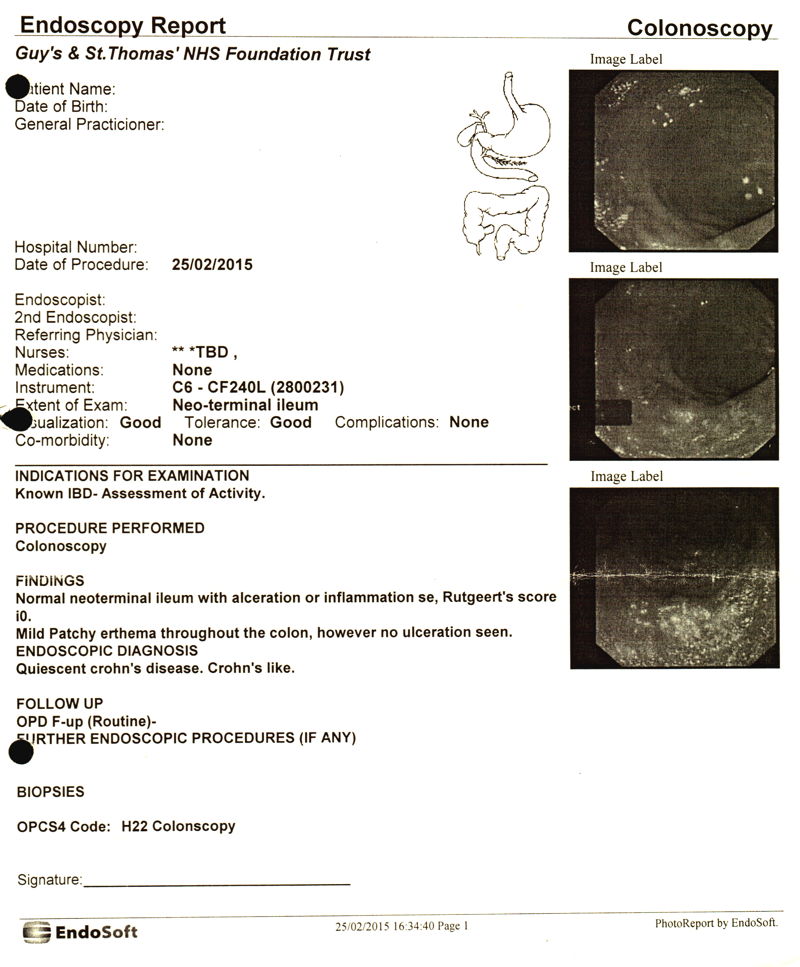
Later that evening, whilst I was having dinner I re-read the colonoscopy report and it struck me that it wasn’t very clear.
I emailed my consultant asking for clarification and received a response along the lines he would get it amended. “The terminal ileum was entirely normal as was the anastomosis. There was some mild inflammation in the colon – not impressive enough to treat to be honest, but this is probably the cause of the mildly raised calprotectin.“
Tuesday 5th May 2015 – St.Thomas’ Hospital – Gastroenterology
The forecast said 50 mph winds and I could vouch for that. Crossing Westminster Bridge was “stimulating” and I was met my a very strange sight as I reached the middle – an animatronic polar bear.
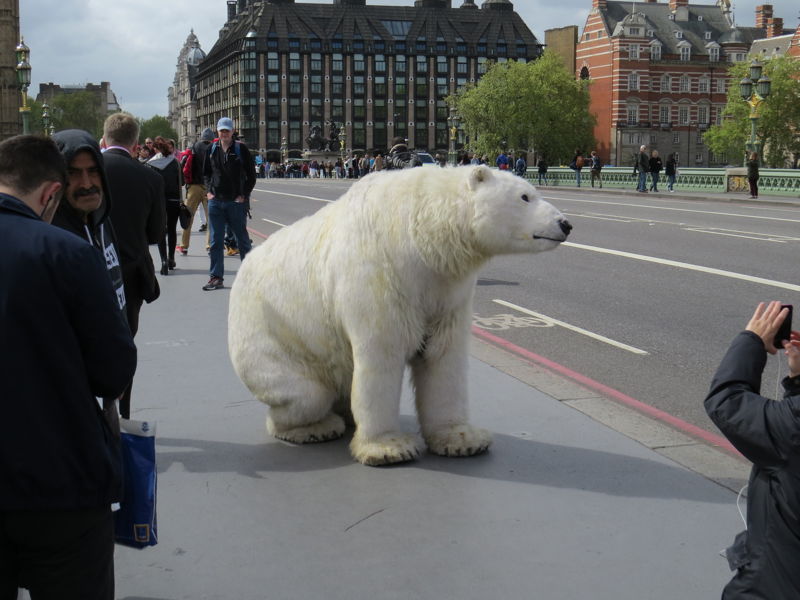
This was to be a routine, six monthly appointment. I had only a short list of questions to ask. The visit started exactly the same as the one in January. (Appointment time 2:50pm, in with the “right” doctor by 3:20pm. Not bad).
I knocked on the door, list at the ready, and entered. I got a warm welcome from my usual doctor who had a medical student sitting in with him. My notes were on the desk. The file was so thick it looked like it couldn’t take one more sheet. “We need to get a new one of these“. I replied that I might just have the solution as I was writing a book covering my medical history and experiences including the treatment at St.Thomas’. He seemed genuinely surprised. I told him it was for real and that I was currently going through the final stages of editing and proof reading. (Slightly optimistic to be honest as you will have gathered by the actual publication date). I reassured him that he wasn’t mentioned by name and that it was all positive anyway!
That prompted a discussion on doctor/patient communication and how patients react to what they are told. He considered himself to be a good communicator (I’ll second that unequivocally) but was concerned that a seemingly innocuous remark, made in passing, could take on far more significance to a patient. We then went on to discuss when and where it is appropriate to tell a patient potential bad news. I mentioned that there were two things I wish I had been told about prior to surgery, and that they were at the end of my list…….
I had been quite tired over the last couple of months and even the B12 injection three weeks ago didn’t seem to have made a difference. He suggested that next time I had a blood test I should get checked for iron and vitamin D levels. I mentioned that the previous week I had walked nearly 50km to and from work and at lunchtimes, so maybe I should be cutting back a little. That lead off at a tangent to the merits of exploring London early in the morning when the streets were quite deserted.
As ever I mentioned the intermittent ache around my anastomosis which we had previously agreed was probably just a mechanical issue. The recent colonoscopy had, again, shown no sign of significant inflammation. He wondered if there might be some other inflammation in a part of my small intestine that neither the colonoscopy or the previous gastroscopies had reached. There was a technique, called a balloon-assisted enteroscopy, that allowed the scope to propel itself along the small bowel. To me that sounded like something to avoid. I asked if a capsule endoscopy would be better alternative but he replied the disadvantage for some patients was the possibility of the capsule becoming stuck if it met a stricture along its path.
Maybe it was time for another MRI scan as the last one was three years ago. He recalled that it had suggested inflammation but the subsequent colonoscopy had shown nothing. You could sometimes get conflicting messages with no explanation as to why there was a difference.
He set the next appointment for six months but it would be down to me to fine tune the actual date, nearer the time, so that it was after the annual gastroscopy. I would also need to ensure that the calprotectin test result was available.
It was time to get my soapbox out again. I was now convinced, more than ever, that BAM was a subject that not enough patients knew about. This was one of the two subjects I wish had been discussed prior to surgery, not because it would have changed anything but at least I would have known what to expect afterwards. It could be part of the pre-op assessment with either the Enhanced Recovery Nurse or the surgeon.
I also wish I had been warned about post-operative ileus, or the lockdown of the digestive system, following surgery. I explained that unless you have suffered intense nausea you have no idea how bad it can feel. I wasn’t joking when I said that it was a good thing the windows on the 11th floor surgical ward at St.Thomas’ were non-opening. I really would have jumped! Both of them looked surprised.
Appointment over and a chance to brave the high winds again. By now they had died down a little and the sun was shining. I took a different route back to Victoria via the Albert Embankment. With the approaching General Election there were film crews wanting to get the classic shot with the Palace of Westminster in the background. It was also proving to be a popular location with oriental couples’ for their pre-wedding photographs. I witnessed both on my walk back.
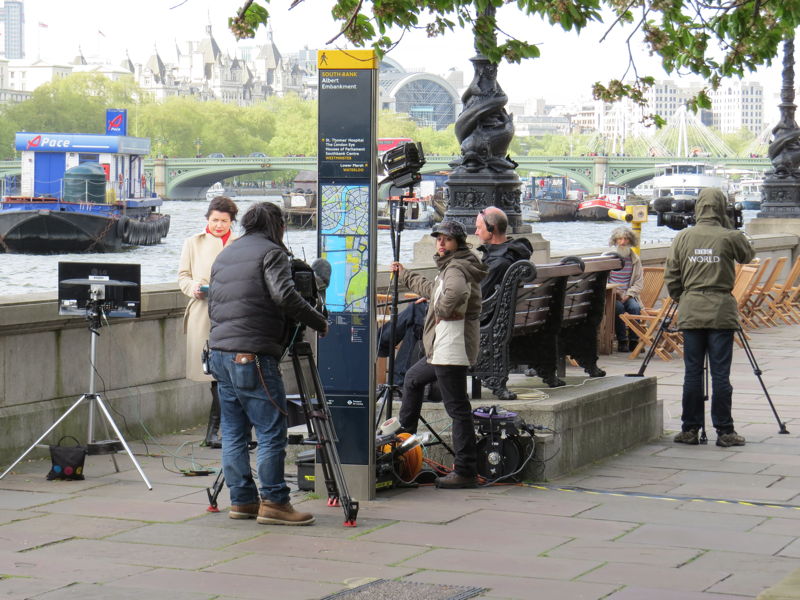
Tuesday 25th August 2015 – Guy’s Hospital – Haematology 2 – a routine, six monthly appointment and for the first time I struggled to come up with any questions to ask. I eventually managed :
Latest platelet count? “56”
Do we need to revisit the warfarin decision at some point in the future? “No”
Do I need to continue with iron tablets or more vitamin D capsules? “Ask your GP to check iron and vitamin D levels”
On the basis of the above we agreed that appointments could now be yearly.
….and then a very long gap until the last routine procedure of the year. In the meantime, after 18 months of working in High Holborn we were on the move once again. This time we transferred to an office block in Canary Wharf in October. It meant adding an extra leg to my journey using either the Tube or the Docklands Light Railway. I can’t say that I found working there very pleasant. The tall buildings created a wind tunnel effect but it was an area of London I was completely unfamiliar with and a rich subject for photography.

Monday 14th December 2015 – St.Thomas’ Hospital – Endoscopy Suite
Had a year passed since my last gastroscopy? The procedure was booked for one o’clock so I went to work first and at lunchtime made my way down to Westminster. My brother-in-law had kindly agreed to leave work early and escort me home.
The procedure followed the pattern I had become so used to. I knew I would be completely sedated as there was the possibility of needing some banding, depending upon what they observed. When I woke up in Recovery I was given the good news that none had been required. I could have a coffee and biscuits before leaving. My escort turned up and we walked back to Victoria Station to catch the train home.As we approached home the pain was becoming unbearable but we made it, just. I immediately took some painkillers and lay on the sofa with a hot water bottle against my back. Over the space of the next couple of hours the pain melted away and didn’t return.