
Having done some further research into PVT I found that in most of the articles the prognosis was not good. The majority of the papers, however, related to patients who were suffering from liver cirrhosis due to heavy drinking, not something I had ever indulged in.
Usually I like to be positive and fully informed about my health but in this instance, PVT/PSC, I chose a different approach. Not knowing much about the liver, biliary system and their related ailments I chose the “educated ostrich approach” – making a positive choice to bury one’s head in the sand, as a coping strategy, but knowing that, at some undefined point in the future, it would be necessary to come to terms with a diagnosis. That point could be getting the results of the biopsy.
One thing that seems to help reduce Crohn’s flare-ups is keeping stress levels as low as possible. By using my approach I had been able to suppress any thoughts about what the biopsy might show and its subsequent implications. I suppose deep down though, whether I liked it or not, I could still hear those two words the consultant uttered back in the summer – “liver transplant”.
I had let it influence some decisions, the main one being delaying changing our car as I didn’t want to end up with a vehicle that wouldn’t get used if I had to be laid up for a long length of time.
For 2013 there were only two appointments lined up, both in January. The first one – to get the liver biopsy results; the second with the haematologist to find out if, or when, to start warfarin. The biopsy should show exactly what state my liver was in and how much stiffening was present; the use of a blood thinner would be to try to prevent another thrombosis.
Whilst I was keen to set the course for future treatment, get more certainty into my life and avoid more tests, I did not want to end up taking additional medication if it could be avoided.
Sunday 20th January 2013 – all day there had been a very fine, powdery snow falling. It didn’t look much to start off with but by the time it had stopped, in late afternoon, a fair layer had built up on already frozen surfaces. I started to worry about getting up to London the next day. Even if I made it to the station there was a possibility that the trains would be disrupted or cancelled. Southern Rail did not have a good reputation for being able to provide a decent service normally, let alone in coping with adverse weather. I could feel my stress levels rising.
Monday 21st January 2013 – St.Thomas’ Hospital – Hepatology – I woke especially early and knew that I wouldn’t get back to sleep. I might as well get up and give myself plenty of time to get ready. The car struggled a little but made it to the station. The trains were running and I arrived in London virtually on time. I went to my office and did some work until it was time to set off for St.Thomas’. My colleagues wished me good luck with the outcome.
I arrived in Outpatients in plenty of time, was weighed but then had a long wait – well over the hour – until my name appeared on the large screen telling me which consulting room to go to. I wished the screens didn’t show that clinics were running within 30 minutes of appointment times when clearly they have slipped well beyond that. Once I was in with the consultant he explained that, due to the bad weather, everyone had turned up early. That suggested that you got seen in the order you arrived at Outpatients, not by the time of your appointment.
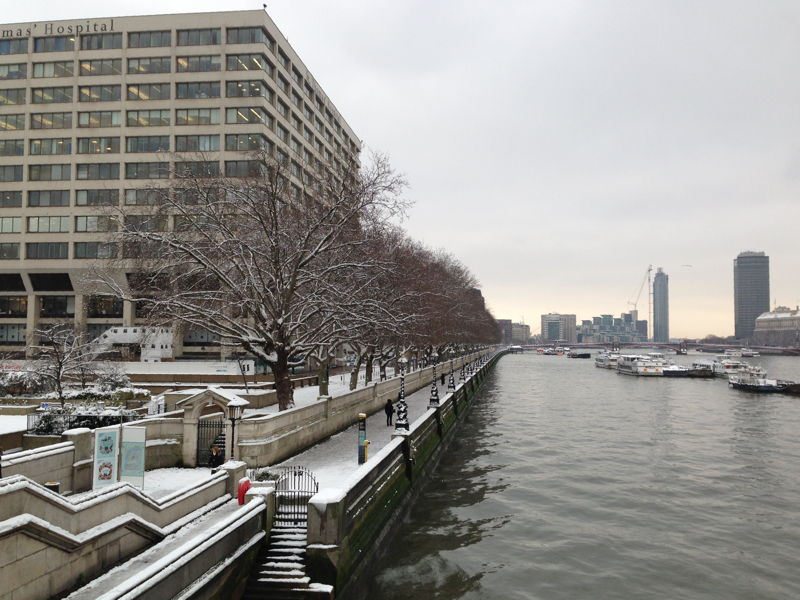
He asked the date of my liver biopsy so he could call up the results on screen. At first he couldn’t find them but eventually they appeared. I was watching his reaction as he read through the report and he was looking concerned. Not a good start.
He told me that the biopsy showed that I had mild biliary system “anomalies”. That didn’t sound too bad, in fact it sounded a lot better than I was expecting (cirrhosis) and I rather lost focus on my list of questions as many of them became irrelevant. He explained that the likely cause was as a side effect of the Crohn’s and that it was quite commonly observed in patients with IBD. It had no connection with the PVT that had caused the varices in my esophagus.
There was a further test that could be carried out to look more precisely at the biliary damage, the previously mentioned ERCP, but this was an invasive test in which marker dyes were injected into the biliary ducts. The concern with this type of test was the risk of introducing an infection into the system that would then be difficult to treat. He did however want to do an MRCP (magnetic resonance cholangiopancreatography) just to “baseline” my current condition for comparing future scans with. He would see me once more to go through the results of the scan and then discharge me back to the care of gastroenterology. I definitely was not expecting that. I needed to quickly think of some more, relevant questions.
How would I know if something was going wrong – “You’ll go yellow and itch a lot”.
Should I keep taking the beta-blocker to keep blood pressure low – “Yes, if you’re not experiencing any side effects”.
Are any further invasive tests planned that would prevent starting a blood thinner – “No further tests planned that would preclude you from taking warfarin”.
Did I still need regular upper GI endoscopies – “Yes, every 12 months”.
Once I had returned home I thought of a couple more questions – did the result of the biopsy tie in with the Fibroscan reading from last November and could I start drinking alcohol again? I put them in an email. The responses came back – “Yes” and “in small quantities”.
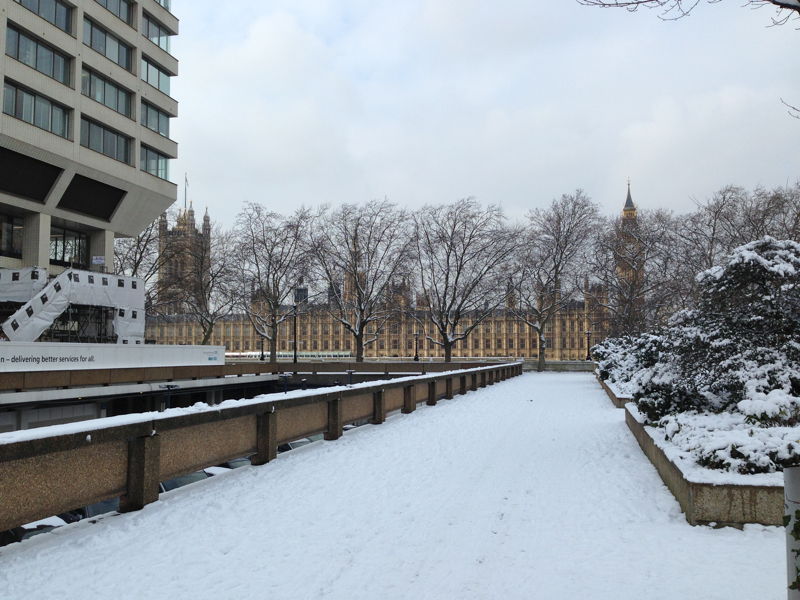
You’ll know from some of the pictures in this book that I enjoy walking around London in all seasons but I don’t ever recall being in the capital with so much snow on the ground. The walk across Westminster Bridge was treacherous due to the icy pavements that had not been cleared.
The request for the MRCP had gone in with the follow-up appointment planned for three months’ time. I was intrigued by this test’s unpronounceable name but what did it mean? It was a type of MRI scan that produced detailed images of the liver, gallbladder, bile ducts and pancreas. It was used to check for tumours, infection or inflammation and was a less invasive alternative to an ERCP.
After seeing the haematologist the following week I was expecting to start warfarin even though I found it difficult to understand why it was necessary given that my platelets were at such a low level. I would have thought my blood would be less likely to clot anyway.
Thursday 24th January 2013 – the follow-up letter from Monday’s appointment arrived. Reading the bullet points at the top it all looked rather grim but got better as it went on. The letter started –
“Liver biopsy – mild cholangitic and sinusoidal ectatic components. Review demonstrates some mild cholangitic changes which could represent early primary sclerosing cholangitis, but may be nothing……
….I have arranged an MRCP really as a baseline. I do not expect to see anything very much on it and I suspect that at his next appointment I will be able to discharge him back to his GI consultant’s care.“
It looked like I might have the start of PSC after all. Maybe the consultant at East Surrey Hospital was right to mention it? I still wasn’t sure.
Friday 25th January 2013 – during the night I was getting quite a bad pain around my midriff. It was really quite worrying. but I managed to fall asleep on the sofa for a few hours. My wife didn’t like to disturb me as I looked so peaceful. I still had the pain at 3am when I dragged myself into bed. Luckily it had passed by the time I got up four hours later. I was still tender around my abdomen but not bad enough to contact the IBD Nurses.
What was the cause? This was becoming too common a dilemma. Could there be a virus going around? Had I been wearing my belt too tight? Was it simply a case of having eaten something that disagreed with me or was it a flare-up marking the return of active disease? If you asked me to sum up the overriding psychological effect of Crohn’s in one word I would choose “uncertainty”. Never knowing if your digestive system would behave when going out or if a spell of remission had suddenly ended.
The pain had passed in the morning but I took it carefully. Nothing too strenuous, just watching the snow melt away. I thought about last week’s appointment with the liver specialist, trying to work out why I had been expecting a far worse diagnosis. When it came, it was a welcome anti-climax. I re-read the previous letter: “The Fibroscan shows that the liver stiffness is in a borderline area and there may be significant fibrosis. The raised ALT also points in this direction.” Which words would you home in on? “Liver stiffness”, “significant fibrosis” probably not the “may be”?
Wednesday 30th January 2013 – Guy’s Hospital – Haematology 2 – I asked the phlebotomist if “my” doctor was in clinic today, “Yes” she replied, and pointed to the post-it note on my medical file. It said that she wanted to see me and would come and find me at the given time, which is exactly what happened.
This was my first haematology appointment after having the recent liver biopsy and colonoscopy so I ran through the results. We then had a detailed conversation about where I was heading bloodwise (if that is a word). As ever, it was nice to be treated as an informed individual. That, together with my list of questions, lead to a large amount of information to take on board :
My platelet count, measured after taking the dexamethasone, was the lowest ever at 66. She told me that: “The platelets are clearly working otherwise you’d be suffering from bleeds”.
I wondered if there would be any benefit in trying to find out what was causing the issue? “Not really. You could undergo a bone marrow biopsy but it’s not going to push your treatment any further forward.”
Would I now be prone to clotting and what is likely to have caused this? “Once you’ve had a clot you are susceptible to getting another one. The clot is probably due to the peritonitis caused by that perforated bowel back in 1979 and has taken all this time for its effects to appear.”. I still struggled with that explanation given the operation was over 30 years ago.
Would warfarin be expected to disperse the existing clot or prevent future clots? “The existing clot will remain as the veins have diverted around it. The warfarin is used to reduce the risk of further clots developing.”
Would the warfarin be long term and would it work correctly with the low platelets? “You will need to take it indefinitely. There is an apparent conflict with taking a drug that is designed to make clotting less likely and a low platelet count that has a similar effect. warfarin has been successfully used to treat patients with values as low as 30”.
Would I need regular blood tests when I’m on warfarin? “Weekly to start off with and then further apart. Some GP surgeries can manage this rather than coming up to Guy’s each time. Once you start on warfarin you will be under the care of the Coagulation Unit, but all these details can be discussed nearer the time”.
Did I need to continue taking iron tablets? “Your Hb level is 14. Next time we do a blood test we’ll look specifically at iron levels”.
We also touched on the side effects of the dexamethasone, the worst one – causing loud and obnoxious behaviour. She said she couldn’t possibly put that down in my notes as she would get struck off so we settled on “mood swings“. The other effects – hiccups, feeling dizzy and eating everything in sight were duly added to my notes.
It was then time to discuss the key question – Warfarin or not. The upside would be the risk reduction of further clots forming; the downside was that thinner blood meant you were more likely to bleed and if the Crohn’s reactivated this could be a problem. We ran through some of the other clotting risk factors and given all of these, the decision was finely balanced. Definitely not clear cut. The haematologist favoured me taking warfarin but I was undecided as the last thing I wanted was even more medication.
She recommended that I should have further blood tests for lupus anticoagulant and anticardiolipin antibodies. She would then present the results to one of her colleagues, who specialised in just this area, and ask for her opinion before advising me. She would keep me informed along the way and arrange a follow-up appointment for the end of March, by which time the test results would have been returned and discussed.
If I was to go onto warfarin the target would be to get the dosage right so that my blood had an INR of between 2 and 3, i.e. 2 or 3 times thinner than normal blood, and that is why the initial blood tests would be so frequent. (INR = international normalised ratio, a measure of the extrinsic pathway of coagulation. As ever, I’m none the wiser for that either).
The wait for a clear way forward would continue for a little longer.
Over the next few days another question came to mind. Whilst there was no treatment for PSC, apart from a liver transplant, it did usually progress slowly and there should be some warning if it started to get really serious. Blood clots and varices were completely the opposite. Should I be scared witless or would it be possible to remain laid back? Time would tell.