
Monday 3rd September 2012 – St.Thomas’ Hospital – Endoscopy Unit
Not exactly a day out, just a routine gastroscopy……at least that’s what I thought. I found endoscopies to be the worst of the procedures to deal with. The only saving graces were not needing any prep solution or the need to change into a hospital gown. I always chose full sedation but the downside was not being able to drive for 24 hours afterwards. We needed the car the next day so I took the decision, before I went in, that I would only have the throat numbing spray, nothing else.
As usual my wife came with me and we had quite a long wait before they were ready. The delay was due to earlier patients taking longer to come round after their procedures and there being no spaces left in Recovery. Eventually it was my turn. My wife went off for a walk along the South Bank.
I had assumed that the doctor would just be examining my upper GI tract to see what state any varices were in. Wrong! She explained that, if necessary, she would treat them by banding, and for this I would need to be fully sedated. The whole procedure would need to be repeated in three weeks time and possibly again in a further three weeks. It all depended upon what she found.
Banding, or ligation, is carried out using a special attachment on the tip of the endoscope that consists of a suction tube loaded with multiple rubber bands. The offending vein (varix) is sucked into the tube and a rubber band slipped over it, effectively sealing it off. This prevents any further flow of blood and after a few days the vein withers away and the band drops off, never to be seen again.
With the consent form signed and the obligatory cannula inserted into the back of my hand I climbed onto a trolley and after a few minutes was wheeled into the procedure room. The team introduced themselves and prepared the endoscope.
As this is a procedure that will crop up many times in future chapters maybe this would be a good time to describe it in some detail. It can be distressing and there is the added risk of complete sedation so your vital signs are monitored throughout. There’s an armband to measure blood pressure, a finger oximeter for checking blood/oxygen levels and a supplemental oxygen supply delivered via a nasal tube.
I was asked to roll over onto my left side to face the endoscope with a pillow placed behind my back as support. In the meantime the doctor was calculating the amount of sedative required and preparing the syringes for injection into the cannula. It was now time for the final preparations.
The penultimate action was to numb the back of the throat with xylocaine spray which had the distinct flavour of burnt bananas. I hadn’t really noticed the taste before but this time it turned my stomach. Finally there was a plastic mouthpiece placed between the teeth that acted as a guide for the camera. This was equally unpleasant.
The doctor injected the cocktail of sedatives into the cannula…..
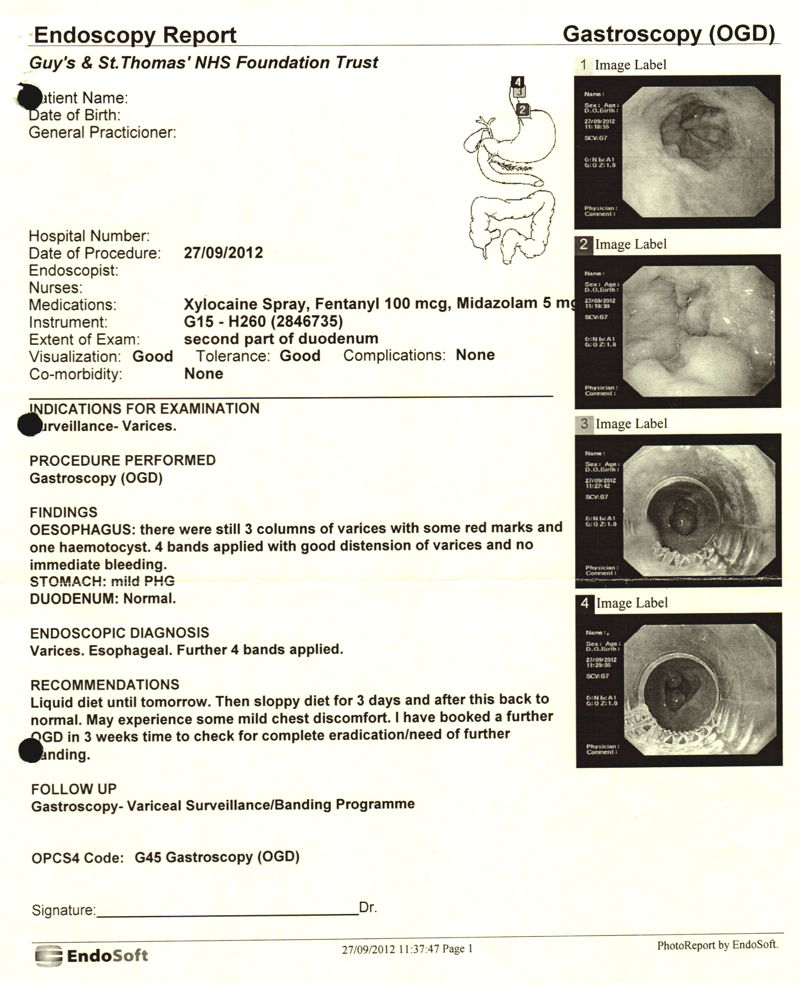
I was lying in Recovery and by now my wife had returned from her walk. When I had come round sufficiently I was given a copy of the gastroscopy report that would be sent to my GP. The doctor had found three large varices with high risk stigmata and had applied six bands to them. (In layman’s terms there were three locations that showed signs of having bled and were likely to do so again).
The nurse told me that I must only have liquids for the next 24 hours and then three days of “sloppy” food. Maybe it’s a man thing, but the sandwiches I had brought with me looked very appetising. I waited a while then tucked in, ignoring the nurse’s advice. Stupidity would be the best description of my actions because it did hurt swallowing.
When we got back from London I did the second stupid thing – got in the car and drove home from the station. It was only afterwards that I read the advice leaflet that pointed out that your insurance is invalid during the 24 hours following sedation. I wouldn’t do that again either.
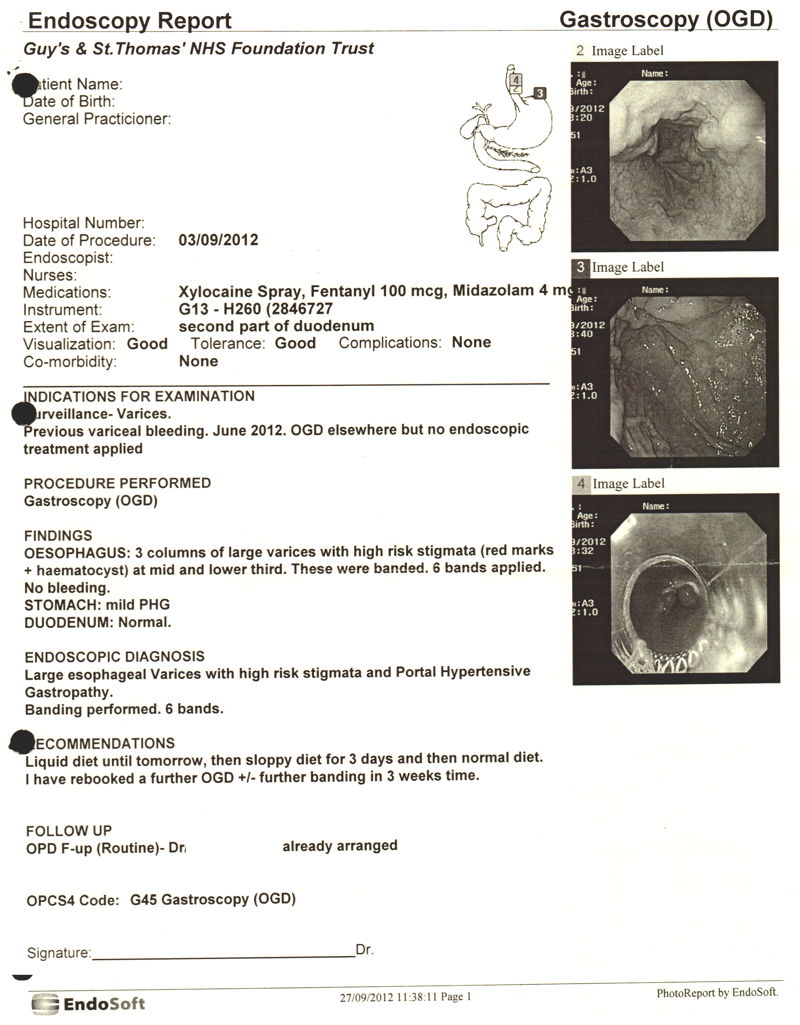
On the endoscopy report the top image showed the varices halfway down the oesophagus; the bottom image showed two that had been banded.
That evening I was aware of losing a little blood, which was only to be expected, but it did lead to a sleepless night worrying about whether we should still go out to all the places we had planned for the rest of the week. In the end I resolved “...not to let Crohn’s, or any other conditions, rule my life” and decided we should go whatever.
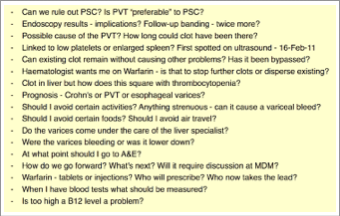
Monday 10th September 2012 – St.Thomas’ Hospital – Hepatology – after a quiet weekend it was time for yet another visit to St.Thomas’, this time to see the hepatologist. It was my first appointment with a liver specialist and gave me a chance to discuss this new area of my health. I had come up with a list of 20 questions.
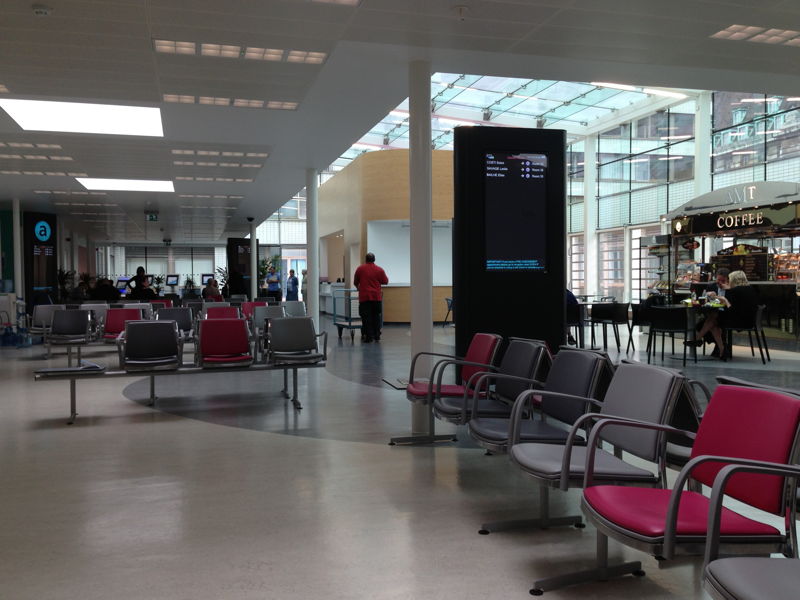
The outpatients’ clinic had moved to a brand new building. The waiting area was now large, light and airy, complete with a coffee bar. I signed in by scanning the barcode on my appointment letter and took a seat whilst waiting for my name to appear on one of the many, large display screens. I didn’t have to wait long and went off to the room number indicated. Disappointingly it was only to get weighed and I was soon back in the main area awaiting the reappearance of my name.
After 30 minutes it was my turn to meet the consultant. He apologised that it would take him a little time to read through my notes and build up a picture of what he would be dealing with. I produced my list of questions.
He asked when I underwent my first operation. I explained about my emergency admission to hospital in June 1979, with suspected appendicitis and the perforated bowel that had leaked into my body cavity. He said that it was possible the blood clot had formed in my liver all that time ago but had only recently started to cause problems. It was a known side effect of peritonitis. This would also explain the enlarged spleen (splenomegaly).
He discussed sending me for an ERCP (Endoscopic Retrograde Cholangio-Pancreatography) scan and a liver biopsy but opted to go for a comprehensive blood test first before deciding what to do next. He would want to see me in another six to eight weeks and was booking a Fibroscan to measure any liver stiffness. I checked my list of questions to make sure they were all answered.
I came away from the consultation a lot happier than when I went in. Previously I had done what most people do when faced with a new diagnosis – look up the prognosis on the internet. I searched on “PVT and Crohn’s” and the first page I found started with the words: “If the patient survives….” Not a good start and I was only partly comforted by realising that the article was written many years ago and hoped that treatment must have moved on since then. Clearly PVT was serious but not as bad as the PSC that was first mentioned. If I was to suffer another major bleed from the varices it would be a question of how quickly I could get to a hospital and have a transfusion. The current banding sessions should get rid of the varices or a least delay the next bleed. It would be like living with an internal time bomb but not being able to see the clock counting down.
The varices could also form further down the GI tract but would be less likely to bleed. I thought about asking the doctor to provide a letter that explained the diagnosis in the hope that it could save vital minutes if an emergency happened.
I went off to find the endoscopy appointments desk and agreed the date for my next banding session – Thursday 27th September – and then off to the blood test section where they took eight phials of blood, a new record.
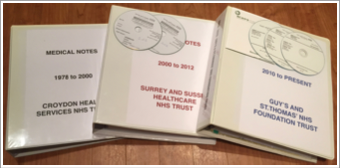
Wednesday 12th September 2012 – I had been online to find out how to obtain copies of all my health records, filled in the necessary forms and sent them off, with payment, to Croydon and Surrey Health Authorities.
The first delivery arrived from Surrey and Sussex NHS Trust. The records came in two packets and had to be signed for. In the first one there were hard copies of all my notes from 2000 onwards; the second, smaller package, contained two CDs.
The first CD was labelled x-rays and CT scans. Very interesting but I really didn’t have a clue what I was looking at. The second CD contained scanned copies of all the clinic and in-patient notes. From a quick read through I was already learning things that I either didn’t know or couldn’t remember. The next step would be to go through in detail as I wanted to see if there were any definitive clues as to how I ended up with PVT.
Sunday 23rd September 2012 – We returned from a few days spent in the New Forest and a copy of the follow-up letter from the liver specialist was waiting. It confirmed our discussion regarding Portal Vein Thrombosis and the possible link with peritonitis from the perforated bowel in 1979. The letter included these words: “I suspect that ……the resultant splenomegaly has been the main cause of his low platelet count and certainly the cause of his oesophageal varices. I suspect that azathioprine is blameless“. It also went on to say: “he is in the process of having his varices obliterated and had some quite juicy ones when endoscoped a week ago“. Was “juicy” a recognised medical term?
The word “blameless” got me thinking. Up until then the general consensus had been that the low platelets were a side effect of taking azathioprine. I now had copies of all my blood test results and wondered if a graph of dosage against platelet count would show a pattern emerging. I plotted these two sets of data but could see no obvious correlation. It was somewhat frustrating that there was no clear cut explanation.
Thursday 27th September 2012 – St.Thomas’ Hospital – Endoscopy Unit
Another session of variceal banding. We knew exactly where to go to get booked in. After five minutes I was called by one of the nurses and the pre-endoscopy procedures started. The good news was that there was only one patient in front of me so she inserted the cannula. It was certainly a lot quieter on a Thursday. I said goodbye to my wife and told her I would be ready for collection in a couple of hours. She went off to visit the nearby Garden Museum, next to Lambeth Palace.
I was led to a small cubicle and waited for the doctor. When she appeared I recognised her as the one who had carried out the previous banding. She asked how I’d been feeling since last time and if I had any questions. I asked why are you only allowed liquids after the banding? Was it purely because it would hurt or was there a medical reason? She explained that the rubber bands placed around the varices might become dislodged, too early, so it was liquids only for the first 24 hours and then three days of sloppy diet. I replied that this time I would heed her advice. She gave me a very “old fashioned” look!
She would see how effective the previous banding had been and then place any new ones required. I might need to be booked in for a third session in another three weeks’ time. I was wheeled into the procedure room, connected up to a blood pressure monitor and oxygen supply. I couldn’t escape the burnt banana spray but at least the mouthpiece was inserted just as I lost consciousness. The doctor injected the sedative with the words: “you’re going to feel a little drowsy“.
The procedure took around 15 minutes and I was soon waking up in Recovery. I had needed further banding so a third session would be required. Compared with last time I was in quite a bit more discomfort and slightly wobbly on my feet.
Before leaving the hospital I booked Obliteration Session 3. I was able to choose the most convenient date. Given that today’s clinic seemed very quiet I chose another Thursday. It had the added advantage of still being able to go to work for the first three days of the week and then spending a long weekend recovering.
That evening the discomfort continued and I took a couple of paracetamol to relieve the pain. The report for the session stated: “….may experience some mild chest discomfort“.
Friday 28th September 2012 – I started to write up an account of the previous day’s procedure for my blog. Each time I thought about the burnt banana spray and mouthpiece I would get a sick feeling in my stomach and at the back of the throat. I needed to mentally confront this issue now so that I was over it in time for the next banding session. I’ve mentioned before that I surprise myself how laid back I can be about hospitals, procedures and appointments; I didn’t want to spoil it for a relatively minor issue.
Whether it was wise or not, I decided to Google “varices” and “banding”. The first study I came across said that for 70% of those who have a variceal bleed it will happen again and for a third of those it will be fatal. If I have the maths right :
70% x 33% = 23%
or, in other words, for almost a quarter of patients, who suffer an initial bleed, the condition will end up killing them. These didn’t sound like very good odds to me. My analogy of living with a time bomb seemed very apt. What the study didn’t explain was what proportion of the patients already had severe liver damage. I appeared to have avoided that, so far. The forthcoming Fibroscan test would measure the level of any cirrhosis.
Tuesday 16th October 2012 – the CT scan images dating from 2008 and 2009 had been the final pieces of evidence confirming that surgery was an inevitability. So far I had only been able to view individual images but had now found some free software that enabled me to convert them into sequences, albeit only in black and white.
My wife was singularly unimpressed by my efforts at producing moving images, although that may have been because we were having dinner at the time. I thought they would prove of great interest to my colleagues at work the next day, but they didn’t. If anything they had completely the opposite effect.
Thursday 18th October 2012 – St.Thomas’ Hospital – Endoscopy Unit
Unlike my previous visit on a Thursday the clinic was busy and I didn’t get called in to the preparation room until well over an hour later than the scheduled time.
It was a different doctor from the one I had seen previously so he asked a few background questions. I wanted to know if this was likely to be the last banding session to which he replied that it would depend on what he found. Once they were happy that banding had been successful I would need yearly endoscopies to check.
Almost immediately I was wheeled into the theatre. I had overcome my issues with the taste of burnt bananas and the mouthpiece as I remember little until waking up, about 30 minutes later, in Recovery.
The nurse came over to see how I was and gave me a copy of the report. Further banding had been carried out and therefore I would need yet another scoping in four weeks’ time. Not what I wanted to hear but I was getting used to it by now. Maybe I wouldn’t need the banding next time. Disappointingly the doctor hadn’t taken any pictures so there was no report to take away.
It wasn’t long before I was allowed down to the seated recovery area where my wife joined me and we set off to catch the train home. Overall I was out of the hospital earlier than the last time. Swings and roundabouts.
Monday 12th November 2012 – St.Thomas’ Hospital – I arrived at the new Outpatient Centre to find the fire alarm sounding and everyone evacuated (not sure that sounds right for a gastroenterology clinic). After a couple of minutes we were allowed back in, with the alarms still screeching. I scanned my barcode at the self check-in and took a seat. It was difficult to concentrate on anything because you had to constantly glance up at the large screens to see if your name had now appeared.
Appointment No.1 – 9:00 am – Fibroscan – a non-invasive alternative to a needle biopsy that worked by passing a mechanical pulse through the skin and into the liver. The velocity of the wave, measured by ultrasound, directly correlated to the stiffness. The stiffer the liver, the greater the degree of fibrosis.
I lay on the bed with my right side exposed and right arm above my head. The probe was placed against my flank and triggered to send the pulse. This was repeated ten or so times and the aggregated scores gave an average value of 7.2. The nurse said that up to 5 was normal and above 12 would cause concern. My value showed that there was some fibrosis but not enough to worry about, yet.
Appointment No.2 – 9:20 am – the Liver Specialist. The very clever self check-in system could not cope with two appointments in one go so I had to go to the reception desk to book in for the second one. I was soon called in to get weighed – 91kg – the heaviest I had ever been. I needed to do something about this. I returned to the waiting area where the screens were displaying: “All clinics are running within 30 minutes of appointment times“. They lied.
As it was only the second time I had seen the hepatologist he took a while to get up to speed with my notes. He was searching for a follow-up letter from my last haematology appointment back in August, but without success. No surprise really as it was the second time this had happened. I would take it up with the haematologist when I saw her at Appointment No.3.
The Fibroscan had shown some fibrosis so he wanted me to undergo a proper liver biopsy. Because of my low platelet count he was hesitant at using the normal method of inserting a needle between the ribs and directly into the liver. The procedure could cause bleeding and my lack of platelets might prevent it from clotting properly. He was therefore booking a transjugular biopsy and expected that I should get an appointment before Christmas. It would involve feeding the biopsy needle down a vein from the shoulder area into the liver. If there was any bleeding it would be directly back into the vein. I wondered if I would be sedated or just have a local anaesthetic. The thought of having a tube fed down a vein brought back memories of the feeding tube in Croydon General Hospital.
Before my appointment I had thought about what my “hoped for” outcome would be. I had expected the Fibroscan to show that my liver was normal. The result gave me new things to think about and questions to ask.
I was given a form to have a blood test but knowing there was usually a long wait at that time of day I decided to make my way home via St.Thomas’ that evening and have it done there. The walk would give me some much needed exercise.
Wednesday 14th November 2012 – Guy’s Hospital – Haematology 2
I checked in and found that the receptionist already had my name written down on a piece of paper. The doctor was keen to see me! With that my consultant appeared and said: “Come with me. We need to talk“. A bit ominous.
She explained that I didn’t need to be examined so instead of going into a consulting room we went into a small side office and sat down. She apologised for not having produced a follow-up letter from my previous appointment and explained the cause of the problem. As it had not affected my ongoing treatment, as I would not have started any new medication until my varices had been treated, I decided not to pursue it further as long as a letter was finally written.
We discussed Crohn’s, spleens, liver fibrosis, blood clots, platelets, misleading information on the internet and warfarin. It gave me a better understanding of the relationship between the various conditions. As she pointed out, the Crohn’s seemed to be under control at present so the emphasis, for now, should be on deciding when or whether I should start on warfarin as a long-term treatment to discourage further clotting. To help with this decision we needed to know exactly what state my liver was in. The priority would be to prepare me for the transjugular biopsy.
One of the guidelines for carrying out the test was a platelet count of at least 80. On the previous Monday I had been measured at 72. She commented that we all tend to get hung up on numbers and, in her opinion, I would be fine, but the guideline had to be followed. Some action was needed if the procedure was to go ahead. A four-day course of a steroid, with a long name that I couldn’t remember, could be given and had been shown to boost platelets in the short term.
Once I had the date for the biopsy I needed to contact Haematology and arrange for a blood test to see if I was still below 80. If so I would need to collect a prescription for the steroids and start taking them five days before the procedure. Three days after commencing I would need a further blood test to ensure the platelets had risen. Because timing was key she asked me to contact her and her secretary directly so the process could be put in motion. She wouldn’t normally ask a patient to contact her by email but in this case she didn’t want the procedure to be delayed.
I had my obligatory list of questions with me and most were answered in the course of our conversation but it left two outstanding. The first one was did she have any other patients with my combination of conditions? “No“. I was on my own with that one.
Question number two- what was the long-term prognosis for my health? I was getting close to the point where it would be feasible to retire. I needed some guidance on what the future could hold. She replied: “if I could tell you that, I should be in another job”.
When I arrived home I looked up “transjugular biopsy” and found that St.Thomas’ had produced a leaflet about this procedure. It read :
“Trans-jugular biopsy is done under ultrasound and X-ray guidance. Local anaesthetic is injected into the right side of your neck. When your skin is numb a small catheter is introduced through a vein in your neck. The catheter is manoeuvred into the liver under X-ray guidance. When the radiologist is satisfied with the position, a small piece of tissue is taken from the liver. This is sent for microscopic examination.
You will need to stay in bed for four to five hours, or as instructed by the nurse. You will need a responsible adult to take you home by car or taxi. We do not recommend that you use public transport as it is unsafe if you feel unwell.“
Another new experience. One that I wanted to get over as soon as possible, so I emailed my hepatologist to find out who I needed to speak to about getting a date booked. Not being able to use public transport would be a problem so it might be worth seeing if they could provide a bed for the night.
Saturday 17th November 2012 – after another couple of days in the New Forest we returned home to find two letters from St.Thomas’. One for a follow-up Haematology appointment in January and secondly the biopsy appointment for 12th December. It was headed “Fluoroscopic Guided Biopsy” so I was none the wiser as to whether this meant conventional or transjugular. It would have to wait until Monday to clear that up. There was also a blood test form enclosed but, it was for another patient. Something else to sort out.
Monday 19th November 2012 – I emailed the haematologist to let her know the date for the biopsy and copied in my hepatologist as I wanted to clarify the type of biopsy that was in prospect.
In the afternoon he replied explaining that it was a normal biopsy carried out under ultrasonic guidance. I realised however that the method could change if a blood test showed my platelets were still under 80. A couple more emails arrived from the haematologist explaining that a blood test had been requested electronically and that I should have it done on 3rd December. There was no mention of the short course of steroids to boost my platelets.
Tuesday 20th November 2012 – St.Thomas’ Hospital – Gastroenterology
My first port of call was Interventional Radiology to talk to one of their doctors. I explained about my borderline platelet count and asked if 80 was a hard and fast rule for deciding which type of biopsy I would undergo. He replied that they would decide on the day. The judgement would e based on the blood test results and an ultrasound scan.
I also told him that it would be difficult for me to be driven home from St.Thomas’ as it would take a long time, probably two hours, to get through the South London traffic. He reiterated the advice given in the biopsy leaflet that they did not recommend using public transport in case there was a problem. The problem being that the puncture created by the biopsy needle could start bleeding, even though they kept you in the unit for up to six hours before allowing you home. I asked if it would be possible to stay in hospital overnight as that would mean my wife would not need to accompany me. He replied that I would need to ask my hepatologist about that.
I then made my way to the outpatients’ waiting area in the adjacent block, ready for my gastro appointment. It followed the usual drill – scan barcode; take seat and watch large screen until name appears; go to room 15; get weighed; return to seat and wait for name to appear again.
I knew that a late afternoon appointment would inevitably lead to a long wait and I was right. The clinic was running one hour late. When my name finally appeared on the screen I started to make my way to the designated room and, as often happened, was met by one of the registrars. I explained that I wanted to see my usual consultant as this wasn’t a routine appointment. The registrar asked me to return to the waiting area and 15 minutes later it was time to see the main man.
I brandished my list of questions. My main reason for requesting the appointment was to discuss the continued ache I had been getting in the area of my reversal operation and to ask whether I should be on a maintenance dose of azathioprine.
As the last colonoscopy was incomplete we decided I should have another one to find out exactly what was going on beyond the splenic flexure.
Thursday 22nd November 2012 – St.Thomas’ Hospital – Endoscopy Unit
The Endoscopy Unit was starting to look very familiar to my wife and I. Having booked in we sat in the waiting area and watched whilst a couple of other patients turned up and were taken into the sideroom to answer the pre-procedure questionnaire. I was starting to get a little worried that I had been forgotten so went back to the reception desk only to find I hadn’t been checked in properly! Very frustrating.
I made sure I was the next to be called. My wife went off for a walk in St.James’s Park. I was taken into the preparation area and cannulated. The doctor came over to discuss the procedure and get the consent form signed. He asked me if I usually felt the banding whilst it was being carried out. I replied: “No” as I was completely sedated. “Right, we’ll give you the same dose of sedatives as before.”
Another few minutes and the procedure commenced. Once again I remembered little of what went on and half an hour later I woke up in Recovery. On previous occasions I could feel some pain in my esophagus but this time nothing. Was this a good sign? The nurse came over to see how I was and told me that I hadn’t required any further banding. Excellent! No liquid or sloppy diet for the next four days and no need for a repeat procedure until the same time next year. My wife returned from her walk and was shown into the Recovery waiting area. Once I had been handed a copy of the gastroscopy report and had the cannula removed we were free to go.
On the way out I arranged a date for the colonoscopy – 20th December. I then returned to the Endoscopy department to pick up the sachets of prep and to run through the timings for taking them.
Friday 23rd November 2012 – With the five appointments over, there was just one last thing that needed sorting out – the forthcoming biopsy on 12th December. The previous afternoon I had emailed my three consultants asking whether I should take the short course of steroids to boost my platelets and if I could use public transport to get home. My hepatologist replied with the criteria for being able to travel by train. Unless there were complications on the day then I could meet all of them. The last piece of the jigsaw was in place.
The liver biopsy would be a new experience and I will admit to a small amount of apprehension. Needles themselves didn’t worry me per se, it was more the uncertainty over which route they would use and whether I would be able to travel home by public transport.