
After the reversal I was determined to give myself plenty of time for the wound to heal and not jeopardise my recovery. In July I felt comfortable enough to start driving again and after a further two weeks we took our first long trip down to the New Forest. It was a tiring journey but we stayed with my in-laws and it gave us a break for a couple of days.
By the second week in August I felt ready to return to work. I had been away for two months. My London client was very flexible and I could choose which three days of the week I worked. I could even work from home as I had full, remote access to their computer system and often found it more productive as there weren’t the distractions of working in a large, open plan office.
Realistically I knew that, despite this latest operation, it was probable that I would need to undergo further surgery in the coming years. I had in mind that this applied to approximately two thirds of Crohn’s patients. Something to ask my consultant about. Having been through the pre-operative assessments it was clear how much importance was placed on the physical fitness of the patient if they were to make a good recovery. I was determined to stay fit and set myself a target weight. My chosen exercise was a brisk walk at lunchtime.
Belgravia continued to be an interesting area to explore if you wanted to see how the other half lived (or, more likely, the other 1% from Russia and the Middle East). The great London parks were also within walking distance and it didn’t take long to discover the shortcuts and backwaters of these well heeled areas..
Wednesday 24th August 2011 – Guy’s Hospital – Haematology – the blood test carried out on the day showed the usual low counts for iron and platelets. I mentioned that, in the past, I had been on steroids for many years and was concerned about being a prime candidate for osteoporosis. The last bone density test in 2003 had shown thinning around my hip joints. The consultant requested another scan. Three weeks later it was carried out and it showed that my bone density had returned to normal.
Monday 26th September 2011 – St.Thomas’ Hospital – the “three months after surgery” appointment with my surgeon’s registrar to make sure everything was going well. I can’t recall our discussion but in the follow-up letter he noted that: “he has had one or two episodes of abdominal pain which have been short lived, and some bloating…” He continued: “these may be the signs of early adhesive symptoms“. I was discharged from the care of the Colorectal Clinic and passed back to Gastroenterology.
October 2011 – I started to feel decidedly unwell with a pain around my middle, a very bloated stomach and was passing jet black liquid. This lasted about a week. I was concerned enough to go and see my GP who did a quick examination, with a latex clad finger, and announced the good news that my prostate was OK but she didn’t know what had caused the other symptoms. She suggested it could be iron tablets which would have been plausible if I hadn’t stopped taking them weeks before. When I returned to work I found that a number of my colleagues had also been off with a gastric bug. Maybe this was the explanation during that period but, as usual with Crohn’s, I didn’t know whether it was a virus or the start of a flare-up.
December 2011 – Just before Christmas I was due to undergo the “six months after surgery” colonoscopy. It had been many years since I last had one but would be a good chance to see if anything unexpected was going on in my colon. Of all the tests Crohn’s patients have to endure the colonoscopy is the one they would most like to avoid. Whilst the procedure itself may only take around 30 minutes there is a four day lead-in of special diet and, on the preceding day, the dreaded prep solution.

There are several different types available and they each require diluting with varying amounts of water. Luckily GSTT use 2 sachets of Citrafleet as their standard and each one only require making up to 150ml. Some other formulations need two or even four litres and, by all accounts, taste disgusting.
Four days out you are instructed to stop taking any medicines containing iron. The next day you do the same with loperamide or similar medication. At day two you must avoid any fibre and on the final day you can have a light breakfast but from then on it’s clear liquids only, such as Bovril or fruit squash (but not red juices as this may colour the inside of the bowel).
Tuesday 13th December 2011 – pre-colonoscopy preparation day. I ate a light breakfast and at noon drank a chaser of senna liquid followed, an hour later, by the first sachet of Citrafleet. Having downed that first glass I did not stray far from the bathroom.
Six hours later I took the second sachet, hoping that they would have done their worst by the time I was ready to set off for hospital the following morning. At least that would mean there wouldn’t be any chance of being taken short on the train to London.
Wednesday 14th December 2011 – Guy’s Hospital – Endoscopy Unit
My wife accompanied me as I was likely to have sedation and the hospital would not carry out the procedure unless I had someone to see me home safely.. It was one of those cold, clear, winter days with hardly a cloud in the sky. Guy’s Hospital is right next to London Bridge train station making it an easy journey for us. We had another chance to see how construction of The Shard was progressing.
Colonoscopies always follow the same pattern, the only variable being the length of waiting time between each stage of the process. I was taken into one of the side offices where a nurse put a bar coded band around my wrist to identify me in case of any problems. My blood pressure was checked and there was a series of questions about my current medication and any allergies I suffered from. She then inserted a cannula into the back of my hand and took me to the changing rooms where I put on a medical gown and a pair of very flimsy, paper underpants.

After a while a doctor appeared carrying the all important consent form. He ran through the possible risks and outcomes and I signed on the dotted line. I was taken into the procedure room where the team introduced themselves. When everything was ready the doctor injected doses of Fentanyl (a powerful synthetic opiate analgesic), Midazolam (a short-acting central nervous system depressant) and Buscopan (to relieve spasms of the gastro-intestinal tract).
The cocktail of drugs is designed to make you drowsy but not put you completely under. It makes it much easier if the nurses then need to move you into a different position to ease the passage of the camera. However, you can opt for full sedation or no sedation if you wish.
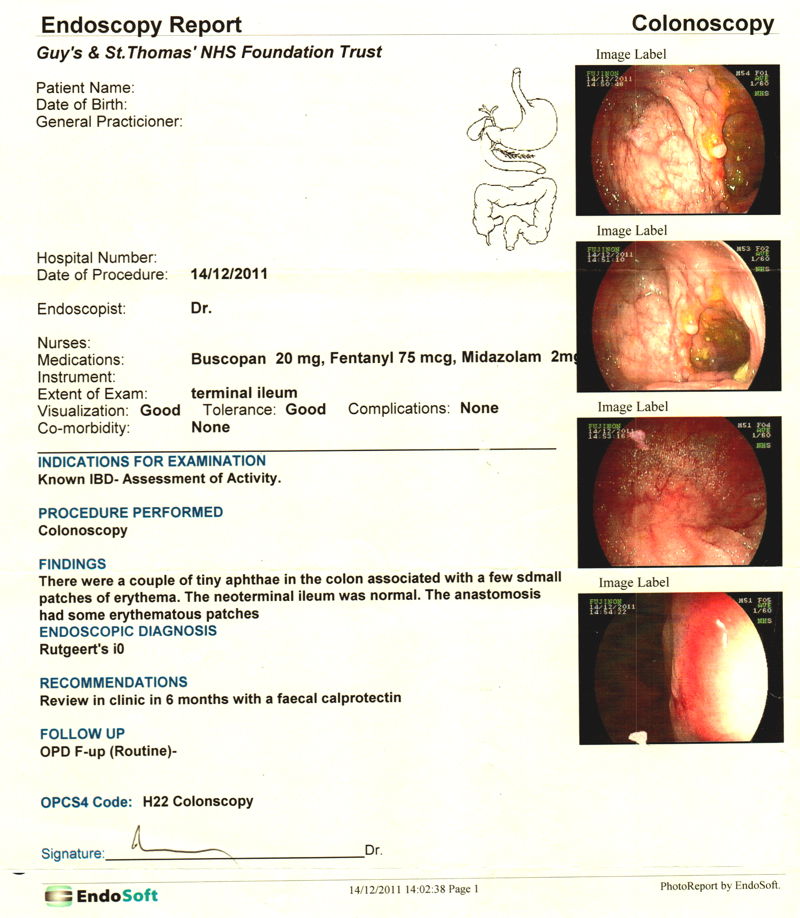
The procedure went without a hitch. There was no sign of Crohn’s and just a slight reddening around the anastomosis (where the colon and ileum were reconnected). It was good news for Christmas and I had the pictures to prove it. I was now five months on from the reversal operation and to my untrained eye the rejoin looked to have healed very well. My consultant gave it a Rutgeert’s Score of i0. Yes, I did have to look that one up. It’s a scoring system that helps to standardise the assessment of what the consultant sees at the anastomosis and is used to predict future recurrence of the disease. An i0 score = “80% to 85% of patients will remain asymptomatic for three years post resection” and the best score you can be given, indicating post-operative remission.
As 2012 approached it was time for the usual end of year soul searching. Would it be a quiet year with just the odd test or routine consultant’s appointment? Would Crohn’s behave itself and simply disappear into the background, as it had done for many of the years after diagnosis? If that was the case life would be able to return to pre-2009 normality.
January passed without incident and it looked like my hopes were being fulfilled. Unfortunately it did not last and in February I had a second bout of the pain around my middle and the disconcerting black liquid returned. I also started to ache more in the area of the rejoin. I emailed my consultant’s secretary and asked for my next appointment to be brought forward as I was concerned about my current symptoms. She duly obliged and a new date was set for March.
This is a good point at which to compliment the medical secretaries I have dealt with and especially my gastroenterologist’s secretary, Sally, who was exceptional. By providing such excellent support, consultants were freed up to concentrate on treating their patients, not becoming submerged in admin tasks.
Monday 19th March 2012 – Guy’s Hospital – Gastroenterology – off to the outpatient appointment that had been brought forward from later in the year. I asked my consultant if the symptoms I had been suffering from were to be expected after a reversal? He said it was quite possible for a “bug” to cause odd symptoms but to be on the safe side he booked an MRI scan.
Monday 30th April 2012 – St.Thomas’ Hospital – MRI Suite – yet another glorious day so I decided to set off from work early and walk down to St.Thomas’ via the House of Parliament.
It would be my first MRI scan so I didn’t know what to expect. The main impression I had gained was that some patients found the whole process claustrophobic. As the scan would be concentrating on the digestive system I wasn’t allowed to eat for the eight hours prior to the test and was asked to arrive one hour early to take a “special preparation drink”.
This fluid looked very much like wallpaper paste but was lemon flavoured. There was one litre to drink and as I got closer to the bottom of the jug it took on the consistency of paste as well. Next time I needed to drink MRI prep I would keep stirring it throughout.
The nurse put a cannula into my arm ready for a contrast dye to be injected later on in the procedure. The use of the dye, gadolinium based, improves the visibility of internal body structures. It was first introduced in the early 1980s but in recent years there has been some debate about possible side effects, especially for patients with reduced renal function and the potential impact of long-term retention, particularly in the brain.
After the “special preparation drink” had time to move into my system I was taken into the scanner room. The machine was large and shaped like a ring doughnut with a trolley that slid in and out. I was asked to lie face down on the trolley with my arms above my head. Not the most comfortable position when you’ve just drunk a litre of liquid. The radiographer explained what to expect and that, at various points within the test process, I would be asked to hold my breath. It didn’t sound like a problem but you have to exhale first and that makes it a lot more difficult. She gave me a set of headphones to wear as the machine was “very noisy”. At least I didn’t get claustrophobia as I went into the doughnut feet first.
She wasn’t kidding about noisy. The best way I can describe it is being caught in the middle of a game of Space Invaders. The machine made some very loud sounds and then, towards the end of the first test sequence, the table I was lying on started to vibrate. A very strange sensation. The contrast dye was then injected and the whole sequence repeated.
Once the tests were complete and I had stepped off of the table another nurse asked me how I was getting home. I said “by public transport”. He replied that the litre of liquid I had just drunk was “specially formulated not to be absorbed by the body” and that I might want to wait around a bit before leaving the hospital. The significance of his comment then dawned on me, but, not being one to shy away from a challenge, decided to jump on the train anyway. I’m pleased to say that nothing happened, not even a hint of rushing off to the toilet.
The results weren’t available straight away as they had to be interpreted by a radiologist. There would be a three-week wait before I saw my gastro consultant again.
Cathartic
I had found writing a journal very therapeutic, one could even say cathartic. Quite an apt term to use as, in a medical sense, it means a purgative, something that helps evacuate the bowels. I had the chance to attempt some creativity and it laid the groundwork for putting this book together. It made me think about the issues confronting any sufferer of a chronic illness and how to best manage their route through the health system. It also allowed me to look objectively at how I had coped with the challenges along the way.
This could have been a good point to finish writing. The only outstanding issue was the outcome of the MRI scan and I was hopeful that it would show the Crohn’s under control, that the octopus had been wrestled into submission. After the life changing experiences of the last two years I was naively expecting that my body, specifically my digestive system, would return to normal. If I was younger you could have put this down to the optimism of youth but I now have to accept that it was ignorance.
What happened next blew any hopes of a quiet life straight out of the water. I quickly learnt two new medical terms – co-morbidities and extra intestinal manifestations (EIMs). Words whose implications could be as bad as they sounded. The next few chapters take my story beyond “simple” Crohn’s Disease and into these territories with a whole range of new medical acronyms to be deciphered.