
Monday 11th October 2010 – Operation Day
Surprisingly I managed to get some sleep. At two o’clock I was woken up by one of the nurses to connect a new drip and then back to sleep again. The next time I opened my eyes it was a glorious autumn morning. One of the specialist registrars (SpRs) came in, introduced himself and explained I was the last on the list for surgery as, contrary to what I had originally been told, the surgeon liked to finish up with the most “interesting” patients as he didn’t know how long their operations would take. That made perfect sense. He answered any questions I had and then went off to the operating theatre. I was given DVT stockings and a surgical gown to put on. I should also have been given two carbohydrate pre-loading drinks but they never arrived. I lay on the bed watching the sun rise over Millbank.

My next visitor was the anaesthetist. He said it looked like I would be going down to theatre at half past eleven and it could be a five-hour operation. There were some formalities that he needed to run through which revolved around risks and consent forms. He explained that they intended to use an epidural for pain control. Whilst this had proved very effective there were a number of risks involved. He went through each one in turn and gave me the probability of them occurring. At the end of it I signed the form that confirmed I understood the issues and was prepared to go ahead with the epidural and the surgery.
I wondered if, after all, I might be able to add to my blog later that night, post operation, but wasn’t sure if I would have access to my iPad as it was going to be locked away in the Cashier’s Office for security. It really depended upon what time I came out of Recovery. The operation start slipped from the original plan. Eventually I was collected from the 12th floor, wheeled into the lift reserved for surgical patients and taken down to the operating theatre suite on the second floor. We arrived in the anaesthesia room at half past twelve. The theatre team were ready and started their preparation procedures. They seemed to be a very happy crew, laughing and joking, and that helped keep me at my ease.
The anaesthetist I had met earlier appeared. He greeted me with a broad smile and said he was ready to fit the epidural. It went in without a hitch and I was conscious for about 15 minutes until he said: “I’m just going to give you a mild sedative to relax you”. Into oblivion. Never trust an anaesthetist.
To fill in some of the details of what happened between oblivion and re-awakening I have relied upon the checklists that were kept at each stage of the operation and the surgeon’s handwritten notes. The pre-operation list explained what happened to the pre-loading drinks.

At 1:15pm I was wheeled into theatre and 35 minutes later the first incision was made. The team was led by the surgeon I had met back in August, assisted by the SpR from the previous evening and another colorectal surgeon.
I hadn’t given any great thought to the actual details of the surgery. No doubt there would have been a video of a similar operation on YouTube but somehow it seemed sensible to remain in blissful ignorance. I didn’t want to upset the calm acceptance of my fate that I had achieved so far.
The operation finished with closure of the wound at half past four and I was taken into Recovery thirty minutes later. The next thing I remember was waking up about an hour later. It was very cold. I was feeling no pain as the epidural was doing its job but I was freezing. Shivering. Violently shivering. The SpR came to see how I was. His first word was: “Sorry…” so I knew what was coming. He lifted the blankets to reveal the stoma. It didn’t really come as a shock as I always knew it was a possibility and was mentally prepared for it. I can imagine what it would have felt like if I hadn’t been forewarned. He told me it was a four and a half hour operation overall and that because of what they found when they opened me up the stoma was necessary to give my large intestine a chance to recover.
By late afternoon my wife was starting to get concerned. It must be a lot worse for those sitting at home waiting for news than the patient who is comfortably numb. She hadn’t been given any news on how the operation went so she rang the Ward. They told her that I hadn’t arrived yet but would call when they knew what was happening. Just gone 6:30pm a doctor rang to tell her that I was OK. It had been complex surgery and I was still in Recovery.
The team were concerned about my readings, especially temperature. At one point I had a “Bair Hugger”, a hollow blanket into which hot air is blown, put around me. Now I knew what a Formula One tyre went through on the starting grid. There was even a warmer for the IV drip. I was offered a hot drink despite it being only a couple of hours after the operation. No more “nil by mouth”. It wasn’t until I was finally wrapped in a large, microwaveable blanket that my temperature began to return to normal and I could be taken up to the Ward. By now it was around eight o’clock.
Another huge change over the past few years was being able to use a mobile phone in hospital. I suppose it was inevitable as people would use them anyway. I asked the nurse if I could get hold of mine to ring my wife. As I explained earlier my valuables had been locked away. They had then been transferred to the ward safe but the night shift nurses didn’t know the combination. Very frustrating. I had been taken to Northumberland Ward on the 11th floor, where I spent the rest of my stay. I had been expecting to go to Page Ward HDU (High Dependency Unit), as they specialised in colorectal surgery but unfortunately there were no beds available. Northumberland was the sister ward, next door, which specialised in upper GI conditions.
I felt fine as I was on a post-op high induced by the drugs. I could have easily written up my journal if I could have accessed my iPad. I finally managed to get hold of it the following morning.
The SpR came to visit again to see if there was anything I needed. I asked if he could ring my wife and tell her I was safely up on the Ward. He had a number of other things to take care of first but eventually she got a call at half past eleven.
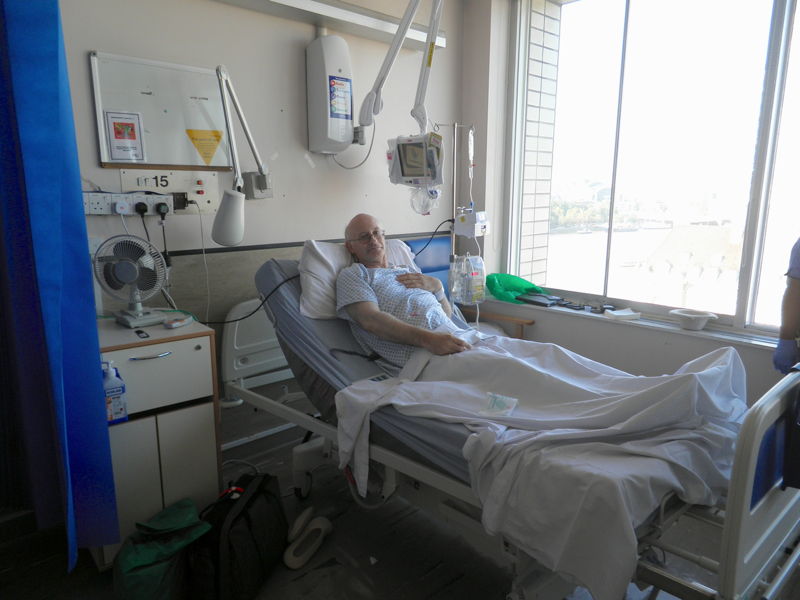
Tuesday 12th October 2010 – First Day Post Operation – I felt a lot drowsier. I had been warned that this would happen. Part of the Enhanced Recovery regime was to get the patient out of bed on the day after their operation. Twice the nurse tried but each time I nearly fainted so she left it a while.
I must have been given breakfast and lunch and as my system was empty I ate what I could manage. I also had four high energy drinks and was still connected to an IV line.
The surgeon had carried out his ward round at half past eight but the only things I can remember him saying was that the operation was complex and “enjoyable”. I suppose you don’t do the job unless you have that attitude. The drug record shows that he restarted me on azathioprine.
I had a visit from the Acute Pain Nurse mid-morning and he checked that the epidural was in place and working. He recommended that it was kept in until the following day and would then review it again.
Next I met with the stoma nurse for her to show me how to change my pouch. This was the first chance to see my stoma out in the open and touch it with the pouch removed. (You won’t find any pictures of it here. I decided that some things are best kept private but if you are really curious there are plenty of photos out there on the internet. Thinking about it again I wish I had taken at least one shot for posterity).
I’d seen pictures of stomas in the booklets I was given several weeks ago but it didn’t prepare me for having my own living, moving little companion. It’s difficult to describe exactly what it reminded me of. It was darker in colour than I expected and it suddenly hit me how strange it was to have part of my intestine sticking outside the body. I just had to suspend disbelief and accept it. I had thought that the gut would be rich in nerve endings and would object to being “on the outside”. You’d think it would hurt when touched but not at all. It was completely impervious.
The word stoma comes from the Greek word for mouth. The operation I had undergone was a “double barreled ileostomy”. As the name implied I had ended up with two stomas – one from the small intestine, which was the most prominent and active; the other from the opening leading to the large intestine which was just sitting there waiting to be reconnected.
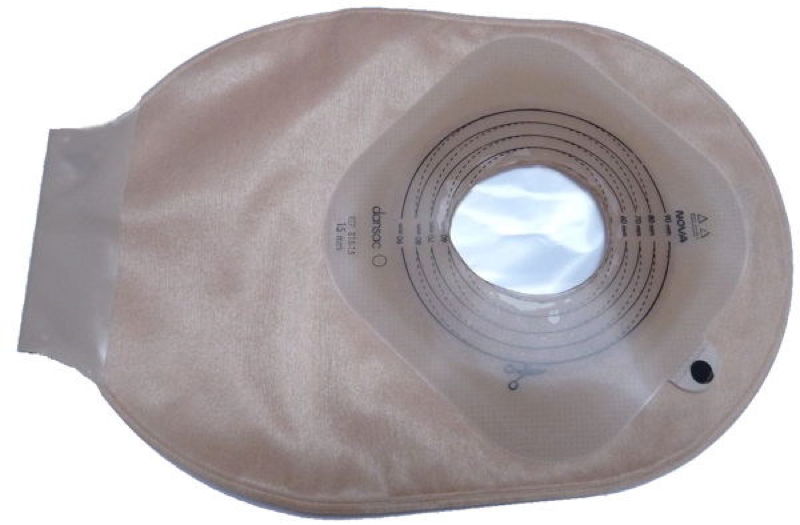
The nurse handed over my stoma survival kit and went through the contents: a couple of fresh pouches, a pair of curved scissors, cleansing wipes, barrier film wipes, a small bowl for warm water, sealing rings and a mirror. The scissors were for trimming the opening in the pouch backplate to match the shape and size of your stoma She must have emptied the pouch but I do not remember much of what happened. It appeared that it was not difficult to do, you just needed confidence. The pouch I was wearing had an opening along the lower edge, sealed by folding it over several times and fastening with velcro.
The only extras that I needed were a razor and shaving foam to keep the area around the stoma smooth. This would help to ensure good adhesion of the pouch, and to prevent it hurting too much when being removed. I had always used an electric razor so it would be a double learning process to smother the area in shaving foam and scrape away with a sharp blade. I had been wary of getting foam on the stoma itself as it was bound to sting but, as I had previously discovered, there were no nerve endings in the area. I was surprised how resilient it was. My other concern was catching it with the razor and making it bleed. Luckily that never happened.
The nurse recommended fitting a new pouch every two days which gave me until Thursday before I would have to try it myself. I was filled with some trepidation but there were plenty of other things to think about so it went to the back of my mind. She told me that at 54 years old I was one of her older patients. Most are in their 20’s and 30’s. With high profile personalities such as Kylie Minogue suffering from breast cancer or Lance Armstrong (not disgraced at that time) with testicular cancer, these conditions were starting to get discussed more widely but not stomas. I certainly had no idea of what was involved or the technology used.
It could do with someone famous to admit that they have one. Stomas are not something that gets much talked about in polite society. I decided from the start that I would be completely open about the issue so that friends and family would understand the processes and the strange, involuntary noises. One of the reasons for starting a journal was to demystify what happens and take others through the learning process.
At eleven o’clock the physiotherapist appeared with the aim of getting me mobilised. It was a slow process which included marching on the spot for two minutes but she finally managed to get me into the chair. next to the bed. I was told to practise my mobility during the day. She left me sitting there but every so often I came over nauseous and tired.
After gastro intestinal operations the surgical team are interested in inputs and outputs. I could almost hear Brian Hanrahan (the late BBC News journalist who famously covered the Falklands War) reporting: “I’ve counted it all in, and I’ve seen it all come out”. To this end I had to record all my liquid inputs and a nurse then had to measure what came out of the pouch and the bladder. Not very pleasant for donor or measurer. You just had to grit your teeth and get on with it. It was not until a healthy balance had been achieved that I would be considered for discharge.
The target was an intake of two litres of liquid in 24 hours. In the afternoon the nurses became concerned at the lack of fluid I had passed considering I had already taken on board a litre and a half through drinks and the IV drip. I told them I was unable to drink more fluid due to nausea. I was examined to see if there was a fluid build-up anywhere but nothing came to light. My blood pressure was dropping so two units of blood were ordered.
Late afternoon I must have turned in my bed and started to feel a little damp. I had dislodged the epidural. It was due to come out on the following day anyway and with the inherent risks involved it was decided not to replace it. Instead I was given a PCA pump (patient-controlled analgesia), a device that enabled me to administer painkiller (Fentanyl) when I needed it. There was a timer fitted to prevent overdosing. Half an hour later I was still in a lot of pain and the nurse was told to call for an anaesthetist if it persisted. Fortunately it never got to that point.
Early evening the first unit of blood arrived, the tubes were connected and the transfusion started. During the process blood pressure and temperature were measured a number of times to make sure I was tolerating it. The second unit arrived at eleven o’clock and the transfusion started straight away.
Wednesday 13th October 2010 – For the first couple of days post op the nurses monitor the patients regularly throughout the day and night. It can be rather frustrating just to get off to sleep only to be woken up to have your blood pressure measured. At 4:30am I was “continuously complaining” about the pain again. The Fentanyl wasn’t giving the necessary relief and was replaced with morphine. The nurses also concluded that I wasn’t pushing the button often enough.
The two units of blood took their effect and by the afternoon I had been taken off the oxygen supply. The nurse noted that the pain was a lot better controlled and that I was “independent and self-caring” but needed assistance due to the attachments, ie. the drips I was connected to. She also noted that I was tolerating small amounts of food without nausea.
My appetite started well and I ate breakfast and lunch and drank cups of coffee. The stoma nurse came round and emptied the pouch. She encouraged me to practise this and said that on the next day she would get me to change one myself whilst she watched.
In the outside world one news story dominated all others, the Chilean Mining Accident, that had been ongoing since August. The final phase of the rescue mission, to free the thirty three miners trapped 700 metres underground, had started late the previous night. Whilst I lay in bed, listening to the radio, the news started filtering through that the first miner had emerged from the rescue shaft that had been drilled down to reach them. At each news bulletin the number rescued increased until, by ten o’clock, all had reached the surface. Real world news like that helped keep my own situation in perspective.
Late afternoon I had a visit from my brother-in-law. He reported back to the family how well I appeared to be getting on, apart from the hiccups, which I had been suffering from intermittently since Monday.
The physiotherapist called by again and noted that I was feeling much better. I showed her that I could sit and stand independently and was mobile using the IV stand to steady myself. I was cleared to mobilise around the ward and set another target of walking circuits of the central area, between the side wards, a certain number of times a day.
Wednesday evening, however, things took a turn for the worse and I couldn’t face eating or drinking anything. I only managed a high energy drink. This is quite a common reaction of the body when it’s undergone the trauma of the gut being manipulated during surgery and I guess there was a lot of handling given more than four hours on the table. I accepted that I would feel rough for a short time and tried to get some sleep. One of the surgeons came round on his evening visit to check up on my progress and asked if I had been “bled” today (by which he meant a blood test). I replied that it sounded like something they did to animals in the slaughterhouse to which he responded: “well, all patients are bits of meat“. Nice to be able to have a joke with the professionals.
At this point I had to take a break from writing as I really couldn’t face doing anything except try to sleep. The nurse was right! It was not entirely unexpected as we were warned that I would feel low on the second day after the operation.
Thursday 14th October 2010 – I was hopeful that my nausea had been just a temporary glitch as I managed some breakfast and a cup of coffee.
The ward round was led by one of my surgeons. He wrote in his notes that my hiccups were settling and I was looking well. The PCA for administering painkillers was still in place but I was finding that I no longer needed it. It was replaced with paracetamol and Sevredol tablets, another opium based painkiller.
After I had seen the surgeon my pouch developed a leak. I don’t remember how it was dealt with. The stoma nurse must have been called to help. It rather knocked my confidence. For the first few days of living with a stoma your emotions are on a bit of a knife edge. They are easy to cope with once you have gained that confidence but the reality of the situation does take some getting used to.
The one thing I was desperate for was a shower. That was an upside to the epidural coming out earlier than planned. I still had a cannula in one arm, connected to a drip, so it wasn’t completely straightforward but having a one handed shower (no, that’s not a euphemism) is a skill you quickly learn. The position of the cannula dictates how easy or difficult it is to manage. My main concern was saturating my dressings but they could easily be changed so I quickly forgot about it.
I continued to use the same brand of gel for several years and each time I caught its perfume I was taken straight back to the hospital. That first shower really lifted my spirits but I was soon brought back down to earth as my digestive system continued to run in slow motion. I felt rough and had no appetite.
My wife and sister came in to visit me. Having had reports of how well I looked the previous day were expecting me to be quite upbeat but I was feeling worse and they went away very despondent. My nausea had returned and I couldn’t face eating anything else.
Friday 15th October 2010 – The handover notes between the night and day staff recorded that I was “self caring” and needed minimal supervision. I was not complaining of any pain or discomfort and had slept well overnight.
[My original post said that the lead surgeon had carried out his ward round the previous evening but having now had the opportunity to read the hospital notes it’s clear that I was wrong and I think that, mentally, I was in a worse state than I realised. This is what really happened…..]
At 8:30am the surgeon arrived to do his ward round. He noted that my abdomen was distended. I explained how bad I felt and that I had developed interminable hiccups. He said that this was a normal reaction of the gut having been manipulated. In his experience around 25% of patients who had colorectal surgery ended up with this temporary condition. The medical term for it was gastroparesis (stomach paralysis). It would just be a matter of time before my digestive system kicked back into action and I would feel ravenous. He said that if I wasn’t eating by Monday then I’d have to go onto intravenous feeding. It put my mind at rest that the top man thought this was an expected reaction and that I wasn’t out of the ordinary. I just wish someone had told me that the, previous day. If you haven’t suffered from nausea you cannot understand just how bad it can be.
[Post diary note: I have subsequently discovered there is another, similar, medical condition called “post operative ileus” and that usually appears between 24 and 72 hours after surgery.]
Today’s big challenge, put off from the previous day, would be to change the pouch myself and I was not looking forward to it. I realised why. With a stoma you have no control when it decides to “wake up and perform”. The thought of this happening just at the point where you’ve removed the old pouch, but haven’t managed to attach the new one, was my concern. Mid-morning my usual stoma nurse appeared, pulled the curtains around the bed and we started. The key was to get everything ready and laid out before you commence.
She showed me how to cut the opening in the pouch backplate so that it fitted over my stoma, brought me a bowl of warm water and had the wipes ready. I gingerly removed the old pouch and put it in a disposal bag. I then cleansed around the area with a skin barrier wipe and peeled the protection sheet off of the backplate to expose the adhesive. I was just getting ready to position the pouch when the stoma “performed”. It wasn’t that bad and after a quick wipe I was ready to apply the sealing washer and then position the new pouch, making sure it was hanging directly downwards. I gently pressed it into position and it was done. A lot easier than I thought. The next challenge would be managing solo.
Generally I was still feeling very rough but brightened up when a friend of the family made a visit. I hadn’t realised that she had dealt with stoma pouches with both her parents and was able to give me some encouraging words on living with them.
That night the house doctor said they were concerned that I was starting to dehydrate. He decided to stick a cannula back into my arm and connected up a drip. That suggests the original cannula must have disappeared at some point, but I didn’t record it going.
There were a couple of things I felt I ought to mention here for potential ostomates (as patients with stomas are sometimes called) :
Firstly, because both ends of the gut poke through the opening in the bag it is possible for “matter” to make its way from the active to the disconnected part. This can form itself into a small object, that looks something like a sultana, and appears in the non-active opening. It’s nothing to worry about but slightly disconcerting the first time it happens.
Secondly, it’s not possible to sleep lying on your front when you have a stoma (for obvious reasons) and even sleeping on your side you have to be careful so I ended up only sleeping on my back. That makes the stoma the highest point of your digestive system. Any gas that might be present in your gut quickly makes its way into the pouch and inflates it like a balloon. It’s a tribute to modern adhesives that I never had any further leaks even though the bag was under extreme pressure. I was half expecting it to detach itself and fly off around the Ward with hilarious consequences.
Saturday 16th October 2010 – Still feeling rough. Probably the worst day but at least the hiccups had gone. I was able to have the tube disconnected so I could have a proper shower and then get into pyjamas rather than a medical gown. That did make me feel quite a bit better.
My wife and one of our carriage driving friends came up to visit in the afternoon and thought I had improved, especially after the way I had been on Thursday.
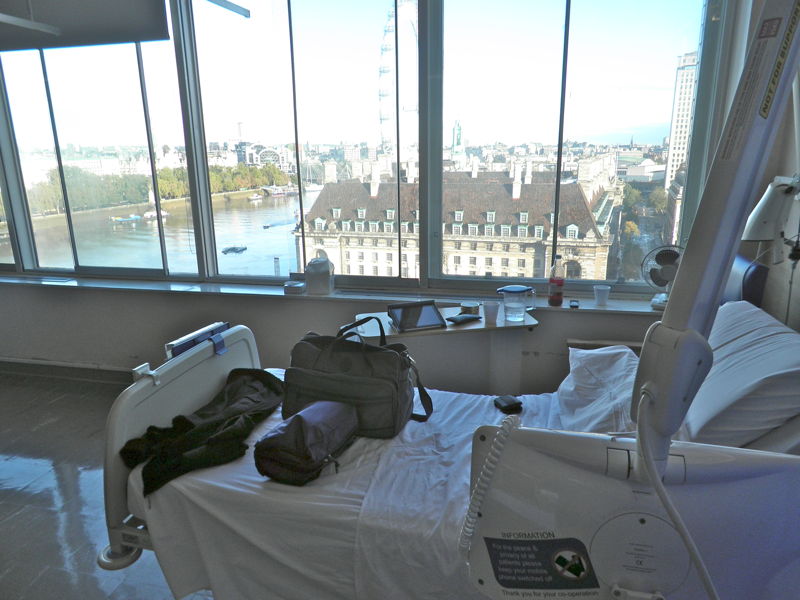
I didn’t see any doctors as it was a Saturday. After my visitors left I started to feel even worse. You get to the point of thinking that the situation will never improve. I couldn’t get to sleep so sat in my bedside chair overlooking Westminster Bridge.
At least the view took my mind off things for a while. At one point it sounded like a lot of powerful motorbikes were passing by the hospital but on closer inspection turned out to be groups of Japanese performance cars. They must have been on a late night cruise. I watched them pass over the Bridge, turn right down the Embankment then disappear from view. About ten minutes later they would appear again. A very welcome distraction.
I hadn’t realised just how bad nausea could make me feel. I know why the windows on the Ward are fixed shut. I was feeling so bad that I would happily have jumped. I’m not joking. I felt that desperate. As I still couldn’t get to sleep I asked for some morphine in a vain attempt to knock myself out for a couple of hours. I was on a “painkiller on demand regime” where I decided if I needed additional medication. I think the limit was one tablet every 4 hours. It seemed to do the trick and I dozed off for a while. When I woke up I started to feel slightly different, as if my system was slowly grinding back into action.
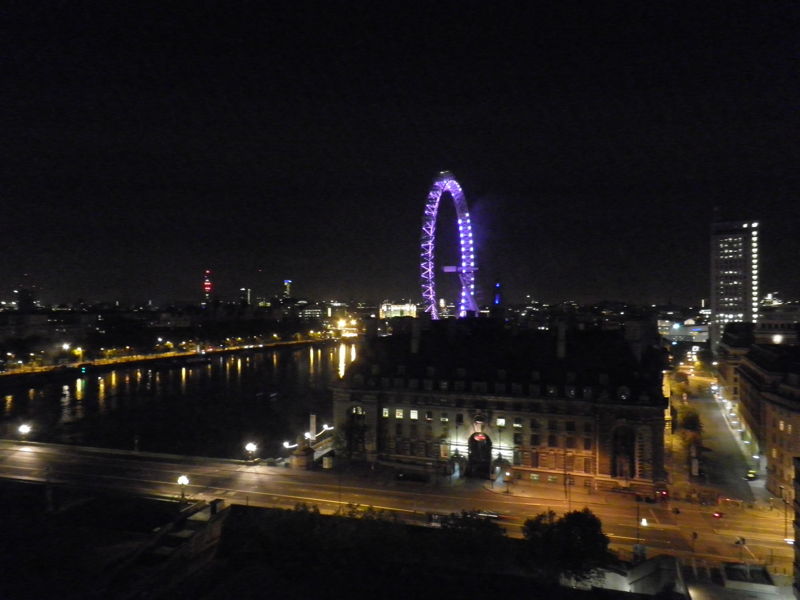
Sunday 17th October 2010 – Wow! The world looked a lot brighter today. I managed some breakfast and sat in my chair, sipping a high energy drink, watching the boats going up and down the River Thames. I was hoping that it wasn’t just another temporary respite so I stopped writing to try and concentrate on keeping the improvement going. I didn’t feel quite so well around midday. I suppose my whole system was taking a while to get back to normal. I still managed some lunch but not much. When my sister and her husband came to visit later in the afternoon I was again feeling rough so their visit was a little curtailed.
Around five o’clock I started to feel better and suddenly knew I was on the road to recovery. Whilst I didn’t manage any supper, I went to bed knowing that I would get a good night’s sleep for the first time, without the morphine, which I preferred not to take. When I was first given the drug, some 30 years ago, the hallucinations were pleasurable and spaced out, now they were more feverish, worrying and repetitive. I assume that was as a result of accumulating another 30 years of “life experiences”.
Monday 18th October 2010 – Going Home…Not Quite Yet – I woke up actually looking forward to my breakfast and the feeling continued through until lunchtime. I saw one of the surgeons who operated on me and we assessed that I should be ready to go home on Wednesday. However, after lunch, I saw the stoma nurse who was worried that my digestive system was now doing overtime and that she wouldn’t want me sent home too soon. The balance of outputs had not normalised – too much stoma, not enough bladder! It made me think it would be more like Thursday or Friday rather than Wednesday. Time would tell.
As a consequence of this imbalance the doctors and nurses became even more interested in measuring inputs and outputs. Inputs – no problem – just write down every time you eat or drink something together with the quantities. Outputs – not so pleasant! How can I put this delicately? Every time an “output” happened you had to save it in a bottle or bowl and leave it in the toilet for some unlucky nurse to quantify and then dispose of. Really not very pleasant but it had to be done and I did get into a routine.
One of my work colleagues came to visit before dinner. It was nice to see him and catch up with what had been happening since being away from the office. His visit was much appreciated.
Cumberland sausages for dinner! The only problem with eating was that it started up all the digestive processes again. It was like living with my own personal whoopee cushion.
I was finding blogging quite therapeutic and filling up a lot of my time but when it got to eleven that night I thought I’d better try to get some sleep. Tomorrow they would make the decision on when I could go home. Fingers firmly crossed.
Tuesday, 19th October 2010 – By The Weekend – Another lovely sunny morning and the Thames was coming to life. The Millennium Wheel had started spinning and cyclists were flooding over Westminster Bridge displaying their usual disregard for other road users and pedestrians. I wondered if cycling in London made you inconsiderate or did you have to be that way inclined to take it up in the first place?
Cornflakes, toast and marmalade for breakfast and they tasted excellent. I was still struggling to manage my pouch, but I needed to get it under control in that “safe” environment so that I would cope when I arrived home.
My surgeon swept into the room with an entourage of 10 or so junior doctors. “Good morning young man” he said, to which my immediate thought was: “If his eyesight’s that bad I hope he cut the right bits out“. He reviewed my progress and said that we needed to get my digestive system “back into balance”. He thought I may have been suffering from a part blockage of my stomach for over a year. That would account for why I still looked incredibly bloated despite losing 10kg. The upshot of these deliberations was that I needed to go onto re-hydration fluids to try to redress the current imbalance. They had to be obtained from the pharmacy so were expected later that day. He said: “we’re not sending you home until we’ve got everything working correctly. Should be Thursday or Friday“.
Let’s assume Friday. I then drank my first glass of oral re-hydration salts. Absolutely DISGUSTING and there was another 800ml to go. It was sitting there in a jug laughing at me. What was great, though, was looking forward to my meals. Not sure about some of the menu choices – lentils, curry or a Mexican sandwich. Best to avoid them. I have to say that the food, whilst not being cordon bleu, was very palatable and always served hot. It was a bit stodgy but that is exactly what is required for the patients recovering from the type of operations being carried out in the Unit. It helped that the meals were dished up in the Ward kitchen, not delivered pre-plated and dried up.
My wife and sister visited in the afternoon. They could see how much brighter I was than when they last saw me. It was good to have a moan together about the selfishness of fellow train travellers and cyclists. Yes, they got more stick. We went through my holdall and decided which items I still required prior to discharge. They took the rest home. Tomorrow’s task would be trying on outdoor clothes for the first time and seeing how they interacted with the whoopee cushion.
I was now fully back in writing mode and trying to describe the five stages of having an operation.
Stage 1 – ANTICIPATION which could well turn into TREPIDATION.
I didn’t get to the trepidation stage as I was determined to treat this whole process as an experience, not something to be scared of. I think the fact we had plenty of time to plan ahead greatly helped, as did the ability to do research on the internet into the dark world of stomas. Strangely, as the operation grew closer, my health seemed to be getting better. Stage 1 ends with the admission process, usually the day before the op, and then the visits from the various doctors and nurses preparing you for theatre. The last bit you’ll probably remember is the anaesthetist saying: “I’m just going to give you something that will make you drowsy“.
Stage 2 – OPERATION. Self explanatory
Stage 3 – EXHILARATION (may not be the right “ion” but it’s the best I have come up with at present. After the operation you are so full of anaesthetic and painkillers that you are on a high for at least a couple of days.
Stage 4 – REALISATION maybe DEPRESSION. The powerful painkilling drugs wear off and you start to realise your body has been through the wars. Some people say Day 2 is worse, some Day 3, but whichever day it is, if you are prepared, you can live with it. For me it was Days 3 to 5. That could be laid at the feet of the nausea and constant hiccups.
Stage 5 – FRUSTRATION. Once you know you’re on the mend the mood changes as you can’t wait to get home. By now I had entered this phase and it explained the ever lengthening posts on my blog. I said that I would buy anyone a pint who had managed to make it that far. What really helped was St.Thomas’s location. If I was bored I just needed to look out of the window. (I had just watched a plain clothed police car thread it way through the evening rush hour with its concealed blue lights flashing).
As I was finishing off what proved to be a marathon post I was given another litre of re-hydration salts to drink. I took one sip – still as disgusting. I added some fruit juice and took another sip – slightly less disgusting but still pretty awful and only another 980ml to go.
Where was dinner ?
Drinking the rest of the re-hydration salts was hard. I was told I needed to get it all down before going to sleep. The last gulp was at midnight but at least it kept me awake to see the only live music show left on TV “Later with Jools Holland” and catch Heaven 17 doing one of the tracks we used to play at discos – “Temptation”. Brilliant!
Wednesday 20th October 2010 – Managed to sleep until just gone three but then that was it. In the space of the next three hours I wrote a blog post in my head, put the world to rights, speculated on exactly what the surgeon had done and why my condition had declined so far over the last couple of years. I tried everything to get back to sleep, including listening to my usual fallback of Terry Riley’s “Rainbow in Curved Air” – the original chill-out music.
Finally I fell asleep just before six o’clock only to be woken up ten minutes later to have my blood pressure, heart rate and temperature recorded.
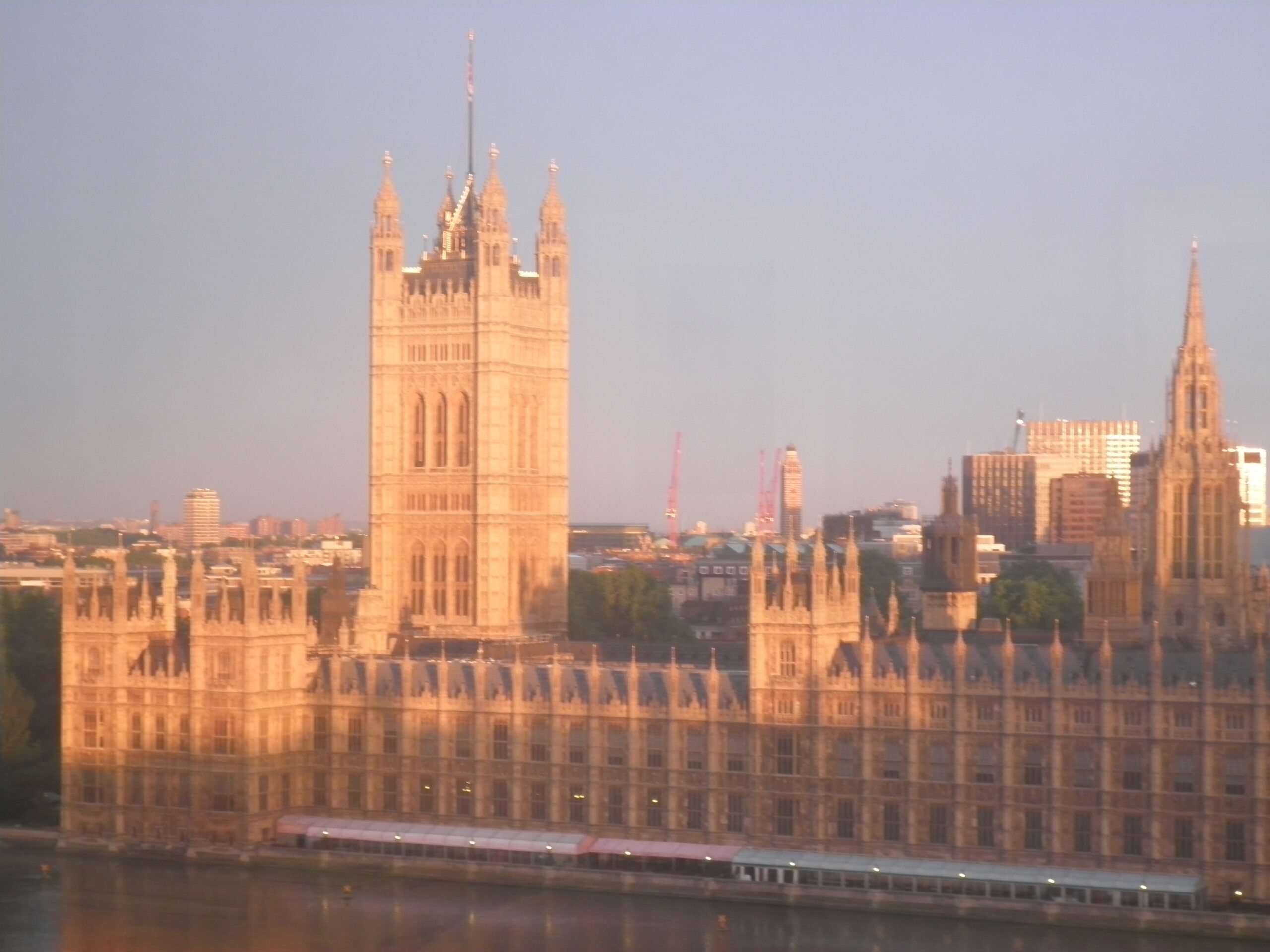
Everyday I had been on the ward the weather was very sunny. The views were stunning and acted as a distraction from the hospital environment. If I was up early enough, and made my way into the Day Room, the sunrise reflecting off the Houses of Parliament was worth seeing. Then, from about seven o’clock onwards, the River Thames would start to come to life. In the distance I could see some of the new buildings springing up on the London skyline. One in particular caught my eye. It had a brightly coloured facade and I made a mental note that, once fit enough, I would find this building to photograph it close up.
I was really looking forward to my breakfast but the mood was rather dampened by being given yet another litre of re-hydration fluid to drink. The problem was that I was running out of fruit juice to make it palatable so I set the day’s target as visiting Marks and Spencer and buying a bottle of squash. This required me to make it down from the eleventh to the ground floor and fitted in with the plan of trying on my outdoor clothes to see how they interacted with the pouch. I felt a little nervous getting into a lift that was bound to get very crowded. I was very protective of my operation scar and stoma in case other passengers got too close.
I successfully achieved the goal and returned with a large bottle of squash to improve any more drinks that I might be given. I would probably have been in trouble with the stoma nurse if she had seen me lifting this “heavy” object.
There was only a small group of doctors on the day’s ward round. The house doctor had a look at my scar and said that the metal staples, of which I counted forty three, could come out the following day. I wondered if it would hurt? I did toy with the idea of taking a picture of them but decided against it. The doctor gave me the option of going home Thursday or Friday. It may sound odd but I chose Friday as my digestive system still wasn’t balanced, plus it gave us another day to plan how I would get home and what food we needed to buy in.

When the nurse came round to hand out the drugs she said that they were a little concerned that some of my salts were below the optimum level. Her advice was to eat crisps, salty things, doughnuts, anything sweet. It went against everything you are told to avoid, in the media, but because Crohn’s disease patients have problems with malabsorption of salts and vitamins we are sometimes given carte blanche to eat all those bad things usually frowned upon. I was up for the challenge. (We’ll return to the subject of malabsorption in a while).
Later on I rang my wife to tell her to make arrangements for me to be picked up by our friend on Friday. No sooner had I made the call than it was time for the handover between the day staff to the night staff. They were standing at the foot of my bed discussing if I should be put on loperamide to try to slow my system down. I told them I was going home on Friday to which one of them replied: “You’re not going anywhere until we address this problem!” I decided not to ring my wife back and tell her that Friday was in jeopardy. Best to see what the doctor said on the ward round the following morning.
Thursday 21st October 2010 – I felt that Wednesday had been spent in limbo. The imbalance in my body salts and fluid intake had been going on for a couple of days and I’d not be given any loperamide. If I was going to go home on Friday then I needed some action. I needed to know exactly who had the final say as to whether I was released or not.
I knew the Enhanced Recovery Nurse was on holiday, as was her assistant. Not very good timing. I thought if I don’t do something now I’ll be here next week so I texted the Nurse to ask her who was standing in during her absence. I think this must have had an effect behind the scenes. I also asked the Ward Sister the same question. I mentioned that it would be my 30th wedding anniversary on the Sunday and that I would like to be home by then. She came back a little later and said that I could go home for the day, if I wanted!
When I saw the registrar on the ward round I asked him if I could start the loperamide and he replied that the surgeon would need to agree to that. I explained about my wedding anniversary and that I would rather not be in hospital then. He checked my blood test results and said that in his judgment I would be able to go home on Saturday but the surgeon would have the ultimate say on when I would be discharged. I would see him on Friday’s ward round. Still some doubt in my mind and the feeling that it would be cutting it very fine.
I made a few telephone calls and changed arrangements so that I could be picked up on Saturday. Now I had to hope that the surgeon would give his blessing. In the afternoon the stoma nurse came to see me to ensure that I was proficient at changing a pouch. She would be back on Friday to remove the stitches around the base of it.
Friday 22nd October 2010 – Judgement Day – My best night’s sleep since the drugs wore off after the operation. I had six full hours which was very good considering that there is always something going on in the ward. When I woke up I sat in my bedside chair to take in the view. I was really looking forward to breakfast. This was much more like it.
I saw the surgeon on the ward round. He said that they now needed to take some positive action to correct my fluid imbalance and prescribed the loperamide I had been waiting for – three capsules four times a day. At last! He liked to leave it as long as possible for the body to correct itself without intervention but this was taking too long. He said that I should be able to be discharged in the next 48 hours. Did that now mean Sunday? I asked him if I should cancel my Saturday arrangements and he replied: “not for the moment”. I was concerned that by the time the loperamide was released by the pharmacy it would be mid-afternoon and there would not be enough time for it to kick in and show sufficient improvement by the Saturday morning. Luckily the pharmacist was on the ward at the time and I had my tablets within a few minutes. Now I just had to hope that they had the desired effect and it was demonstrable.
The stoma nurse called by mid-morning to say she would be up after lunch to remove the stitches. She asked if I had taken any painkillers that morning. I replied that I had not taken any for a couple of days. She said: “I’ll go and ask the nurses to give you some“. That sounded ominous. The other thing that needed doing was to remove the staples from my main scar. A student nurse was sent in to do that. She removed the dressing and it gave me a chance to see if I had counted them correctly. Yes, there were 43 of them! No wonder the surgeon had said that my bikini modelling career would be over. The nurse removed them very quickly and easily whilst I watched the various tugs and barges make their way along the river. Another hurdle out of the way.
The stoma nurse came up after lunch with her curved scalpel and tweezers and proceeded to remove the conventional stitches. It stung a fair amount so I’m glad she suggested the painkillers. I told her that the plan was to be discharged the next day. She replied that whilst she was happy I knew what I was doing with the stoma she wasn’t happy with the fluid levels they were recording. She would prefer that I was in hospital over the weekend but would not put a stop to me leaving on Saturday providing the loperamide had started working. Saturday discharge was starting to look doubtful again. Around six o’clock the registrar popped into the ward to tell me that my bloods were now fine. I asked him if that meant I could go home tomorrow and he said “yes“ as far as he was concerned. Saturday looking more hopeful again but I still had a horrible feeling that someone could appear out of the woodwork at the last minute to scupper the plan.
I needed to know, if I was going to be discharged, what time it would be and was told: “around lunchtime“. I rang my wife to tell her the (possible) good news and to confirm that a good friend of ours would be able to pick me up. We wouldn’t know for certain, if I was leaving, until the morning. It’s a good thing I’m pretty laid back about this otherwise the indecision would be driving me mad. Roll on Saturday.
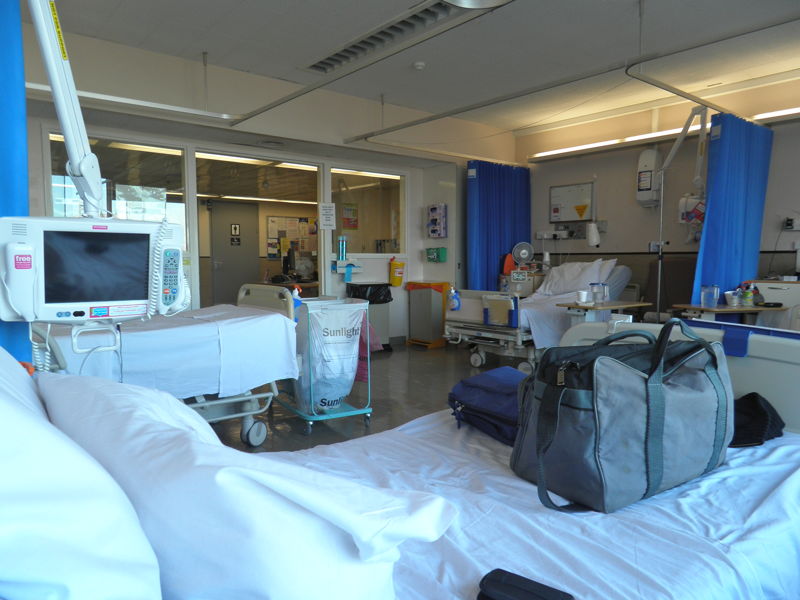
Shortly before dinner a new patient was wheeled into the ward and put in the bay opposite. He was quite rotund, in fact rotund enough that a standard surgical gown did not meet at the back and he didn’t have a dressing gown. Unfortunately he decided to get out of bed and even more unfortunately I happened to look up and what I saw quite put me off my dinner. At least I would only have this for one night (or not?).
Midnight – I now understood why my wife complained when I snored. The new patient promptly fell asleep and proceeded to snore through until morning, interspersed with the odd moan. I felt I had gained some insight into what it might be like to spend a night in a walrus colony. Thank goodness for in-ear headphones.
Saturday 23rd October 2010 – For the first morning since I’d been in St.Thomas’ it was miserable outside and must have rained hard overnight. I was hoping this wasn’t an omen. I was contemplating that my target date for discharge had been the previous Saturday but, one week on, I was still lying on my hospital bed. I knew that the original target was ambitious but I didn’t expect to be in there that long, even having had such a major operation. Because my wife had coped so well at home and our friends had rallied round to help I had been able to remain very calm about the whole affair. It had been so comforting to have a supportive family and friends.
One week ago I felt terrible. I could not face any food, even the thought of it made me feel sick. Now I was positively looking forward to breakfast and I’d not been on any regular painkillers for three or four days so clearly recovery was well underway. What could stop me now? At handover from the night to day shift I told the nurse that I was leaving today. A little bit later one of the senior nurses, who I’d not met before, came over to see me and asked when I thought I was going home. I explained that as far as I was concerned all the boxes had been ticked and in four hours time I would be picked up. She said that my fluid levels were still high and that the doctor had not signed off at what point he would be happy for me to be discharged. It was starting to look like Monday again!
I mentioned that the registrar had seen me at six o’clock the previous evening and told me I could go. It sounded like he should have signed off a form accordingly. I also explained that the fluid level she was looking at related to the previous day and that the loperamide had already had a beneficial effect in reducing the output. She went off to contact my District Nurse to provide cover over the weekend. Being a Saturday she was unable to raise anyone at our local surgery. It looked like yet another hurdle!
Finally the nurse came back and said that they had decided I didn’t need cover for just a couple of days and that if I had any problems I could see my practice nurse on Monday. She then handed over two bags of drugs and my discharge letter. I was on my way! I told her that I was being picked up around half twelve. “Why so late?” she asked. A quick telephone call to my wife and we brought my departure time forward by an hour.
After breakfast I had a shower, changed from my hospital pyjamas into outdoor clothes and packed my bag. I went down to Marks and Spencer to get some sandwiches and crisps for the journey home.
The blood test lady turned up to take one final sample and then it was just a question of waiting until my lift arrived. I decided to read the discharge letter which contained a section written by the surgeon. Naturally it was all medical terms. I asked the nurse if she could help translate and even she struggled. Suffice to say it appears that my innards were in a very bad way. I wondered how much longer I could have gone on without ending up as an emergency case, or worse, in our local hospital. It really didn’t bear thinking about.
[The exact details of the operation the surgeons performed only became apparent once I had obtained copies of all my medical notes in 2015. The full description can be found in the chapter – “Loose Ends”]
The discharge letter also showed the date for my follow-up appointment with the surgeon, 11th January, when we would, hopefully, set the day for the reversal operation (removing the stoma and rejoining the small and large bowels).
Just before lunchtime my wife and our friend turned up. They had made good time and managed to find a space in the car park, one advantage of a Saturday discharge. We thanked the nurses for the excellent care they had given me, said our goodbyes and were finally on our way.
It was a very quiet, uneventful journey home. Our friend deliberately chose a route that avoided speed bumps, much to my relief. I wasn’t sure how I, or my stoma, would cope with sitting in a car. It turned out not to be a problem. I was fine.
We passed through parts of South London that were “my patch” when I worked for a building company and had to visit their construction sites on a regular basis. I probably hadn’t driven down those roads for at least 20 years. We even passed the church in Sanderstead where, 30 years previously (minus a day), we were married.
I was now leaving the sanctuary of St.Thomas’. It would be an important time – learning to cope outside the cosy environment of the hospital ward and living with a stoma, solo. It would also be a frustrating time as I attempted to ensure the reversal operation went ahead. What obstacles and challenges lay ahead?